Medical Research council Cognition and Brain Sciences Unit, Cambridge, Cambridgeshire, CB2 7EF, UK.
Cereb Cortex. 2011 Jan;21(1):1-10. doi: 10.1093/cercor/bhq085. Epub 2010 May 18.
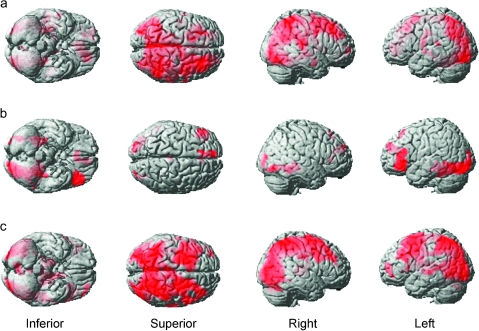
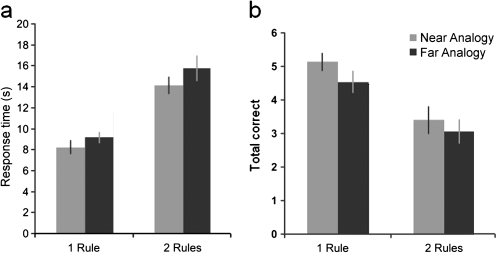
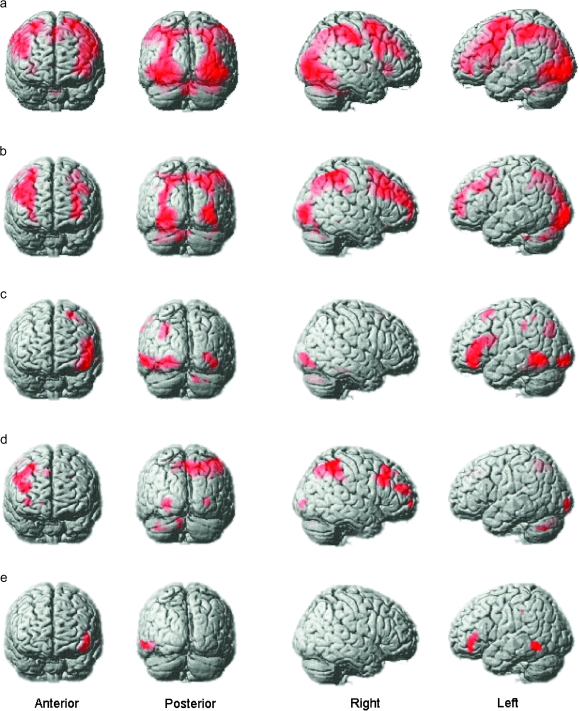
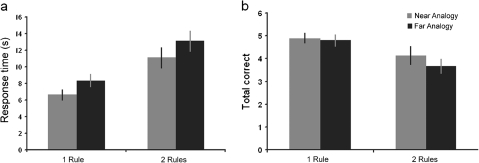
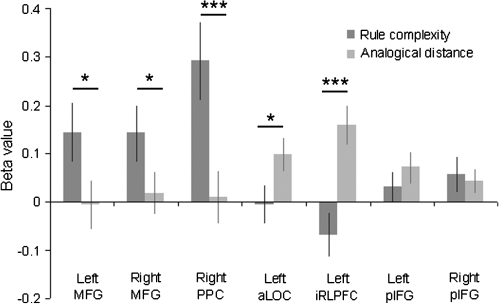
Reasoning is a key component of adaptable "executive" behavior and is known to depend on a network of frontal and parietal brain regions. However, the mechanisms by which this network supports reasoning and adaptable behavior remain poorly defined. Here, we examine the relationship between reasoning, executive control, and frontoparietal function in a series of nonverbal reasoning experiments. Our results demonstrate that, in accordance with previous studies, a network of frontal and parietal brain regions is recruited during reasoning. Our results also reveal that this network can be fractionated according to how different subregions respond when distinct reasoning demands are manipulated. While increased rule complexity modulates activity within a right lateralized network including the middle frontal gyrus and the superior parietal cortex, analogical reasoning demand-or the requirement to remap rules on to novel features-recruits the left inferior rostrolateral prefrontal cortex and the lateral occipital complex. In contrast, the posterior extent of the inferior frontal gyrus, associated with simpler executive demands, is not differentially sensitive to rule complexity or analogical demand. These findings accord well with the hypothesis that different reasoning demands are supported by different frontal and parietal subregions.
推理是适应性“执行”行为的关键组成部分,已知依赖于额叶和顶叶大脑区域的网络。然而,该网络支持推理和适应性行为的机制仍未得到明确界定。在这里,我们在一系列非言语推理实验中检查推理、执行控制和额顶叶功能之间的关系。我们的结果表明,与先前的研究一致,在推理过程中会募集到一个额叶和顶叶大脑区域的网络。我们的结果还表明,根据不同的推理需求被操纵时不同的子区域如何响应,可以将这个网络进行细分。虽然增加规则复杂性会调节包括中间额回和上顶叶皮层在内的右侧偏侧网络中的活动,但类比推理需求或需要将规则重新映射到新特征上则会招募左侧下额侧前扣带回和外侧枕叶复合体。相比之下,与更简单的执行需求相关的下额回的后部分对规则复杂性或类比需求不敏感。这些发现与以下假设一致,即不同的推理需求由不同的额顶叶子区域支持。