Leadership Sinai Centre for Diabetes, Mount Sinai Hospital, Toronto, Canada.
Diabetes Care. 2010 Aug;33(8):1798-804. doi: 10.2337/dc10-0351. Epub 2010 May 18.
Both gestational diabetes mellitus (GDM) and mild glucose intolerance in pregnancy identify women at increased risk of future type 2 diabetes. In this context, we queried whether metabolic changes that occur in the 1st year postpartum vary in relation to gestational glucose tolerance status.
Three-hundred-and-ninety-two women underwent glucose challenge test (GCT) and oral glucose tolerance test (OGTT) in pregnancy followed by repeat OGTT at both 3 months' postpartum and 12 months' postpartum. The antepartum testing defined four gestational glucose tolerance groups: GDM (n = 107); gestational impaired glucose tolerance (GIGT) (n = 75); abnormal GCT with normal glucose tolerance (NGT) on OGTT (abnormal GCT NGT) (n = 137); and normal GCT with NGT on OGTT (normal GCT NGT) (n = 73).
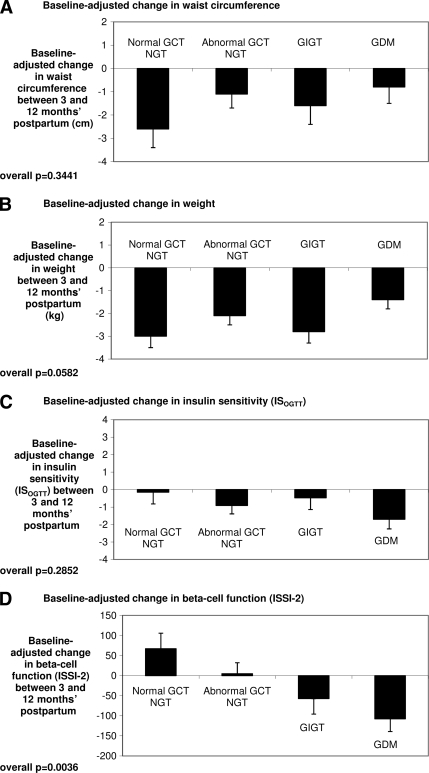
The prevalence of dysglycemia progressively increased across the groups from normal GCT NGT to abnormal GCT NGT to GIGT to GDM at both 3 months' postpartum (2.7% to 10.2% to 18.7% to 34.6%, P < 0.0001) and 12 months' postpartum (2.7% to 11.7% to 17.3% to 32.7%, P < 0.0001). Between 3 and 12 months' postpartum, the groups did not differ with respect to changes in waist circumference, weight, or insulin sensitivity. Importantly, however, they exhibited markedly different changes in beta-cell function (Insulin Secretion-Sensitivity Index-2 [ISSI-2]) (P = 0.0036), with ISSI-2 declining in both the GDM and GIGT groups. Furthermore, on multiple linear regression analysis, both GDM (t = -3.06, P = 0.0024) and GIGT (t = -2.18, P = 0.03) emerged as independent negative predictors of the change in ISSI-2 between 3 and 12 months' postpartum.
Women with GDM and GIGT exhibit declining beta-cell function in the 1st year postpartum that likely contributes to their future diabetic risk.
妊娠糖尿病(GDM)和妊娠期间轻度葡萄糖耐量异常均会增加女性未来患 2 型糖尿病的风险。在此背景下,我们探究了产后第 1 年发生的代谢变化是否与妊娠时的血糖耐受状态有关。
392 名女性在妊娠期间接受了葡萄糖挑战试验(GCT)和口服葡萄糖耐量试验(OGTT),随后在产后 3 个月和 12 个月时重复进行 OGTT。产前检测将妊娠血糖耐受状态分为以下 4 组:GDM(n = 107);妊娠期糖耐量受损(GIGT)(n = 75);异常 GCT 但 OGTT 正常(异常 GCT-NGT)(n = 137);正常 GCT 且 OGTT 正常(正常 GCT-NGT)(n = 73)。
从正常 GCT-NGT 到异常 GCT-NGT 到 GIGT 再到 GDM,产后 3 个月(2.7%到 10.2%到 18.7%到 34.6%,P<0.0001)和 12 个月(2.7%到 11.7%到 17.3%到 32.7%,P<0.0001)时,各组的糖代谢异常患病率逐渐升高。然而,在产后 3 至 12 个月期间,各组间腰围、体重或胰岛素敏感性的变化无差异。然而,重要的是,它们在β细胞功能(胰岛素分泌敏感性指数-2(ISSI-2))方面表现出明显不同的变化(P=0.0036),GDM 和 GIGT 组的 ISSI-2 均下降。此外,在多元线性回归分析中,GDM(t=-3.06,P=0.0024)和 GIGT(t=-2.18,P=0.03)均为产后 3 至 12 个月期间 ISSI-2 变化的独立负预测因子。
GDM 和 GIGT 女性在产后第 1 年β细胞功能下降,这可能是导致其未来糖尿病风险的原因。