Chipimo Peter J, Fylkesnes Knut
University of Zambia, School of Medicine, Department of Community Medicine, P/Bag RW X1, Lusaka, Zambia.
Clin Pract Epidemiol Ment Health. 2010 Jan 27;6:4-15. doi: 10.2174/1745017901006010004.
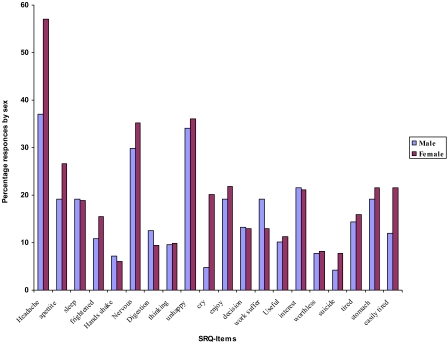
The recognition of mental health as a major contributor to the global burden of disease has led to an increase in the demand for the inclusion of mental health services in primary health care as well as in community-based health surveys in order to improve screening, diagnosis and treatment of mental distress. Many screening instruments are now available. However, the cultural validity of these instruments to detect mental distress has rarely been investigated in developing countries. In these countries, limited trained staff and specialized psychiatric facilities hamper improvement of mental health services. It is therefore imperative to develop a quick, low cost screening instrument that does not require specialized training. We validated different well established screening instruments among primary health care clinic attendees in Lusaka, Zambia. We also assess the face, content and criterion validity of the SRQ's and determined the most commonly reported symptoms for mental distress.
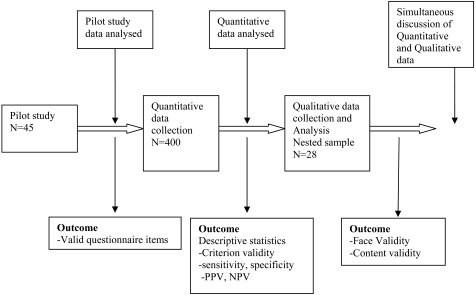
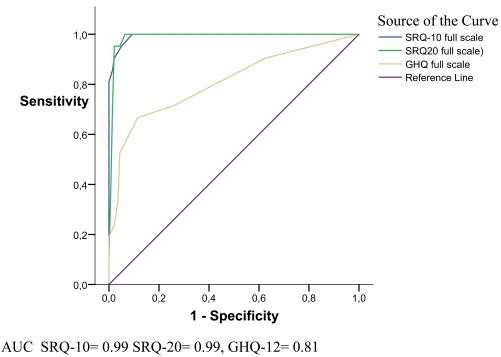
The screening instruments, SRQ-20, SRQ-10 and GHQ-12 were used as concurrent criteria for each other and compared against a gold standard, DSM-IV. Their correlation, sensitivity and specificity were assessed. All instruments were administered to 400 primary health care clinic attendees. In-depth interviews were also conducted with 28 of these clinic attendees.
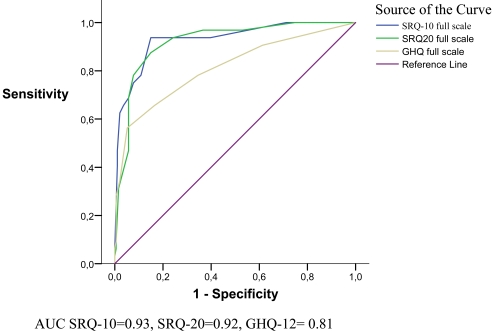
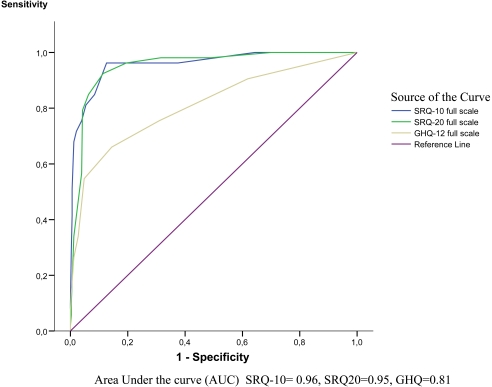
Both the SRQ-20 and SRQ-10 had high properties for identifying mental distress correctly with an AUC of 0.96 and 0.95 respectively while the GHQ-12 had modest properties (AUC, 0.81). The optimum cut-off points for this population were 7 and 3 for the SRQ and GHQ-12 respectively. The SRQ was also found to have good face and content validity.
The study establishes the utility of the SRQ-20 for detecting mental distress cases and also underscores the importance of validating instruments to suit the context of the target population. It also validates the SRQ-10 as the first reliable abbreviated and easy-to-use screening instrument for mental distress in primary health care facilities in Zambia.
心理健康被视为全球疾病负担的主要促成因素,这导致对将心理健康服务纳入初级卫生保健以及社区健康调查的需求增加,以便改善对心理困扰的筛查、诊断和治疗。现在有许多筛查工具可供使用。然而,在发展中国家,这些工具检测心理困扰的文化效度很少得到研究。在这些国家,训练有素的工作人员有限以及专门的精神科设施不足,阻碍了心理健康服务的改善。因此,开发一种不需要专门培训的快速、低成本筛查工具势在必行。我们在赞比亚卢萨卡的初级卫生保健诊所就诊者中验证了不同的成熟筛查工具。我们还评估了SRQ的表面效度、内容效度和效标效度,并确定了心理困扰最常报告的症状。
将筛查工具SRQ - 20、SRQ - 10和GHQ - 12相互作为并行标准,并与金标准DSM - IV进行比较。评估它们的相关性、敏感性和特异性。所有工具均应用于400名初级卫生保健诊所就诊者。还对其中28名诊所就诊者进行了深入访谈。
SRQ - 20和SRQ - 10在正确识别心理困扰方面具有很高的性能,曲线下面积(AUC)分别为0.96和0.95,而GHQ - 12的性能一般(AUC为0.81)。该人群SRQ和GHQ - 12的最佳截断点分别为7和3。还发现SRQ具有良好的表面效度和内容效度。
该研究确立了SRQ - 20在检测心理困扰病例方面的效用,也强调了根据目标人群的情况验证工具的重要性。它还验证了SRQ - 10作为赞比亚初级卫生保健机构中首个可靠的、简短且易于使用的心理困扰筛查工具。