Department of Social Medicine, University of Bristol, Bristol, United Kingdom.
Cancer Epidemiol Biomarkers Prev. 2010 Jun;19(6):1632-42. doi: 10.1158/1055-9965.EPI-10-0180. Epub 2010 May 25.
Disturbed folate metabolism is associated with an increased risk of some cancers. Our objective was to determine whether blood levels of folate, vitamin B(12), and related metabolites were associated with prostate cancer risk.
Matched case-control study nested within the U.K. population-based Prostate testing for cancer and Treatment (ProtecT) study of prostate-specific antigen-detected prostate cancer in men ages 50 to 69 years. Plasma concentrations of folate, B(12) (cobalamin), holo-haptocorrin, holo-transcobalamin total transcobalamin, and total homocysteine (tHcy) were measured in 1,461 cases and 1,507 controls. ProtecT study estimates for associations of folate, B(12), and tHcy with prostate cancer risk were included in a meta-analysis, based on a systematic review.
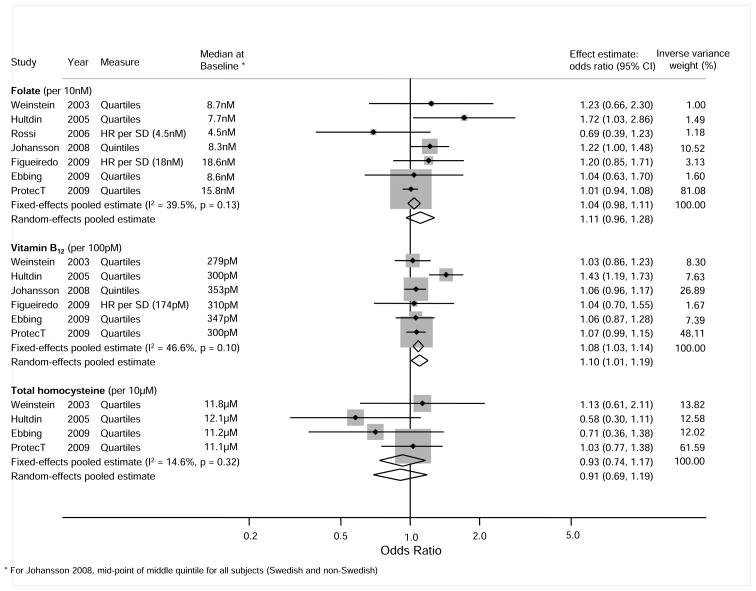
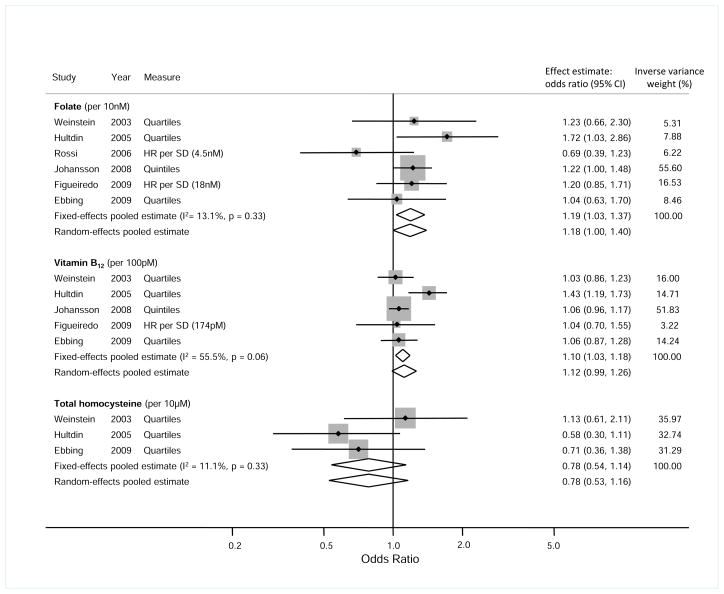
In the ProtecT study, increased B(12) and holo-haptocorrin concentrations showed positive associations with prostate cancer risk [highest versus lowest quartile of B(12) odds ratio (OR) = 1.17 (95% confidence interval, 0.95-1.43); P(trend) = 0.06; highest versus lowest quartile of holo-haptocorrin OR = 1.27 (1.04-1.56); P(trend) = 0.01]; folate, holo-transcobalamin, and tHcy were not associated with prostate cancer risk. In the meta-analysis, circulating B(12) levels were associated with an increased prostate cancer risk [pooled OR = 1.10 (1.01-1.19) per 100 pmol/L increase in B(12); P = 0.002]; the pooled OR for the association of folate with prostate cancer was positive [OR = 1.11 (0.96-1.28) per 10 nmol/L; P = 0.2) and conventionally statistically significant if ProtecT (the only case-control study) was excluded [OR = 1.18 (1.00-1.40) per 10 nmol/L; P = 0.02].
Vitamin B(12) and (in cohort studies) folate were associated with increased prostate cancer risk.
Given current controversies over mandatory fortification, further research is needed to determine whether these are causal associations.
叶酸代谢紊乱与某些癌症的风险增加有关。我们的目的是确定血液中的叶酸、维生素 B(12) 和相关代谢物是否与前列腺癌风险相关。
这是一项嵌套在英国人群为基础的前列腺癌筛查和治疗(ProtecT)研究中的病例对照研究,对年龄在 50 至 69 岁的男性进行前列腺特异性抗原检测到的前列腺癌进行研究。在 1461 例病例和 1507 例对照中测量了血浆叶酸、B(12)(钴胺素)、全同型半胱氨酸(holo-haptocorrin)、全转钴胺素、总转钴胺素和总同型半胱氨酸(tHcy)的浓度。ProtecT 研究估计了叶酸、B(12) 和 tHcy 与前列腺癌风险的关联,并基于系统评价进行了荟萃分析。
在 ProtecT 研究中,B(12)和 holo-haptocorrin 浓度的增加与前列腺癌风险呈正相关[最高与最低四分位数的 B(12)比值比(OR)=1.17(95%置信区间,0.95-1.43);P(趋势)=0.06;最高与最低四分位数的 holo-haptocorrin OR=1.27(1.04-1.56);P(趋势)=0.01];叶酸、全转钴胺素和 tHcy 与前列腺癌风险无关。在荟萃分析中,循环 B(12)水平与前列腺癌风险增加相关[每增加 100pmol/L B(12),比值比(OR)增加 1.10(1.01-1.19);P=0.002];叶酸与前列腺癌的关联的汇总 OR 呈阳性[OR=1.11(0.96-1.28),每增加 10nmol/L;P=0.2],如果排除 ProtecT(唯一的病例对照研究),则传统上具有统计学意义[OR=1.18(1.00-1.40),每增加 10nmol/L;P=0.02]。
维生素 B(12)和(在队列研究中)叶酸与前列腺癌风险增加有关。
鉴于目前对强制强化的争议,需要进一步研究以确定这些是否为因果关联。