Living Links, Yerkes National Primate Research Center, Emory University, Lawrenceville, Georgia, United States of America.
PLoS One. 2010 May 19;5(5):e10625. doi: 10.1371/journal.pone.0010625.
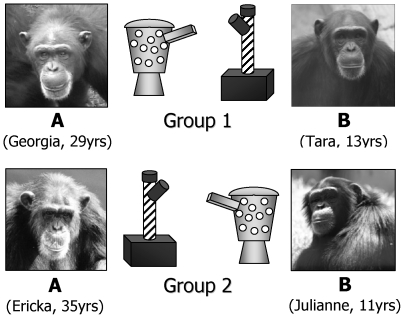
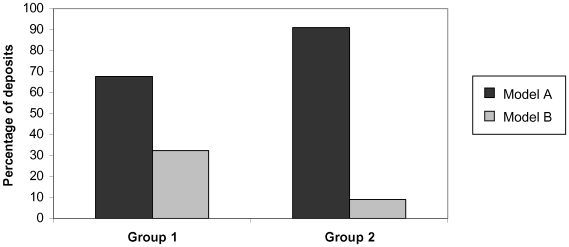
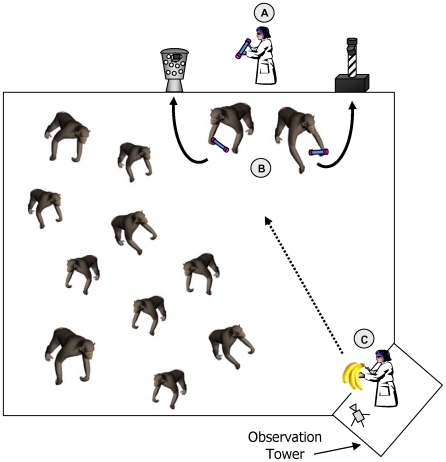
Humans follow the example of prestigious, high-status individuals much more readily than that of others, such as when we copy the behavior of village elders, community leaders, or celebrities. This tendency has been declared uniquely human, yet remains untested in other species. Experimental studies of animal learning have typically focused on the learning mechanism rather than on social issues, such as who learns from whom. The latter, however, is essential to understanding how habits spread. Here we report that when given opportunities to watch alternative solutions to a foraging problem performed by two different models of their own species, chimpanzees preferentially copy the method shown by the older, higher-ranking individual with a prior track-record of success. Since both solutions were equally difficult, shown an equal number of times by each model and resulted in equal rewards, we interpret this outcome as evidence that the preferred model in each of the two groups tested enjoyed a significant degree of prestige in terms of whose example other chimpanzees chose to follow. Such prestige-based cultural transmission is a phenomenon shared with our own species. If similar biases operate in wild animal populations, the adoption of culturally transmitted innovations may be significantly shaped by the characteristics of performers.
人类更倾向于效仿有声望、地位高的个体,而不是其他人,比如我们会模仿村里的长辈、社区领袖或名人的行为。这种倾向被认为是人类独有的,但在其他物种中尚未得到验证。动物学习的实验研究通常侧重于学习机制,而不是社会问题,例如谁向谁学习。然而,后者对于理解习惯的传播至关重要。在这里,我们报告说,当有机会观察到两种不同的自身物种模型在觅食问题上的替代解决方案时,黑猩猩更倾向于复制由年长、地位更高、且之前有成功记录的个体展示的方法。由于两个解决方案同样困难,每个模型都展示了同样多的次数,并且都得到了同样的奖励,因此我们将这一结果解释为,在两个测试组中,被选择效仿的优先模型在某种程度上享有威望,其他黑猩猩更愿意效仿它。这种基于威望的文化传播是我们人类共有的现象。如果类似的偏见在野生动物群体中起作用,那么文化传播创新的采用可能会受到表演者特征的显著影响。