Centre for Health Related Research, School of Healthcare Sciences, Bangor University, Ffriddoedd Road, Bangor, UK.
Implement Sci. 2010 May 26;5:38. doi: 10.1186/1748-5908-5-38.
'Protocol based care' was envisioned by policy makers as a mechanism for delivering on the service improvement agenda in England. Realistic evaluation is an increasingly popular approach, but few published examples exist, particularly in implementation research. To fill this gap, within this paper we describe the application of a realistic evaluation approach to the study of protocol-based care, whilst sharing findings of relevance about standardising care through the use of protocols, guidelines, and pathways.
Situated between positivism and relativism, realistic evaluation is concerned with the identification of underlying causal mechanisms, how they work, and under what conditions. Fundamentally it focuses attention on finding out what works, for whom, how, and in what circumstances.
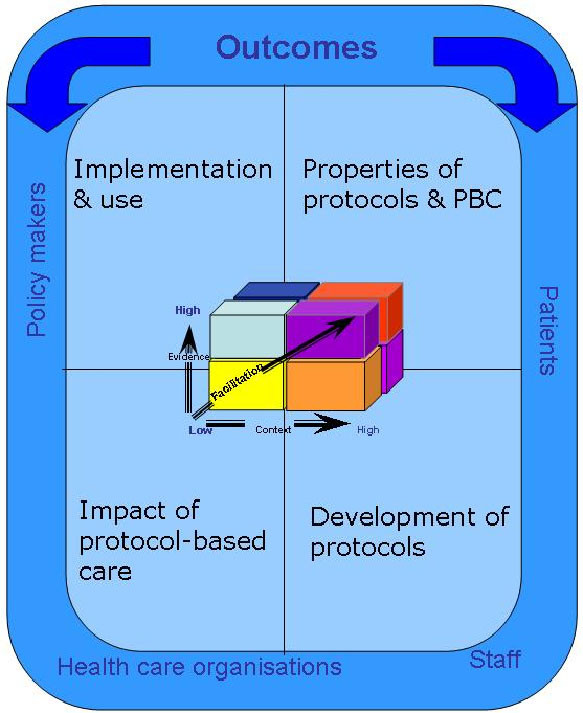
In this research, we were interested in understanding the relationships between the type and nature of particular approaches to protocol-based care (mechanisms), within different clinical settings (context), and what impacts this resulted in (outcomes). An evidence review using the principles of realist synthesis resulted in a number of propositions, i.e., context, mechanism, and outcome threads (CMOs). These propositions were then 'tested' through multiple case studies, using multiple methods including non-participant observation, interviews, and document analysis through an iterative analysis process. The initial propositions (conjectured CMOs) only partially corresponded to the findings that emerged during analysis. From the iterative analysis process of scrutinising mechanisms, context, and outcomes we were able to draw out some theoretically generalisable features about what works, for whom, how, and what circumstances in relation to the use of standardised care approaches (refined CMOs).
As one of the first studies to apply realistic evaluation in implementation research, it was a good fit, particularly given the growing emphasis on understanding how context influences evidence-based practice. The strengths and limitations of the approach are considered, including how to operationalise it and some of the challenges. This approach provided a useful interpretive framework with which to make sense of the multiple factors that were simultaneously at play and being observed through various data sources, and for developing explanatory theory about using standardised care approaches in practice.
政策制定者设想“基于方案的护理”是实现英格兰服务改善议程的一种机制。真实评估是一种越来越受欢迎的方法,但发表的例子很少,特别是在实施研究中。为了填补这一空白,本文介绍了将真实评估方法应用于基于方案的护理研究,并分享了通过使用方案、指南和途径标准化护理的相关发现。
真实评估位于实证主义和相对主义之间,关注的是确定潜在的因果机制、它们如何运作以及在什么条件下运作。从根本上说,它专注于找出什么有效、对谁有效、如何有效以及在什么情况下有效。
在这项研究中,我们感兴趣的是了解不同临床环境中基于方案的护理特定方法的类型和性质(机制)之间的关系,以及这会产生什么影响(结果)。使用真实综合原则进行的证据审查导致了一些命题,即情境、机制和结果线索(CMO)。然后,通过多次案例研究,使用包括非参与观察、访谈和通过迭代分析过程进行的文件分析在内的多种方法来“测试”这些命题。最初的命题(推测的 CMO)仅部分对应于分析过程中出现的发现。通过对机制、情境和结果进行反复分析,我们能够得出一些关于标准化护理方法使用方面的理论上可推广的特征,即什么有效、对谁有效、如何有效以及在什么情况下有效(精炼的 CMO)。
作为第一个在实施研究中应用真实评估的研究之一,它非常适合,特别是考虑到越来越强调理解情境如何影响循证实践。考虑了该方法的优缺点,包括如何实施以及一些挑战。这种方法提供了一个有用的解释框架,可以理解同时起作用并通过各种数据源观察到的多个因素,并为在实践中使用标准化护理方法发展解释性理论。