National Emerging Infectious Diseases Laboratories Institute, Boston University School of Medicine, Boston, MA 02118, USA.
Lancet. 2010 May 29;375(9729):1896-905. doi: 10.1016/S0140-6736(10)60357-1.
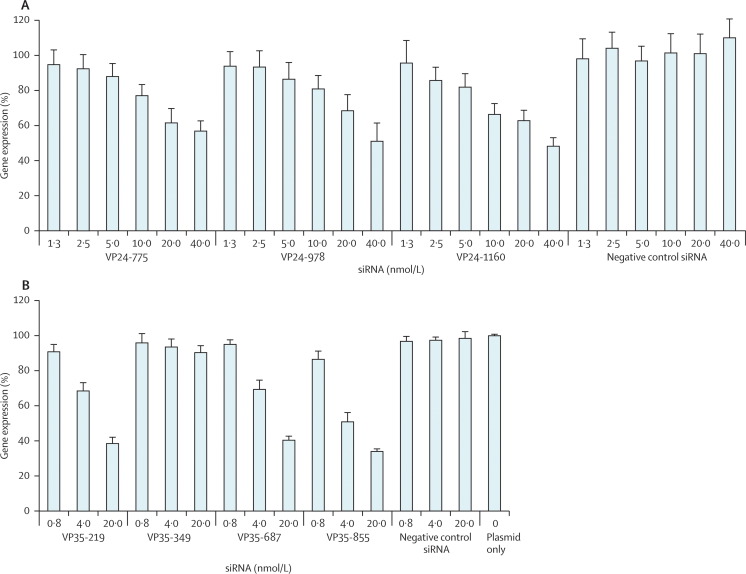
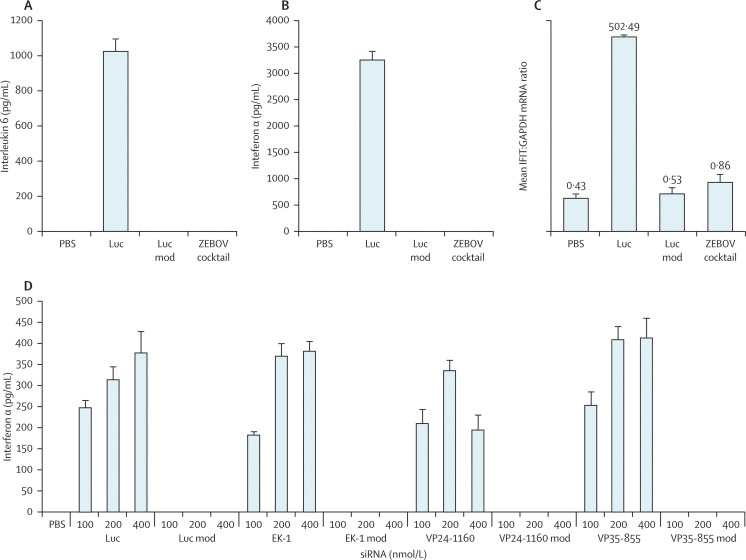
We previously showed that small interfering RNAs (siRNAs) targeting the Zaire Ebola virus (ZEBOV) RNA polymerase L protein formulated in stable nucleic acid-lipid particles (SNALPs) completely protected guineapigs when administered shortly after a lethal ZEBOV challenge. Although rodent models of ZEBOV infection are useful for screening prospective countermeasures, they are frequently not useful for prediction of efficacy in the more stringent non-human primate models. We therefore assessed the efficacy of modified non-immunostimulatory siRNAs in a uniformly lethal non-human primate model of ZEBOV haemorrhagic fever.
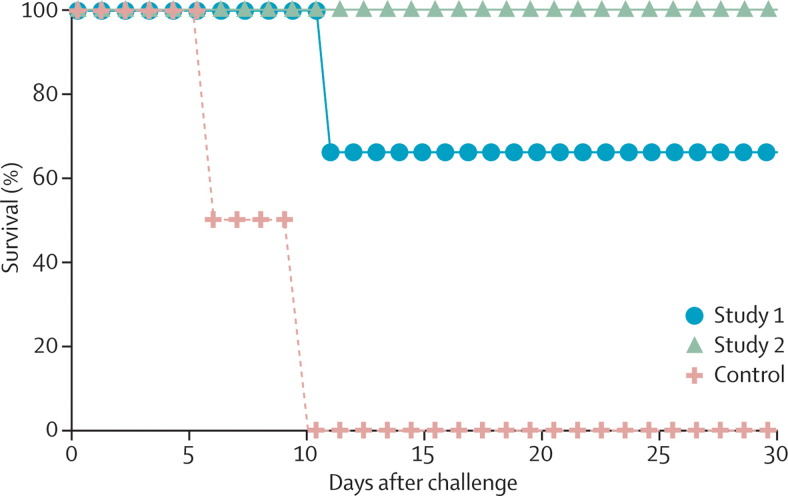
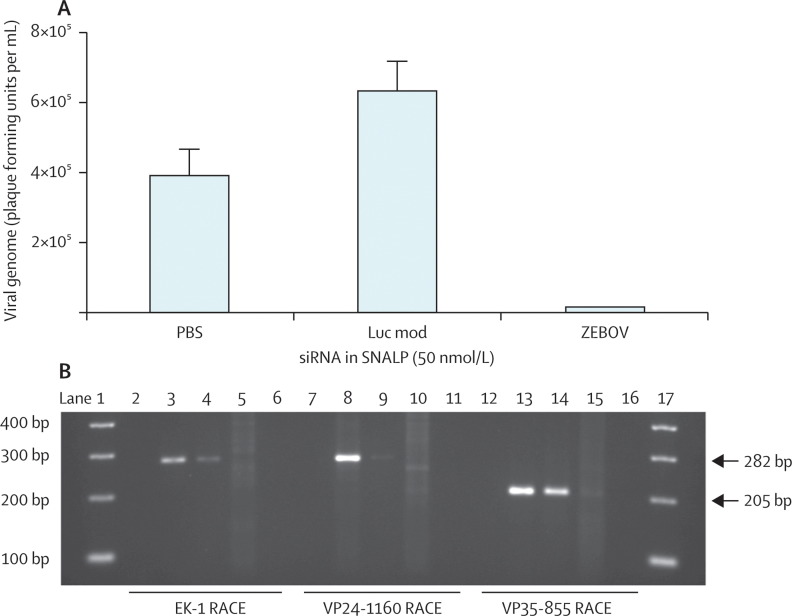
A combination of modified siRNAs targeting the ZEBOV L polymerase (EK-1 mod), viral protein (VP) 24 (VP24-1160 mod), and VP35 (VP35-855 mod) were formulated in SNALPs. A group of macaques (n=3) was given these pooled anti-ZEBOV siRNAs (2 mg/kg per dose, bolus intravenous infusion) after 30 min, and on days 1, 3, and 5 after challenge with ZEBOV. A second group of macaques (n=4) was given the pooled anti-ZEBOV siRNAs after 30 min, and on days 1, 2, 3, 4, 5, and 6 after challenge with ZEBOV.
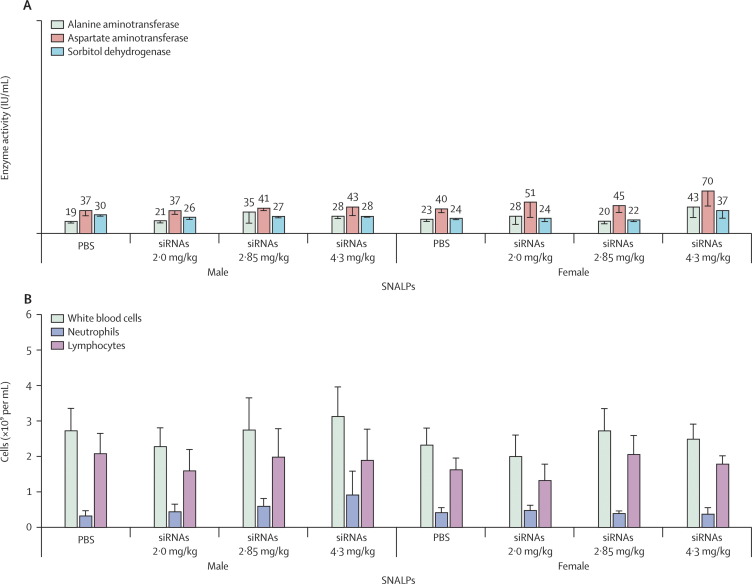
Two (66%) of three rhesus monkeys given four postexposure treatments of the pooled anti-ZEBOV siRNAs were protected from lethal ZEBOV infection, whereas all macaques given seven postexposure treatments were protected. The treatment regimen in the second study was well tolerated with minor changes in liver enzymes that might have been related to viral infection.
This complete postexposure protection against ZEBOV in non-human primates provides a model for the treatment of ZEBOV-induced haemorrhagic fever. These data show the potential of RNA interference as an effective postexposure treatment strategy for people infected with Ebola virus, and suggest that this strategy might also be useful for treatment of other emerging viral infections.
Defense Threat Reduction Agency.
我们之前的研究表明,针对扎伊尔埃博拉病毒(ZEBOV)RNA 聚合酶 L 蛋白的小干扰 RNA(siRNA),在以稳定核酸脂质体(SNALP)的形式给药后,在致命的 ZEBOV 攻击后不久给予,可完全保护豚鼠。虽然 ZEBOV 感染的啮齿动物模型对于筛选潜在的对策很有用,但它们通常对于更严格的非人类灵长类动物模型中的疗效预测没有用处。因此,我们评估了改良的非免疫刺激 siRNA 在 ZEBOV 出血热的一致致命非人类灵长类动物模型中的功效。
针对 ZEBOV L 聚合酶(EK-1 mod)、病毒蛋白(VP)24(VP24-1160 mod)和 VP35(VP35-855 mod)的组合的改良 siRNA 被配制在 SNALPs 中。一组猕猴(n=3)在 30 分钟后接受这些组合的抗 ZEBOV siRNA(2mg/kg/剂量,静脉推注),并在 ZEBOV 攻击后第 1、3 和 5 天接受治疗。第二组猕猴(n=4)在 30 分钟后接受组合的抗 ZEBOV siRNA,并在 ZEBOV 攻击后第 1、2、3、4、5 和 6 天接受治疗。
在接受四次暴露后抗 ZEBOV siRNA 治疗的三只恒河猴中,有两只(66%)免受致命的 ZEBOV 感染,而接受七次暴露后治疗的所有猕猴均受到保护。第二项研究中的治疗方案耐受性良好,仅出现轻微的肝酶变化,可能与病毒感染有关。
这种针对非人类灵长类动物的 ZEBOV 的完全暴露后保护提供了一种治疗 ZEBOV 引起的出血热的模型。这些数据表明 RNA 干扰作为一种有效的暴露后治疗策略用于感染埃博拉病毒的人的潜力,并表明该策略对于治疗其他新出现的病毒感染也可能有用。
国防威胁降低局。