Department of Primary Careand Population Health, University College London, London, UK.
J Epidemiol Community Health. 2011 Sep;65(9):770-4. doi: 10.1136/jech.2009.098087. Epub 2010 Jun 1.
Both the incidence of myocardial infarction (MI) and short-term case fatality have declined in the UK. However, little is known about trends in longer-term survival following an MI. The aim of the study was to investigate trends in longer-term survival, alongside trends in medication prescribing in primary care.
Data came from 218 general practices contributing to the Health Improvement Network, a UK-wide primary care database. 3-year survival and medication use were determined for 6,586 men and 3,766 women who had an MI between 1991 and 2002 and had already survived 3 months.
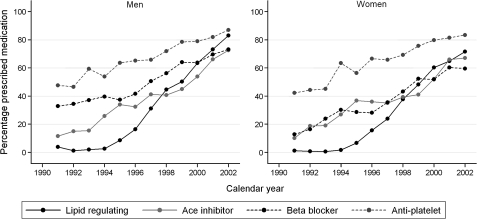
Adjusting for age and gender, the 3-year post-MI case-fatality rate among 3-month survivors fell by 28% (95% CI 13 to 40), from 83 deaths per 1000 person-years for MI occurring in 1991-2 to 61 deaths per 1000 person-years for MI in 2001-2. Relative declines in the case-fatality rate of 37% (20 to 50) and 14% (-11 to 34) were observed for men and women, respectively (p=0.06 for interaction). Prescribing in the 3 months following the MI of lipid-regulating drugs increased from 3% of patients in 1991 to 79% in 2002, prescribing of beta-blockers increased from 26% to 68%, prescribing of ACE inhibitors increased from 11% to 71% and prescribing of anti-platelet medication increased from 46% to 86%.
There has been a moderate improvement in longer-term survival following an MI, distinct from improvements in short-term survival, although men may have benefited more than women. Increased medication prescribing in primary care may be a contributing factor.
英国的心肌梗死(MI)发病率和短期病死率均有所下降。然而,人们对 MI 后长期生存趋势知之甚少。本研究旨在调查长期生存趋势,并探讨初级保健中药物处方的趋势。
数据来自参与健康改善网络(一个英国范围的初级保健数据库)的 218 家常规诊所。共确定了 1991 年至 2002 年间发生 MI 且已存活 3 个月的 6586 名男性和 3766 名女性的 3 年生存率和药物使用情况。
调整年龄和性别后,3 个月 MI 幸存者的 3 年 post-MI 病死率从 1991-2 年的每 1000 人年 83 例死亡下降至 2001-2 年的每 1000 人年 61 例死亡(95%CI 13 至 40),下降了 28%。男性和女性病死率分别下降了 37%(20 至 50)和 14%(-11 至 34)(p=0.06 交互作用)。MI 后 3 个月内调脂药物的处方从 1991 年的 3%增加到 2002 年的 79%,β受体阻滞剂的处方从 26%增加到 68%,ACE 抑制剂的处方从 11%增加到 71%,抗血小板药物的处方从 46%增加到 86%。
MI 后长期生存状况有所改善,与短期生存状况的改善不同,尽管男性可能比女性受益更多。初级保健中药物处方的增加可能是一个促成因素。