Calistri Paolo, Giovannini Armando, Hubalek Zdenek, Ionescu Aurelia, Monaco Federica, Savini Giovanni, Lelli Rossella
Istituto Zooprofilattico Sperimentale dell'Abruzzo e del Molise "G. Caporale", Teramo, Italy.
Open Virol J. 2010 Apr 22;4:29-37. doi: 10.2174/1874357901004020029.
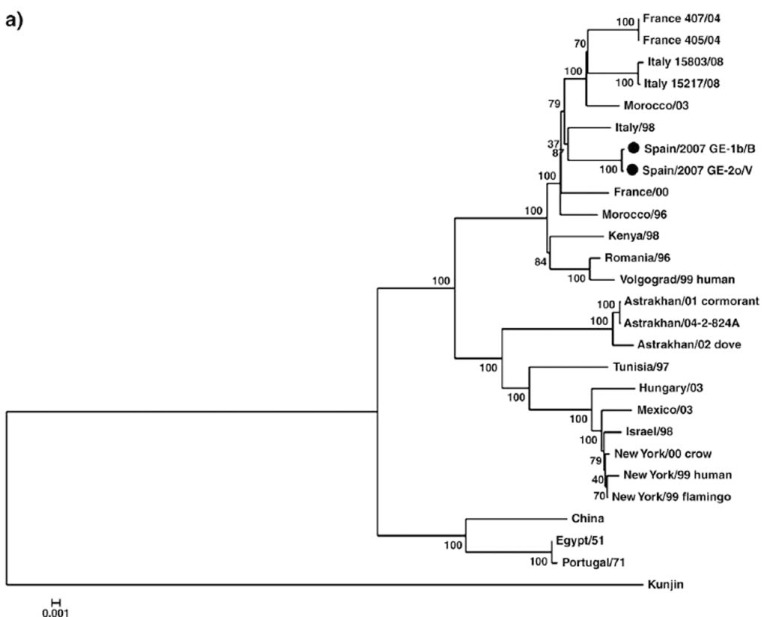
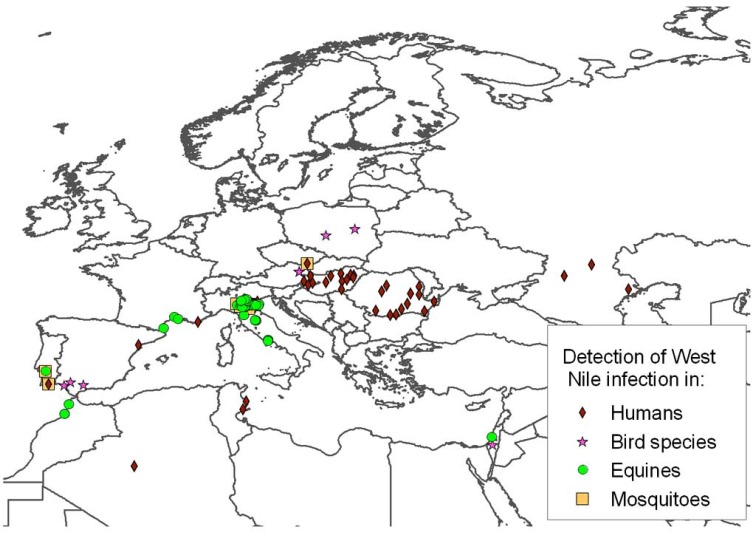
In the last 30 years several cases of West Nile (WN) virus infection were reported in horses and humans in Europe and in the Mediterranean Basin. Most of them were determined by strains of the Lineage 1 included in the European Mediterranean/Kenyan cluster. Strains of this cluster are characterised by a moderate pathogenicity for horses and humans and limited or no pathogenicity for birds. In recent years, however, WN cases determined by strains grouped in the Israeli/American cluster of Lineage 1 or in the lineage 2 have been reported in Hungary and Austria. The role of migrating birds in introducing new viruses to Europe has been often demonstrated. The migratory birds, which may be infected in their African wintering places, carry the virus northward to European sites during spring migrations. In the past, the virus introduction determined occasional cases of WN. In the recent years, new epidemiological scenarios are developing. In few occasions it has been evidenced the capability of WNV strains of overwintering by using local birds and mosquitoes. Species of Culex amongst mosquitoes and magpies (Pica pica), carrion crows (Corvus corone) and rock pigeons (Columba livia) amongst resident birds are the most probable species involved in this hypothetical WND endemic cycle.
在过去30年里,欧洲和地中海盆地报告了数起马匹和人类感染西尼罗河(WN)病毒的病例。其中大多数是由欧洲地中海/肯尼亚集群中包含的1型谱系毒株引起的。该集群的毒株对马匹和人类具有中等致病性,对鸟类的致病性有限或无致病性。然而,近年来,匈牙利和奥地利报告了由1型谱系的以色列/美国集群或2型谱系中的毒株引起的WN病例。候鸟在将新病毒引入欧洲方面的作用经常得到证实。这些候鸟可能在其非洲越冬地感染病毒,在春季迁徙期间将病毒向北携带到欧洲地区。过去,病毒引入偶尔会导致WN病例。近年来,新的流行病学情况正在发展。在少数情况下,已经证明WNV毒株有通过当地鸟类和蚊子越冬的能力。蚊子中的库蚊属物种以及留鸟中的喜鹊(Pica pica)、小嘴乌鸦(Corvus corone)和岩鸽(Columba livia)是参与这种假设的WN地方病循环最可能的物种。