Kondratova Anna A, Dubrovsky Yuliya V, Antoch Marina P, Kondratov Roman V
Lerner Research Institute, Cleveland Clinic, OH 44195, USA.
Aging (Albany NY). 2010 May;2(5):285-97. doi: 10.18632/aging.100142.
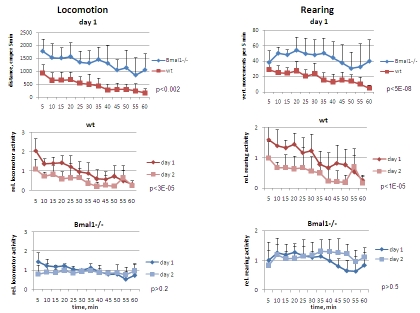
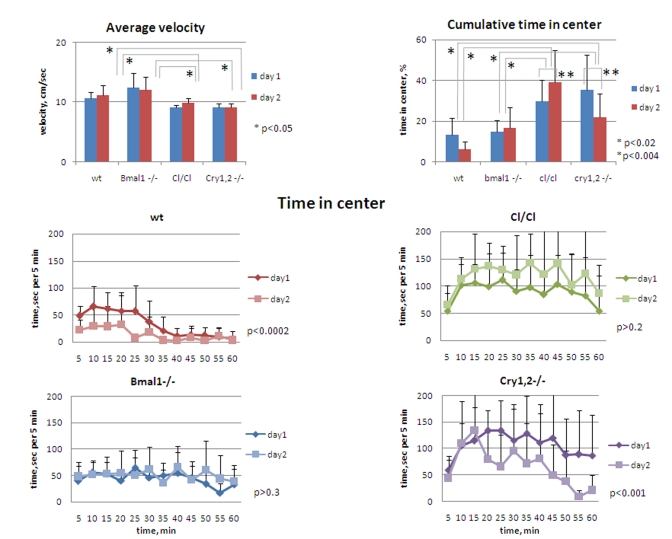
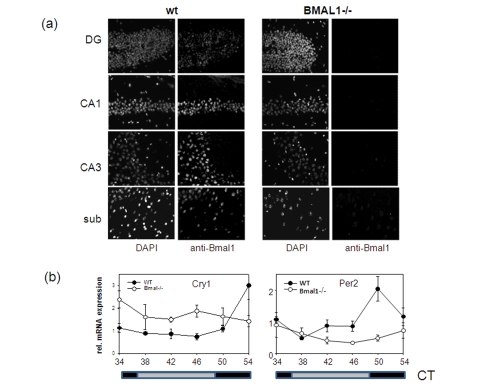
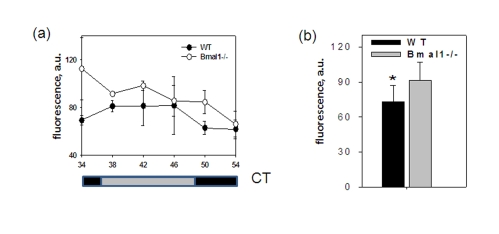
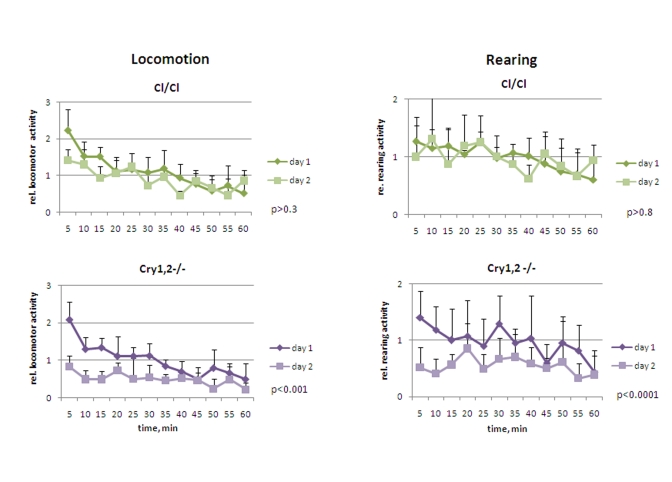
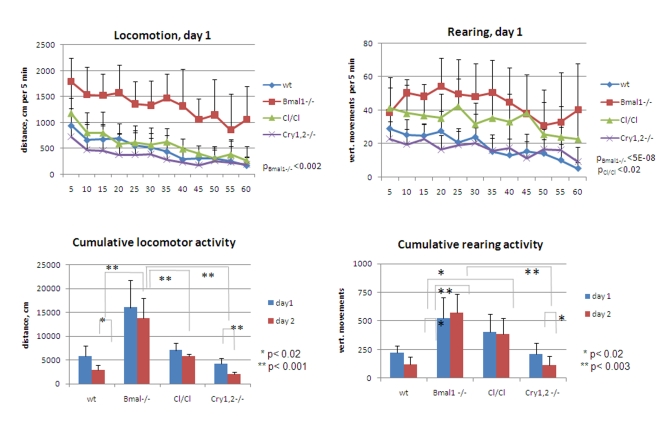
Deficiency of the transcription factor BMAL1, a core component of the circadian clock, results in an accelerated aging phenotype in mice. The circadian clock regulates many physiological processes and was recently implicated in control of brain-based activities, such as memory formation and the regulation of emotions. Aging is accompanied by the decline in brain physiology, particularly decline in the response and adaptation to novelty. We investigated the role of the circadian clock in exploratory behavior and habituation to novelty using the open field paradigm. We found that mice with a deficiency of the circadian transcription factor BMAL1 display hyperactivity in novel environments and impaired intra- and intersession habituation, indicative of defects in short- and long-term memory formation. In contrast, mice double-deficient for the circadian proteins CRY1 and CRY2 (repressors of the BMAL1-mediated transcription) demonstrate reduced activity and accelerated habituation when compared to wild type mice. Mice with mutation in theClock gene (encoding the BMAL1 transcription partner) show normal locomotion, but increased rearing activity and impaired intersession habituation. BMAL1 is highly expressed in the neurons of the hippocampus - a brain region associated with spatial memory formation; BMAL1 deficiency disrupts circadian oscillation in gene expression and reactive oxygen species homeostasis in the brain, which may be among the possible mechanisms involved. Thus, we suggest that the BMAL1:CLOCK activity is critical for the proper exploratory and habituation behavior, and that the circadian clock prepares organism for a new round of everyday activities through optimization of behavioral learning.
转录因子BMAL1是生物钟的核心组成部分,其缺乏会导致小鼠出现加速衰老的表型。生物钟调节许多生理过程,最近还被认为参与了基于大脑的活动控制,如记忆形成和情绪调节。衰老伴随着大脑生理功能的衰退,尤其是对新事物的反应和适应能力的下降。我们使用旷场实验范式研究了生物钟在探索行为和对新事物的习惯化中的作用。我们发现,缺乏生物钟转录因子BMAL1的小鼠在新环境中表现出多动,并且在实验内和实验间的习惯化受损,这表明其短期和长期记忆形成存在缺陷。相比之下,生物钟蛋白CRY1和CRY2(BMAL1介导转录的抑制因子)双缺失的小鼠与野生型小鼠相比,活动减少且习惯化加速。Clock基因(编码BMAL1转录伴侣)发生突变的小鼠运动正常,但竖毛活动增加且实验间习惯化受损。BMAL1在海马体神经元中高度表达,海马体是与空间记忆形成相关的脑区;BMAL1缺乏会破坏大脑中基因表达的昼夜节律振荡和活性氧稳态,这可能是其中涉及的潜在机制。因此,我们认为BMAL1:CLOCK活性对于正确的探索和习惯化行为至关重要,并且生物钟通过优化行为学习使机体为新一轮日常活动做好准备。