Department of Molecular Biology, Max Planck Institute for Developmental Biology, 72076 Tübingen, Germany.
Nature. 2010 Jun 3;465(7298):632-6. doi: 10.1038/nature09083.
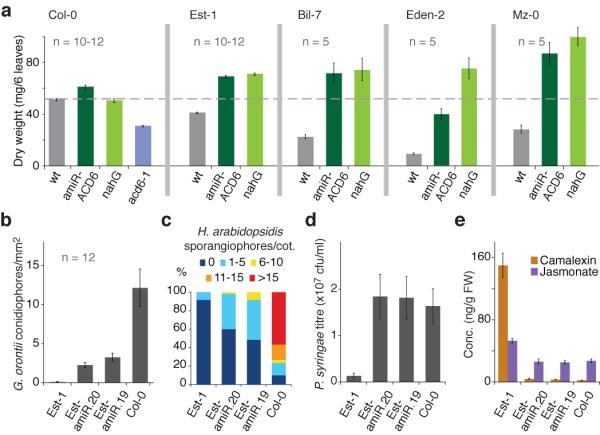
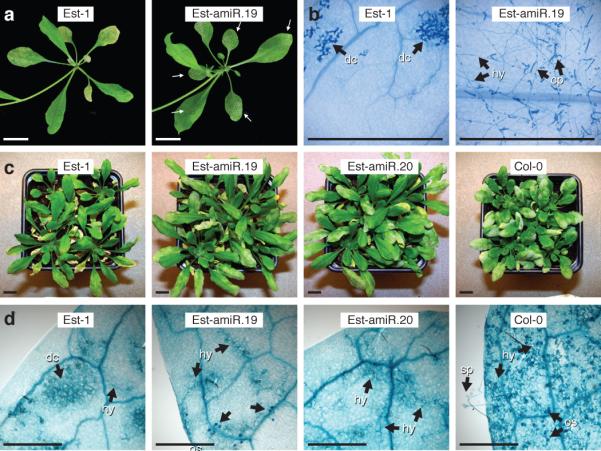
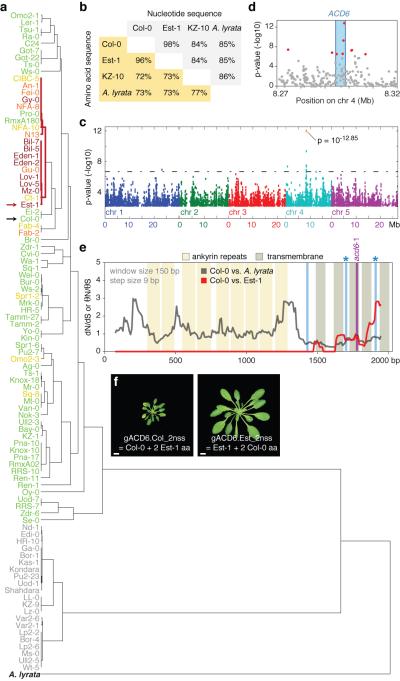
Plants can defend themselves against a wide array of enemies, from microbes to large animals, yet there is great variability in the effectiveness of such defences, both within and between species. Some of this variation can be explained by conflicting pressures from pathogens with different modes of attack. A second explanation comes from an evolutionary 'tug of war', in which pathogens adapt to evade detection, until the plant has evolved new recognition capabilities for pathogen invasion. If selection is, however, sufficiently strong, susceptible hosts should remain rare. That this is not the case is best explained by costs incurred from constitutive defences in a pest-free environment. Using a combination of forward genetics and genome-wide association analyses, we demonstrate that allelic diversity at a single locus, ACCELERATED CELL DEATH 6 (ACD6), underpins marked pleiotropic differences in both vegetative growth and resistance to microbial infection and herbivory among natural Arabidopsis thaliana strains. A hyperactive ACD6 allele, compared to the reference allele, strongly enhances resistance to a broad range of pathogens from different phyla, but at the same time slows the production of new leaves and greatly reduces the biomass of mature leaves. This allele segregates at intermediate frequency both throughout the worldwide range of A. thaliana and within local populations, consistent with this allele providing substantial fitness benefits despite its marked impact on growth.
植物可以抵御各种敌人,从微生物到大型动物,但这种防御的有效性在物种内和物种间存在很大的差异。这种变异的一部分可以用来自不同攻击模式的病原体的冲突压力来解释。第二个解释来自于进化的“拉锯战”,在这种拉锯战中,病原体适应以逃避检测,直到植物进化出对病原体入侵的新识别能力。然而,如果选择足够强烈,易感染的宿主应该仍然很少。在没有害虫的环境中,组成性防御所带来的代价,很好地解释了为什么情况并非如此。我们通过正向遗传学和全基因组关联分析的结合,证明了单个基因座 ACCELERATED CELL DEATH 6 (ACD6) 的等位基因多样性,为自然拟南芥种群中营养生长和对微生物感染及草食性的抗性的显著多效性差异提供了基础。与参考等位基因相比,一个超活跃的 ACD6 等位基因强烈增强了对来自不同门的多种病原体的抗性,但同时减缓了新叶片的产生,并大大降低了成熟叶片的生物量。这个等位基因在拟南芥的全球分布范围内以及在当地种群中都以中等频率分离,尽管这个等位基因对生长有显著影响,但它仍能提供大量的适应度优势。