National Center for Tuberculosis Control and Prevention, China Center for Disease Control and Prevention (China CDC), Beijing, China.
PLoS One. 2010 May 24;5(5):e10799. doi: 10.1371/journal.pone.0010799.
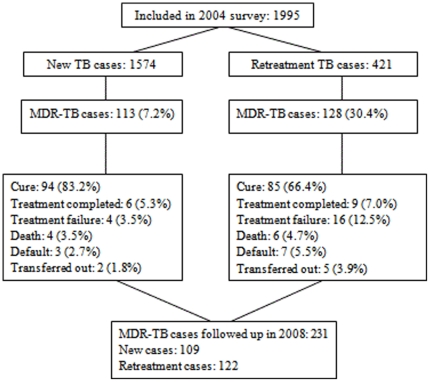
In 2004, an anti-tuberculosis (TB) drug resistance survey in Heilongjiang province, China, enrolled 1574 (79%) new and 421 (21%) retreatment patients. Multi-drug resistant (MDR) TB was detected in 7.2% of new and 30.4% of retreatment patients. All received treatment with standardized first-line drug (FLD) regimens.
METHODOLOGY/PRINCIPAL FINDINGS: We report treatment outcomes of the 2004 cohort, and long-term outcomes as assessed in the second half of 2008. The reported cure rate for MDR-TB patients was 83% (94/113) among new and 66% (85/128) among retreatment patients (P<0.001). Ten of the 241 MDR-TB patients died during treatment. Of the remaining 231, 129 (56%) could be traced in 2008. The overall recurrence rates among new and retreatment cases were 46% and 66%, respectively (P = 0.03). The overall death rates among new and retreatment cases were 25% and 46%, respectively (P = 0.02). Forty percent of the traced new cases and 24% of the retreatment cases were alive and without recurrent TB (P = 0.01). Of the 16 patients who failed or defaulted from treatment in 2004, only two patients were not re-diagnosed with TB by 2008. Of the 111 (86%) patients with an initial successful treatment outcome 63 (57%) had developed recurrent TB, 40 (36%) had died, 27 (24%) of them died of TB. The follow-up period of four years precluded follow-up of all patients. In a highly conservative sensitivity analysis in which we assumed that all non-included patients were alive and did not have recurrent TB, the recurrence and death rate were 33% and 21%.
CONCLUSIONS/SIGNIFICANCE: Documentation of cure based on conventional smear microscopy was a poor predictor of long term outcomes. MDR-TB patients in Heilongjiang province in China had high recurrence and death rates four years after treatment with standardized FLD regimens, reinforcing the need for early diagnosis and treatment of MDR-TB, including assessment of treatment outcomes with more sensitive laboratory methods.
2004 年,在中国黑龙江省进行了一项抗结核(TB)药物耐药性调查,共纳入 1574 例(79%)新发病例和 421 例(21%)复治病例。新发病例中检出耐多药(MDR)TB 占 7.2%,复治病例中检出 MDR-TB 占 30.4%。所有患者均接受标准化一线药物(FLD)方案治疗。
方法/主要发现:我们报告了 2004 年队列的治疗结果,并在 2008 年下半年评估了长期结果。新发病例中 MDR-TB 患者的治愈率为 83%(94/113),复治病例中为 66%(85/128)(P<0.001)。241 例 MDR-TB 患者中有 10 人在治疗期间死亡。在其余 231 例患者中,有 129 例(56%)在 2008 年可追踪。新发病例和复治病例的总复发率分别为 46%和 66%(P=0.03)。新发病例和复治病例的总死亡率分别为 25%和 46%(P=0.02)。在可追踪的新发病例中,有 40%和复治病例中 24%的患者存活且无复发性 TB(P=0.01)。2004 年治疗失败或失访的 16 例患者中,到 2008 年仅 2 例未重新诊断为 TB。在 111 例初始治疗结果成功的患者中,有 63 例(57%)发生了复发性 TB,40 例(36%)死亡,其中 27 例(24%)死于 TB。四年的随访期未能随访所有患者。在一项非常保守的敏感性分析中,我们假设所有未纳入的患者均存活且无复发性 TB,复发率和死亡率分别为 33%和 21%。
结论/意义:基于常规涂片显微镜检查的治愈证明是长期结果的一个较差预测因素。中国黑龙江省的 MDR-TB 患者在接受标准化 FLD 方案治疗四年后复发和死亡的风险很高,这强调了需要早期诊断和治疗 MDR-TB,包括使用更敏感的实验室方法评估治疗结果。