Department of Migration and Immuno-Ecology, Max Planck Institute for Ornithology, Radolfzell, Germany.
PLoS One. 2010 May 26;5(5):e10738. doi: 10.1371/journal.pone.0010738.
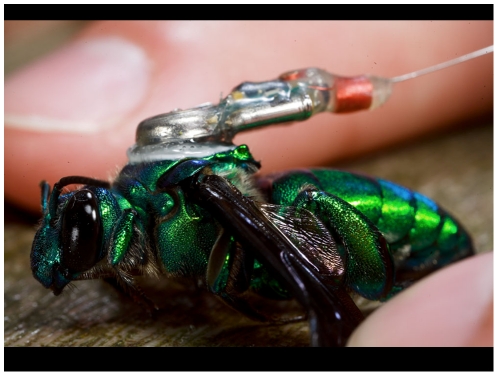
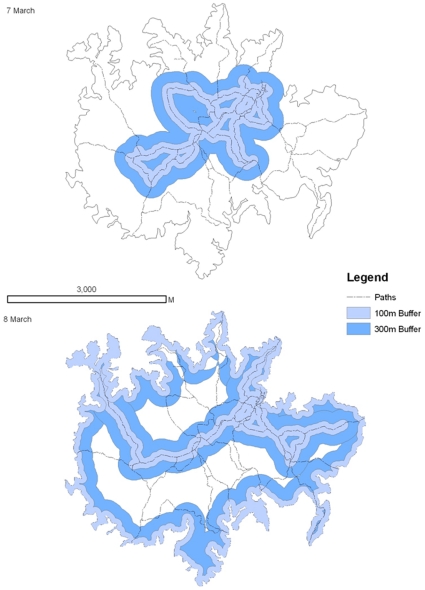
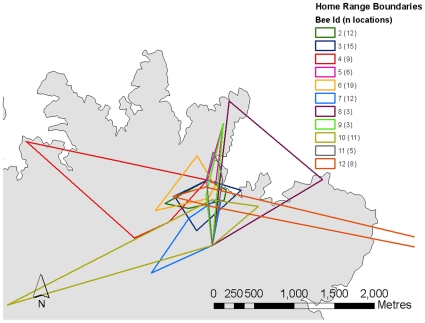
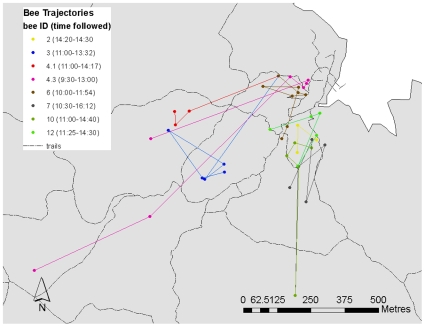
Neotropical orchid bees (Euglossini) are often cited as classic examples of trapline-foragers with potentially extensive foraging ranges. If long-distance movements are habitual, rare plants in widely scattered locations may benefit from euglossine pollination services. Here we report the first successful use of micro radio telemetry to track the movement of an insect pollinator in a complex and forested environment. Our results indicate that individual male orchid bees (Exaerete frontalis) habitually use large rainforest areas (at least 42-115 ha) on a daily basis. Aerial telemetry located individuals up to 5 km away from their core areas, and bees were often stationary, for variable periods, between flights to successive localities. These data suggest a higher degree of site fidelity than what may be expected in a free living male bee, and has implications for our understanding of biological activity patterns and the evolution of forest pollinators.
新热带兰花蜂(Euglossini)常被作为经典的陷阱觅食者范例,其觅食范围可能很广。如果远距离移动是习惯行为,那么分布广泛的稀有植物可能会受益于兰花蜂的传粉服务。本文首次成功使用微无线电遥测技术来追踪复杂森林环境中昆虫传粉者的移动。研究结果表明,雄性兰花蜂(Exaerete frontalis)个体每天习惯性地使用至少 42-115 公顷的大型雨林区域。空中遥测定位个体距离核心区域最远可达 5 公里,而且在飞往下一个地点的飞行之间,蜜蜂通常会在不同的位置保持静止状态。这些数据表明,与自由生活的雄性蜜蜂相比,兰花蜂对栖息地的忠诚度更高,这对我们理解生物活动模式和森林传粉者的进化具有重要意义。