Neurobiology Department, Harvard Medical School, Boston, Massachusetts, USA.
PLoS One. 2010 May 24;5(5):e10806. doi: 10.1371/journal.pone.0010806.
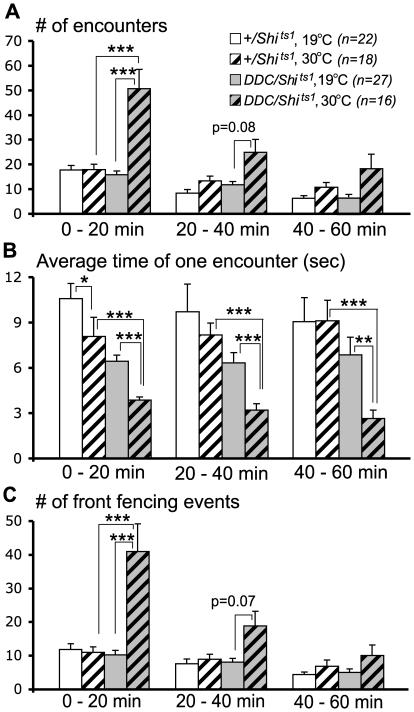
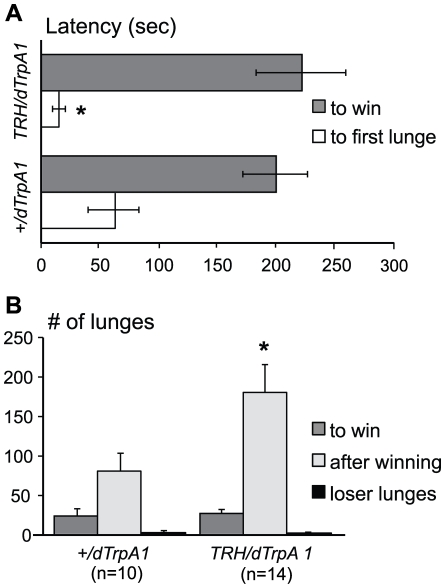
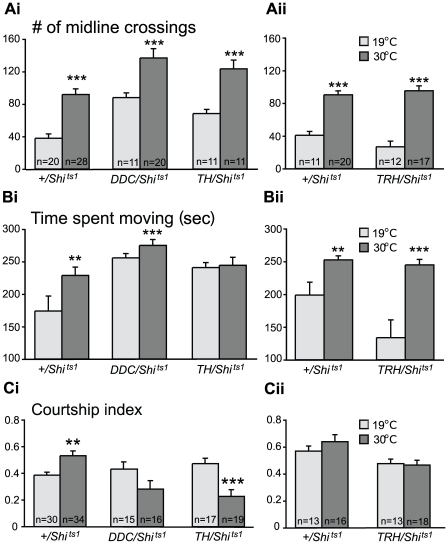
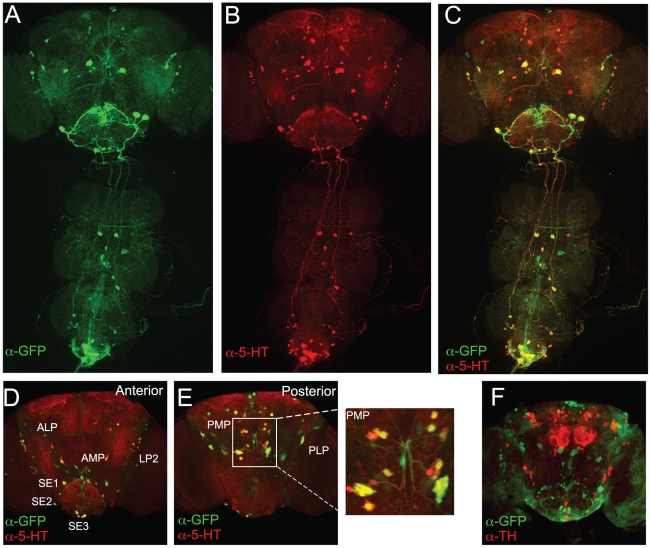
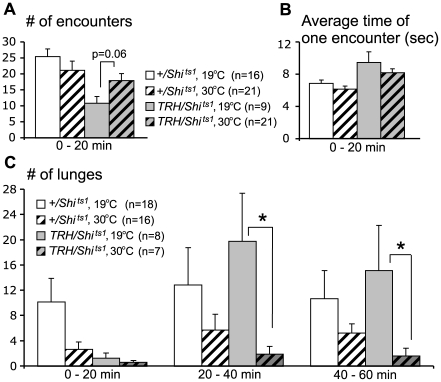
Dopamine (DA) and serotonin (5HT) are reported to serve important roles in aggression in a wide variety of animals. Previous investigations of 5HT function in adult Drosophila behavior have relied on pharmacological manipulations, or on combinations of genetic tools that simultaneously target both DA and 5HT neurons. Here, we generated a transgenic line that allows selective, direct manipulation of serotonergic neurons and asked whether DA and 5HT have separable effects on aggression. Quantitative morphological examination demonstrated that our newly generated tryptophan hydroxylase (TRH)-Gal4 driver line was highly selective for 5HT-containing neurons. This line was used in conjunction with already available Gal4 driver lines that target DA or both DA and 5HT neurons to acutely alter the function of aminergic systems. First, we showed that acute impairment of DA and 5HT neurotransmission using expression of a temperature sensitive form of dynamin completely abolished mid- and high-level aggression. These flies did not escalate fights beyond brief low-intensity interactions and therefore did not yield dominance relationships. We showed next that manipulation of either 5HT or DA neurotransmission failed to duplicate this phenotype. Selective disruption of 5HT neurotransmission yielded flies that fought, but with reduced ability to escalate fights, leading to fewer dominance relationships. Acute activation of 5HT neurons using temperature sensitive dTrpA1 channel expression, in contrast, resulted in flies that escalated fights faster and that fought at higher intensities. Finally, acute disruption of DA neurotransmission produced hyperactive flies that moved faster than controls, and rarely engaged in any social interactions. By separately manipulating 5HT- and DA- neuron systems, we collected evidence demonstrating a direct role for 5HT in the escalation of aggression in Drosophila.
多巴胺(DA)和 5-羟色胺(5HT)被报道在各种动物的攻击中发挥重要作用。先前对成年果蝇行为中 5HT 功能的研究依赖于药理学操作,或同时针对 DA 和 5HT 神经元的遗传工具的组合。在这里,我们生成了一个转基因系,允许对 5HT 神经元进行选择性、直接操作,并询问 DA 和 5HT 是否对攻击有可分离的影响。定量形态学检查表明,我们新生成的色氨酸羟化酶(TRH)-Gal4 驱动线对 5HT 神经元具有高度选择性。该系与已经可用的靶向 DA 或 DA 和 5HT 神经元的 Gal4 驱动系结合使用,以急性改变胺能系统的功能。首先,我们表明使用温度敏感形式的 dynamin 表达急性损害 DA 和 5HT 神经传递完全消除了中等到高水平的攻击。这些苍蝇不会将战斗升级到短暂的低强度互动之外,因此不会产生支配关系。我们接下来表明,操纵 5HT 或 DA 神经传递都不能复制这种表型。选择性破坏 5HT 神经传递产生了战斗的苍蝇,但战斗升级的能力降低,导致较少的支配关系。使用温度敏感的 dTrpA1 通道表达急性激活 5HT 神经元,相反,导致苍蝇更快地升级战斗,并以更高的强度战斗。最后,急性破坏 DA 神经传递产生了比对照更快移动的过度活跃的苍蝇,并且很少参与任何社交互动。通过分别操纵 5HT-和 DA-神经元系统,我们收集了证据表明 5HT 在果蝇攻击的升级中起着直接作用。