Department of Child and Adolescent Psychiatry, University of Zurich, Neumuensterallee 9, 8032 Zurich, Switzerland.
Behav Brain Funct. 2010 Jun 4;6:31. doi: 10.1186/1744-9081-6-31.
The present study investigated the impact of divergent instructions and response cost on strategic cognitive control in children with ADHD.
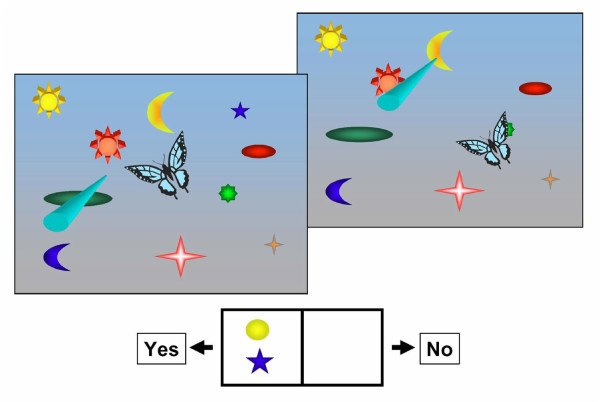
Children with ADHD (N = 34), combined subtype, and control children (N = 34) performed a series of self-paced computerized visual search tasks. The tasks varied by verbal instructions: after a baseline task, children were either instructed to work as fast as possible (speed instruction) or as accurately as possible (accuracy instruction). In addition, tasks were performed with and without response cost.
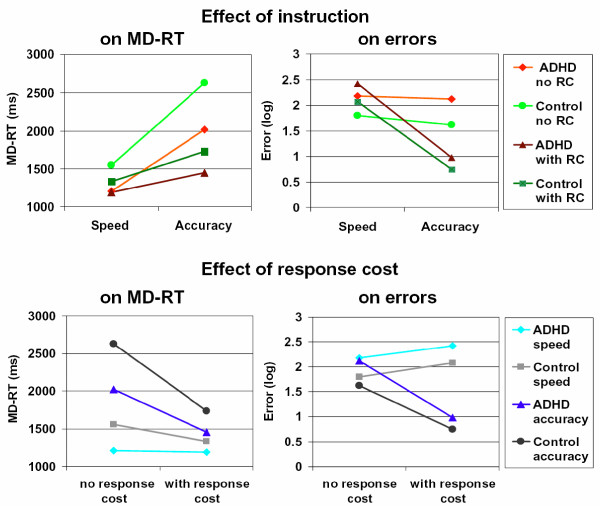
Both groups modulated latencies and errors according to instructions in a comparable way, except for latency in the accuracy - instruction without response cost, where control children showed a larger increase of response time. Response cost did not affect the modulation of response style in children with ADHD to a larger extent than in controls. However, with instructions group differences related to target criteria became clearly more accentuated compared to baseline but disappeared when response cost was added.
Delay aversion theory and motivational or state regulation models may account for different aspects of the results. Modifications related to task presentation, such as the emphasis put on different details in the verbal instruction, may lead to divergent results when comparing performances of children with ADHD and control children on a self-paced task.
本研究考察了发散式指令和反应代价对 ADHD 儿童策略性认知控制的影响。
采用计算机化视觉搜索任务,对 ADHD 儿童(共 34 名,其中混合亚型 19 名)和正常对照儿童(共 34 名)进行了一系列自我调节的测试。任务的指导语不同:在基线任务之后,儿童被指示要么尽可能快地(速度指令),要么尽可能准确地(准确性指令)完成任务。此外,任务执行时还带有或不带有反应代价。
两组儿童根据指令以类似的方式调节了反应时和错误率,除了准确性指令且无反应代价的情况下,对照组儿童的反应时间有更大的增加。反应代价对 ADHD 儿童的反应方式的调节影响并不比对照组大,但当加入反应代价时,与目标标准相关的指令组差异变得更加明显。
延迟厌恶理论和动机或状态调节模型可以解释结果的不同方面。与任务呈现相关的修改,例如在口头指令中强调不同的细节,可能会导致在自我调节任务上比较 ADHD 儿童和正常对照儿童的表现时产生不同的结果。