Papworth Hospital NHS Trust, Cambridge, UK.
Health Qual Life Outcomes. 2010 Jun 4;8:54. doi: 10.1186/1477-7525-8-54.
The EuroQoL 5D (EQ-5D) is a questionnaire that provides a measure of utility for cost-effectiveness analysis. The EQ-5D has been widely used in many patient groups, including those with coronary heart disease. Studies often require patients to complete many questionnaires and the EQ-5D may not be gathered. This study aimed to assess whether demographic and clinical outcome variables, including scores from a disease specific measure, the Seattle Angina Questionnaire (SAQ), could be used to predict, or map, the EQ-5D index value where it is not available.
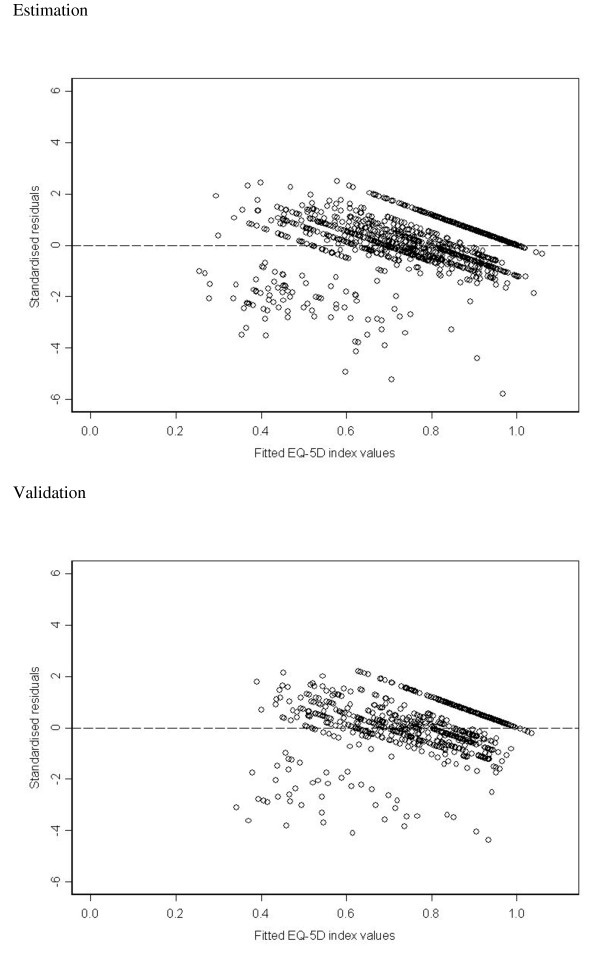
Patient-level data from 5 studies of cardiac interventions were used. The data were split into two groups - approximately 60% of the data were used as an estimation dataset for building models, and 40% were used as a validation dataset. Forward ordinary least squares linear regression methods and measures of prediction error were used to build a model to map to the EQ-5D index. Age, sex, a proxy measure of disease stage, Canadian Cardiovascular Society (CCS) angina severity class, treadmill exercise time (ETT) and scales of the SAQ were examined.
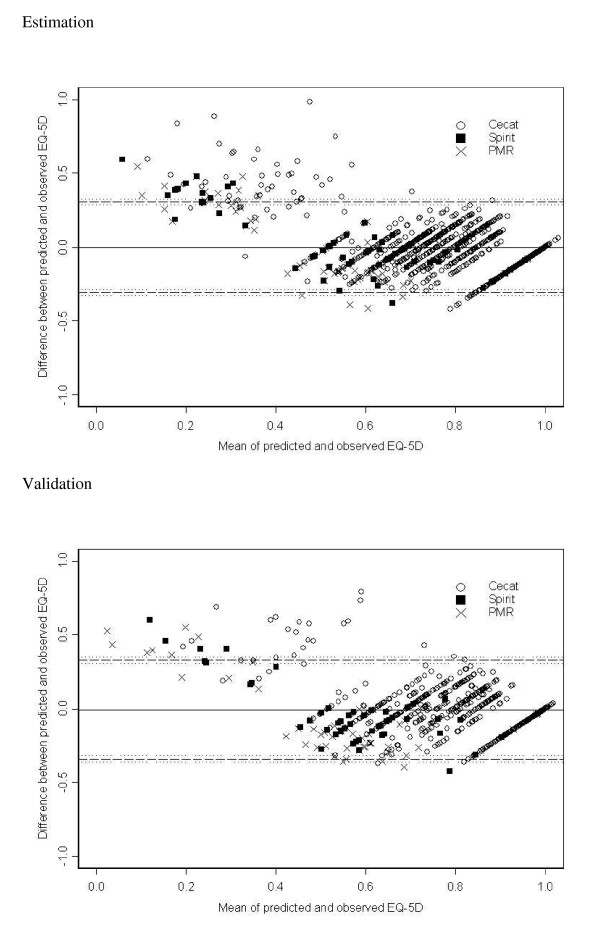
The exertional capacity (ECS), disease perception (DPS) and anginal frequency scales (AFS) of the SAQ were the strongest predictors of the EQ-5D index and gave the smallest root mean square errors. A final model was chosen with age, gender, disease stage and the ECS, DPS and AFS scales of the SAQ. ETT and CCS did not improve prediction in the presence of the SAQ scales. Bland-Altman agreement between predicted and observed EQ-5D index values was reasonable for values greater than 0.4, but below this level predicted values were higher than observed. The 95% limits of agreement were wide (-0.34, 0.33).
Mapping of the EQ-5D index in cardiac patients from demographics and commonly measured cardiac outcome variables is possible; however, prediction for values of the EQ-5D index below 0.4 was not accurate. The newly designed 5-level version of the EQ-5D with its increased ability to discriminate health states may improve prediction of EQ-5D index values.
EuroQoL 5D(EQ-5D)是一种用于成本效益分析的效用衡量工具。EQ-5D 已广泛应用于许多患者群体,包括冠心病患者。研究通常需要患者完成许多问卷,而 EQ-5D 可能无法收集。本研究旨在评估人口统计学和临床结果变量,包括特定疾病量表西雅图心绞痛问卷(SAQ)的评分,是否可用于预测或映射无法获得的 EQ-5D 指数值。
使用 5 项心脏介入研究的患者水平数据。数据分为两组 - 约 60%的数据用于构建模型的估计数据集,40%的数据用于验证数据集。使用正向普通最小二乘线性回归方法和预测误差测量方法构建模型以映射到 EQ-5D 指数。评估年龄、性别、疾病阶段的替代指标、加拿大心血管学会(CCS)心绞痛严重程度分级、跑步机运动时间(ETT)和 SAQ 量表。
SAQ 的运动能力(ECS)、疾病感知(DPS)和心绞痛频率量表(AFS)是 EQ-5D 指数的最强预测指标,其均方根误差最小。选择了一个包含年龄、性别、疾病阶段以及 SAQ 的 ECS、DPS 和 AFS 量表的最终模型。在存在 SAQ 量表的情况下,ETT 和 CCS 并不能提高预测能力。对于大于 0.4 的 EQ-5D 指数值,预测值与观察值之间的 Bland-Altman 一致性是合理的,但低于该水平时,预测值高于观察值。95%的一致性界限较宽(-0.34,0.33)。
从人口统计学和常用的心脏结局变量映射心脏患者的 EQ-5D 指数是可行的;然而,对于 EQ-5D 指数低于 0.4 的值,预测并不准确。新设计的 5 级 EQ-5D 具有更高的区分健康状态的能力,可能会提高 EQ-5D 指数值的预测能力。