Thermophysiological Chronobiology, Centre for Chronobiology, Psychiatric University Clinics, Basel, Switzerland.
Popul Health Metr. 2010 Jun 4;8:17. doi: 10.1186/1478-7954-8-17.
The aim of this epidemiological study was to investigate the relationship of thermal discomfort with cold extremities (TDCE) to age, gender, and body mass index (BMI) in a Swiss urban population.
In a random population sample of Basel city, 2,800 subjects aged 20-40 years were asked to complete a questionnaire evaluating the extent of cold extremities. Values of cold extremities were based on questionnaire-derived scores. The correlation of age, gender, and BMI to TDCE was analyzed using multiple regression analysis.
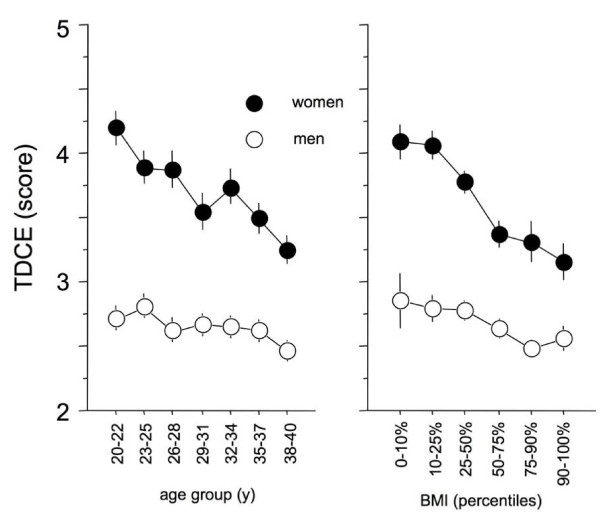
A total of 1,001 women (72.3% response rate) and 809 men (60% response rate) returned a completed questionnaire. Statistical analyses revealed the following findings: Younger subjects suffered more intensely from cold extremities than the elderly, and women suffered more than men (particularly younger women). Slimmer subjects suffered significantly more often from cold extremities than subjects with higher BMIs.
Thermal discomfort with cold extremities (a relevant symptom of primary vascular dysregulation) occurs at highest intensity in younger, slimmer women and at lowest intensity in elderly, stouter men.
本项流行病学研究旨在调查瑞士城市人群中热不舒适与四肢发冷(TDCE)与年龄、性别和体重指数(BMI)的关系。
在巴塞尔市的一个随机人群样本中,要求 2800 名 20-40 岁的受试者完成一份调查问卷,评估四肢发冷的程度。四肢发冷的数值基于问卷得出的分数。使用多元回归分析来分析年龄、性别和 BMI 与 TDCE 的相关性。
共有 1001 名女性(72.3%的回复率)和 809 名男性(60%的回复率)交回了完整的问卷。统计分析发现以下结果:年轻受试者比老年受试者更强烈地感到四肢发冷,女性比男性更强烈(尤其是年轻女性)。较瘦的受试者比 BMI 较高的受试者更频繁地感到四肢发冷。
热不舒适与四肢发冷(原发性血管调节障碍的一个相关症状)在年轻、苗条的女性中强度最高,在老年、粗壮的男性中强度最低。