Institute for Ageing and Health Stroke Research Group, Medical School, Newcastle University, Newcastle upon Tyne, UK.
BMC Health Serv Res. 2010 Jun 8;10:157. doi: 10.1186/1472-6963-10-157.
The English National Stroke Strategy suggests that there is a need to improve the response of patients and witnesses to the symptoms of acute stroke to increase rapid access to specialist care. We wished to review the evidence base regarding the knowledge, attitudes and behaviours of stroke patients, witnesses and the public to the symptoms of stroke and the need for an urgent response at the onset of symptoms.
We conducted a systematic review of UK articles reporting empirical research on a) awareness of and response to the symptoms of acute stroke or TIA, and b) beliefs and attitudes about diagnosis, early treatment and consequences of acute stroke or TIA. Nine electronic databases were searched using a robust search strategy. Citations and abstracts were screened independently by two reviewers. Data were extracted by two researchers independently using agreed criteria.
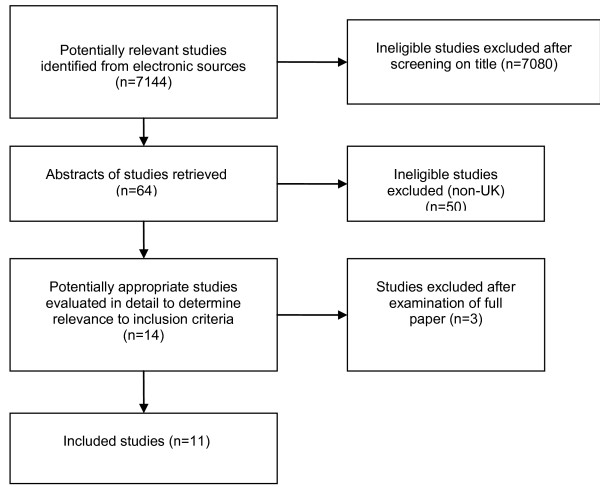
11 studies out of 7144 citations met the inclusion criteria. Methods of data collection included: postal survey (n = 2); interview survey (n = 6); review of hospital documentation (n = 2) and qualitative interviews (n = 1). Limited data reveal a good level of knowledge of the two commonest stroke symptoms (unilateral weakness and speech disturbance), and of the need for an emergency response among the general public and at risk patients. Despite this, less than half of patients recognised they had suffered a stroke. Symptom recognition did not reduce time to presentation. For the majority, the first point of contact for medical assistance was a general practitioner.
There is an assumption that, in the UK, public knowledge of the symptoms of stroke and of the need for an emergency response is lacking, but there is little published research to support this. Public awareness raising campaigns to improve response to the symptoms of stroke therefore may not produce an increase in desired behaviours. Further research is needed to understand why people who experience or witness stroke symptoms frequently do not call emergency services.
英国国家卒中战略建议,需要提高患者和目击者对急性卒中症状的反应能力,以增加快速获得专科护理的机会。我们希望回顾有关卒中患者、目击者和公众对卒中症状的认识、态度和行为,以及在症状发作时需要紧急反应的证据基础。
我们对英国报告关于急性卒中或 TIA 症状的意识和反应,以及对诊断、早期治疗和急性卒中或 TIA 后果的信念和态度的实证研究的文章进行了系统综述。使用强大的搜索策略在 9 个电子数据库中进行了搜索。两名审查员独立筛选了引文和摘要。两名研究人员使用商定的标准独立提取数据。
在 7144 条引文中有 11 项研究符合纳入标准。数据收集方法包括:邮寄调查(n = 2);访谈调查(n = 6);医院文档审查(n = 2)和定性访谈(n = 1)。有限的数据显示,公众和高危患者对两种最常见的卒中症状(单侧无力和言语障碍)以及对紧急反应的需求有很好的了解。尽管如此,仍有不到一半的患者意识到自己曾患有卒中。症状识别并没有减少就诊时间。对于大多数人来说,寻求医疗援助的第一站是全科医生。
人们假设在英国,公众对卒中症状和紧急反应的需求缺乏认识,但几乎没有发表的研究支持这一假设。提高对卒中症状反应的公众意识活动可能不会产生期望的行为增加。需要进一步研究以了解为什么经历或目睹卒中症状的人经常不呼叫急救服务。