*MRC Mitochondrial Biology Unit, Cambridge, UK.
Biochem J. 2010 Aug 15;430(1):49-59. doi: 10.1042/BJ20100633.
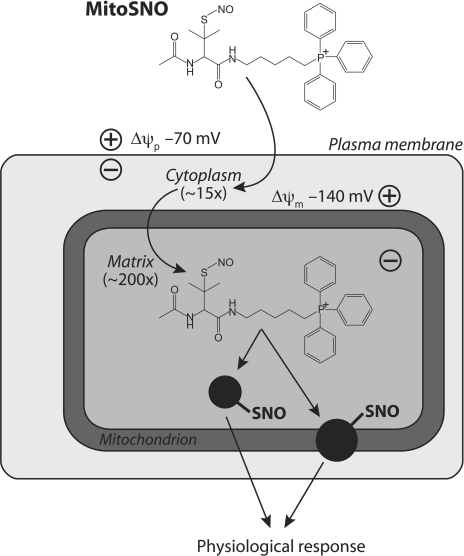
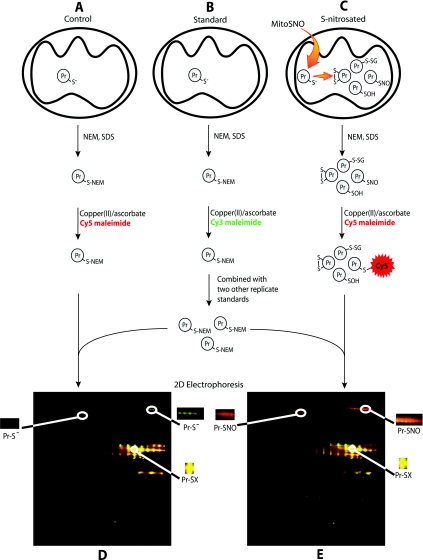
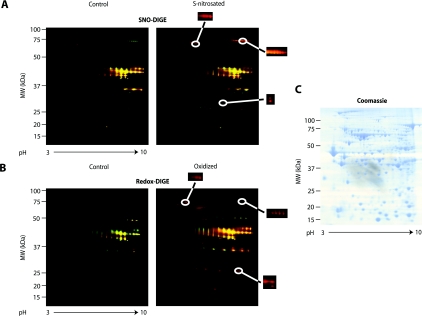
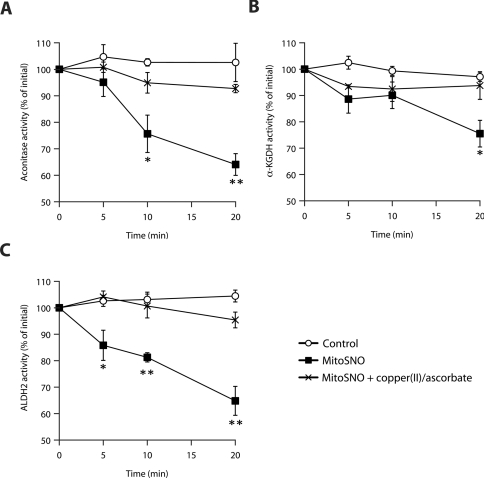
The S-nitrosation of mitochondrial proteins as a consequence of NO metabolism is of physiological and pathological significance. We previously developed a MitoSNO (mitochondria-targeted S-nitrosothiol) that selectively S-nitrosates mitochondrial proteins. To identify these S-nitrosated proteins, here we have developed a selective proteomic methodology, SNO-DIGE (S-nitrosothiol difference in gel electrophoresis). Protein thiols in control and MitoSNO-treated samples were blocked, then incubated with copper(II) and ascorbate to selectively reduce S-nitrosothiols. The samples were then treated with thiol-reactive Cy3 (indocarbocyanine) or Cy5 (indodicarbocyanine) fluorescent tags, mixed together and individual protein spots were resolved by 2D (two-dimensional) gel electrophoresis. Fluorescent scanning of these gels revealed S-nitrosated proteins by an increase in Cy5 red fluorescence, allowing for their identification by MS. Parallel analysis by Redox-DIGE enabled us to distinguish S-nitrosated thiol proteins from those which became oxidized due to NO metabolism. We identified 13 S-nitrosated mitochondrial proteins, and a further four that were oxidized, probably due to evanescent S-nitrosation relaxing to a reversible thiol modification. We investigated the consequences of S-nitrosation for three of the enzymes identified using SNO-DIGE (aconitase, mitochondrial aldehyde dehydrogenase and alpha-ketoglutarate dehydrogenase) and found that their activity was selectively and reversibly inhibited by S-nitrosation. We conclude that the reversible regulation of enzyme activity by S-nitrosation modifies enzymes central to mitochondrial metabolism, whereas identification and functional characterization of these novel targets provides mechanistic insight into the potential physiological and pathological roles played by this modification. More generally, the development of SNO-DIGE facilitates robust investigation of protein S-nitrosation across the proteome.
蛋白质的 S-亚硝基化作为 NO 代谢的结果具有生理和病理意义。我们之前开发了一种 MitoSNO(靶向线粒体的 S-亚硝硫醇),它可以选择性地 S-亚硝基化线粒体蛋白质。为了鉴定这些 S-亚硝基化的蛋白质,我们在这里开发了一种选择性的蛋白质组学方法,SNO-DIGE(S-亚硝硫醇差异凝胶电泳)。对照和 MitoSNO 处理样品中的蛋白质巯基被阻断,然后用铜 (II) 和抗坏血酸孵育以选择性还原 S-亚硝硫醇。然后用巯基反应性 Cy3(吲哚羰花青)或 Cy5(吲哚二羰花青)荧光标记物处理样品,混合在一起,通过 2D(二维)凝胶电泳分离单个蛋白质斑点。这些凝胶的荧光扫描通过 Cy5 红色荧光的增加显示 S-亚硝基化的蛋白质,从而通过 MS 对其进行鉴定。Redox-DIGE 的平行分析使我们能够区分由于 NO 代谢而氧化的 S-亚硝基化的巯基蛋白和那些由于 S-亚硝基化而氧化的巯基蛋白。我们鉴定了 13 种 S-亚硝基化的线粒体蛋白质,还有另外 4 种蛋白质发生了氧化,可能是由于 S-亚硝酰化松弛到可逆的巯基修饰。我们使用 SNO-DIGE 研究了 3 种酶的 S-亚硝基化后果(顺乌头酸酶、线粒体醛脱氢酶和α-酮戊二酸脱氢酶),发现它们的活性被 S-亚硝基化选择性和可逆地抑制。我们得出结论,S-亚硝基化对酶活性的可逆调节改变了线粒体代谢中至关重要的酶,而这些新靶标的鉴定和功能特征为这种修饰所发挥的潜在生理和病理作用提供了机制上的见解。更一般地说,SNO-DIGE 的开发促进了对整个蛋白质组中蛋白质 S-亚硝基化的稳健研究。