Mirabile Scott P, Scaramella Laura V, Sohr-Preston Sara L, Robison Sarah D
University of New Orleans, GP 2001, New Orleans, LA 70148, USA.
Child Youth Care Forum. 2009 Feb 1;38(1):19-37. doi: 10.1007/s10566-008-9063-5.
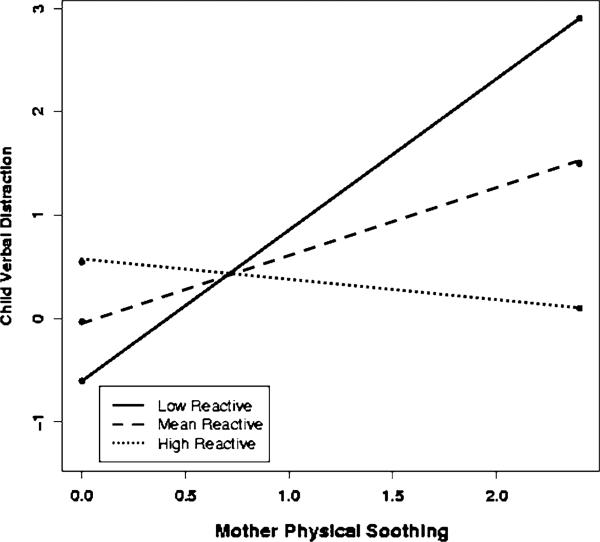
During the toddler period, children begin to shift from being primarily dependent on parents to regulate their emotions to managing their emotions independently. The present study considers how children's propensity towards negative emotional arousal interacts with mothers' efforts to socialize emotion regulation. Fifty-five low income mothers and their 2-year-old children completed observational assessments measuring mothers' socialization of emotion regulation, children's reactivity propensity, and children's emotion regulation. Children's propensity towards negative reactivity significantly interacted with mothers' use of physical soothing. That is, mothers with less reactive children who used more soothing had children who were more likely to use interactive, distraction-based regulatory behaviors during a frustration situation. Theoretical and child care implications of the finding are discussed.
在幼儿期,孩子们开始从主要依赖父母调节情绪转变为独立管理自己的情绪。本研究探讨了儿童消极情绪唤起倾向如何与母亲促进情绪调节社会化的努力相互作用。55位低收入母亲及其2岁的孩子完成了观察评估,测量母亲在情绪调节方面的社会化程度、孩子的反应倾向以及孩子的情绪调节能力。孩子的消极反应倾向与母亲使用身体安抚的方式存在显著的相互作用。也就是说,对于反应较小的孩子,母亲使用更多安抚方式,其孩子在遇到挫折时更有可能采用基于分散注意力的互动调节行为。文中讨论了这一发现的理论意义和对儿童保育的启示。