Department of Internal Medicine, Ewha Medical Research Institute, Ewha Womans University School of Medicine, Seoul, Korea.
J Neurogastroenterol Motil. 2010 Apr;16(2):148-56. doi: 10.5056/jnm.2010.16.2.148. Epub 2010 Apr 27.
BACKGROUND/AIMS: Gastroesophageal reflux disease (GERD) is increasing in Asian countries. Functional dyspepsia (FD) or irritable bowel syndrome (IBS) are also prevalent and commonly overlapped with GERD. This study was conducted to compare the proportion and risk factors for overlapping reflux esophagitis (RE) and non-erosive reflux disease (NERD) with functional gastrointestinal disorders (FGIDs).
A total of 2,388 [male, 55.9%; mean age (+/- SD), 43.2 years (+/- 8.4)] Korean subjects who underwent the upper endoscopy for health screening were prospectively included. The subjects were asked about demographic, medical and social history by using a structured questionnaire, and FD and IBS were assessed according to the Rome III criteria.
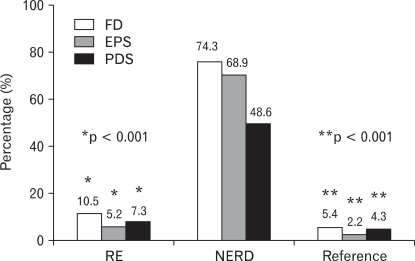
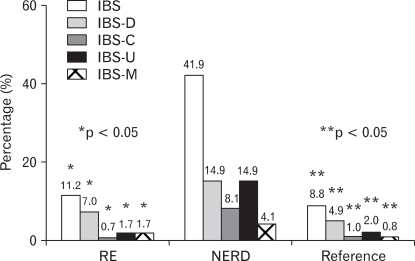
The subjects with RE were 286 (12.0%, male 88.5%, 42.8 years) and 74 subjects had NERD (3.1%) while the prevalence of FD and IBS were 8.1% and 10.1%, respectively. The proportion of FD and IBS in NERD was higher than that of RE (74.3% vs. 10.5%, p = 0.000; 41.9% vs. 11.2%, p = 0.000, respectively). The epigastric pain syndrome (EPS) was more prevalent than postprandial distress syndrome in NERD. According to multiple regression analysis, high somatization score and the presence of FD increased the odd ratio for NERD. However, male gender and current smoker were significant risk factors for RE.
Compared to RE, NERD is more frequently overlapped with FD, especially EPS, and also are associated with significantly increased frequency of IBS. Our data draws attention to the possibility of subgrouping FGIDs and GERD to be important in understanding the pathophysiology of these conditions.
背景/目的:胃食管反流病(GERD)在亚洲国家呈上升趋势。功能性消化不良(FD)或肠易激综合征(IBS)也很常见,并且常与 GERD 重叠。本研究旨在比较重叠性反流性食管炎(RE)和非糜烂性反流病(NERD)与功能性胃肠病(FGIDs)的比例和危险因素。
共前瞻性纳入 2388 名(男性,55.9%;平均年龄(+/-标准差),43.2 岁(+/-8.4))接受健康筛查行上消化道内镜检查的韩国受试者。通过结构化问卷询问受试者的人口统计学、医学和社会史,并根据罗马 III 标准评估 FD 和 IBS。
RE 患者 286 例(12.0%,男性 88.5%,42.8 岁),NERD 患者 74 例(3.1%),FD 和 IBS 的患病率分别为 8.1%和 10.1%。NERD 中 FD 和 IBS 的比例高于 RE(74.3% vs. 10.5%,p = 0.000;41.9% vs. 11.2%,p = 0.000)。NERD 中餐后不适综合征(EPS)比餐后窘迫综合征更常见。多元回归分析显示,高躯体化评分和 FD 的存在增加了 NERD 的比值比。然而,男性和当前吸烟者是 RE 的显著危险因素。
与 RE 相比,NERD 更常与 FD 重叠,尤其是 EPS,并且与 IBS 的发生频率显著增加有关。我们的数据提示了将 FGIDs 和 GERD 分组为亚组的可能性,这对于理解这些疾病的病理生理学可能很重要。