Division of Pharmacology, Utrecht Institute for Pharmaceutical Sciences, Utrecht University, Sorbonnelaan 16, 3584CA, Utrecht, The Netherlands.
Psychopharmacology (Berl). 2010 Aug;211(2):123-30. doi: 10.1007/s00213-010-1895-7. Epub 2010 Jun 10.
Stress-related disorders are associated with dysfunction of both serotonergic and GABAergic pathways, and clinically effective anxiolytics act via both neurotransmitter systems. As there is evidence that the GABA(A) and the serotonin receptor system interact, a serotonergic component in the anxiolytic actions of benzodiazepines could be present.
The main aim of the present study was to investigate whether the anxiolytic effects of (non-)selective alpha subunit GABA(A) receptor agonists could be reversed with 5-HT(1A) receptor blockade using the stress-induced hyperthermia (SIH) paradigm.
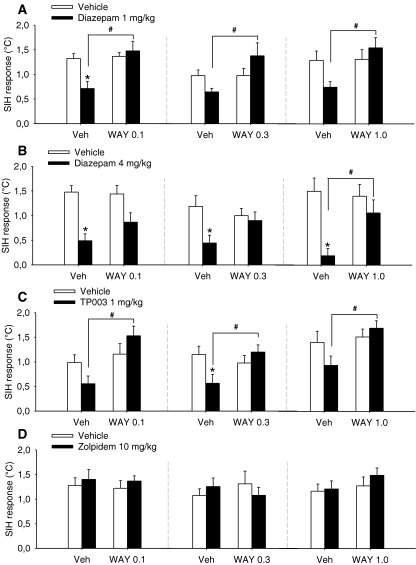
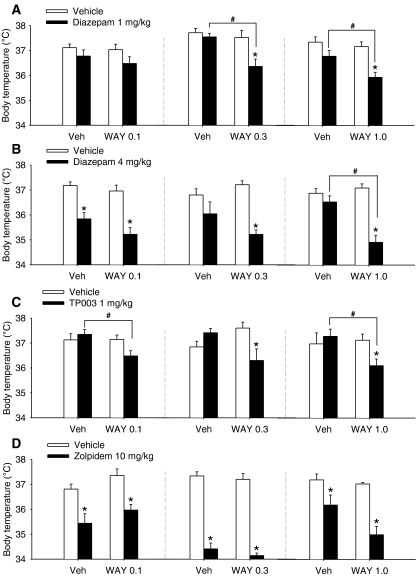
The 5-HT(1A) receptor antagonist WAY-100635 (0.1-1 mg/kg) reversed the SIH-reducing effects of the non-alpha-subunit selective GABA(A) receptor agonist diazepam (1-4 mg/kg) and the GABA(A) receptor alpha(3)-subunit selective agonist TP003 (1 mg/kg), whereas WAY-100635 alone was without effect on the SIH response or basal body temperature. At the same time, co-administration of WAY-100635 with diazepam or TP003 reduced basal body temperature. WAY-100635 did not affect the SIH response when combined with the preferential alpha(1)-subunit GABA(A) receptor agonist zolpidem (10 mg/kg), although zolpidem markedly reduced basal body temperature.
The present study suggests an interaction between GABA(A) receptor alpha-subunits and 5-HT(1A) receptor activation in the SIH response. Specifically, our data indicate that benzodiazepines affect serotonergic signaling via GABA(A) receptor alpha(3)-subunits. Further understanding of the interactions between the GABA(A) and serotonin system in reaction to stress may be valuable in the search for novel anxiolytic drugs.
与应激相关的紊乱与 5-羟色胺能和 GABA 能途径的功能障碍有关,并且临床上有效的抗焦虑药物通过这两个神经递质系统发挥作用。由于有证据表明 GABA(A)和 5-羟色胺受体系统相互作用,苯二氮䓬类药物的抗焦虑作用可能存在 5-羟色胺能成分。
本研究的主要目的是使用应激诱导性体温升高 (SIH) 范式,研究非选择性α亚基 GABA(A) 受体激动剂的抗焦虑作用是否可以被 5-HT(1A) 受体阻断所逆转。
5-HT(1A) 受体拮抗剂 WAY-100635(0.1-1mg/kg) 逆转了非α亚基选择性 GABA(A) 受体激动剂地西泮 (1-4mg/kg) 和 GABA(A) 受体 α3-亚基选择性激动剂 TP003(1mg/kg) 的 SIH 降低作用,而 WAY-100635 本身对 SIH 反应或基础体温没有影响。与此同时,WAY-100635 与地西泮或 TP003 联合给药降低了基础体温。当与优先的 α1-亚基 GABA(A) 受体激动剂唑吡坦 (10mg/kg) 联合使用时,WAY-100635 不会影响 SIH 反应,尽管唑吡坦显著降低了基础体温。
本研究表明,在 SIH 反应中,GABA(A) 受体 α 亚基与 5-HT(1A) 受体激活之间存在相互作用。具体而言,我们的数据表明,苯二氮䓬类药物通过 GABA(A) 受体 α3-亚基影响 5-羟色胺能信号。进一步了解应激反应中 GABA(A) 和 5-羟色胺系统之间的相互作用可能对寻找新型抗焦虑药物具有重要价值。