Department of Neurology, University of California, San Francisco, CA 94158-9001, USA.
Curr Top Microbiol Immunol. 2010;347:279-96. doi: 10.1007/82_2010_67.
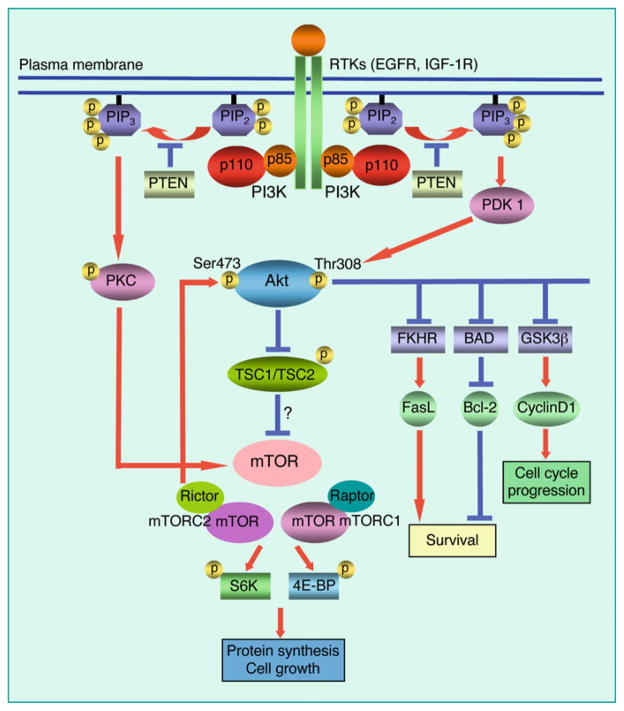
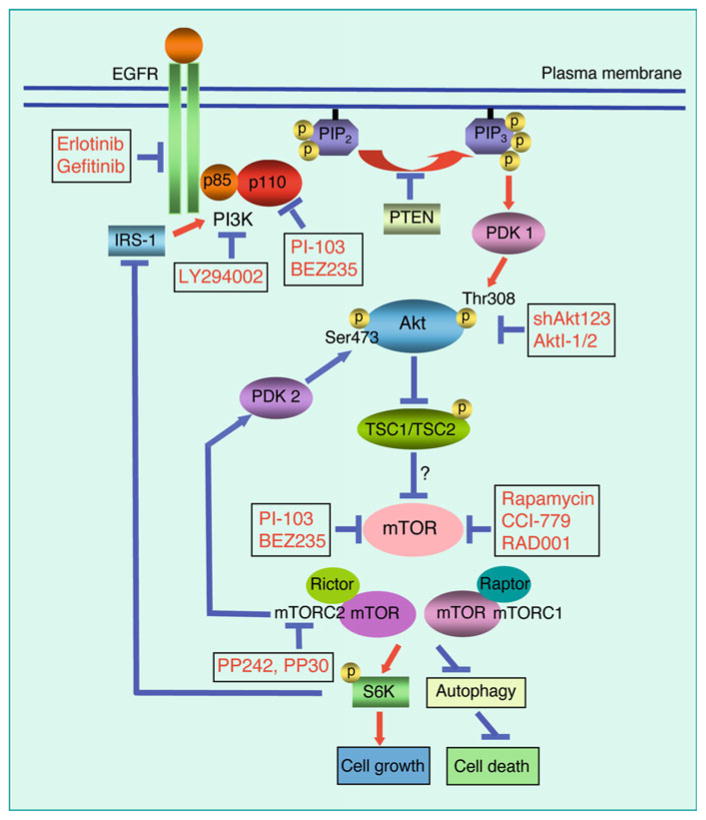
Gliomas represent the most common primary brain tumor and among the most aggressive of cancers. Patients with glioma typically relapse within a year of initial diagnosis. Recurrent glioma is associated with acquired therapeutic resistance. Although neurosurgical resection, radiation and chemotherapy provide clear benefit, survival remains disappointing. It is, therefore, critical that we identify effective medical therapies and appropriate tumor biomarkers in patients at initial presentation, to promote durable responses in glioma. Pathways linking receptor tyrosine kinases, PI3 kinase, Akt, and mTOR feature prominently in this disease and represent therapeutic targets. Small molecules that inhibit one or more of these kinases are now being introduced into the clinic and may have some activity. Disappointingly, however, preclinical studies demonstrate these agents to be primarily cytostatic rather than cytotoxic to glioma cells. Here, we detail activation of the EGFR-PI3K-Akt-mTOR signaling network in glioma, review class I PI3K inhibitors, discuss roles for Akt, PKC and mTOR, and the importance of biomarkers. We further delineate attempts to target both single and multiple components within the EGFR-PI3K-Akt-mTOR axes. Lastly, we discuss the need to combine targeted therapies with cytotoxic chemotherapy, radiation and with inhibitors of survival signaling to improve outcomes in glioma.
神经胶质瘤是最常见的原发性脑肿瘤,也是最具侵袭性的癌症之一。神经胶质瘤患者通常在初次诊断后的一年内复发。复发性神经胶质瘤与获得性治疗耐药有关。尽管神经外科手术切除、放疗和化疗有明确的疗效,但患者的生存预后仍然较差。因此,在初次就诊时,我们必须确定有效的治疗方法和合适的肿瘤生物标志物,以促进神经胶质瘤的持久缓解。受体酪氨酸激酶、PI3 激酶、Akt 和 mTOR 通路在这种疾病中起着重要作用,是治疗的靶点。现在已经有一些能够抑制这些激酶中的一个或多个激酶的小分子药物被引入临床,并可能具有一定的疗效。然而,令人失望的是,临床前研究表明这些药物对神经胶质瘤细胞主要是细胞抑制作用,而不是细胞毒性作用。在这里,我们详细描述了 EGFR-PI3K-Akt-mTOR 信号网络在神经胶质瘤中的激活,综述了 I 类 PI3K 抑制剂,讨论了 Akt、PKC 和 mTOR 的作用以及生物标志物的重要性。我们进一步详细描述了靶向 EGFR-PI3K-Akt-mTOR 轴的单个和多个成分的尝试。最后,我们讨论了将靶向治疗与细胞毒性化疗、放疗以及生存信号抑制剂相结合,以改善神经胶质瘤患者预后的必要性。