Department of Medical Decision Making, Leiden University Medical Center, Leiden, The Netherlands.
Respir Res. 2010 Jun 10;11(1):74. doi: 10.1186/1465-9921-11-74.
Internet-based self-management has shown to improve asthma control and asthma related quality of life, but the improvements were only marginally clinically relevant for the group as a whole. We hypothesized that self-management guided by weekly monitoring of asthma control tailors pharmacological therapy to individual needs and improves asthma control for patients with partly controlled or uncontrolled asthma.
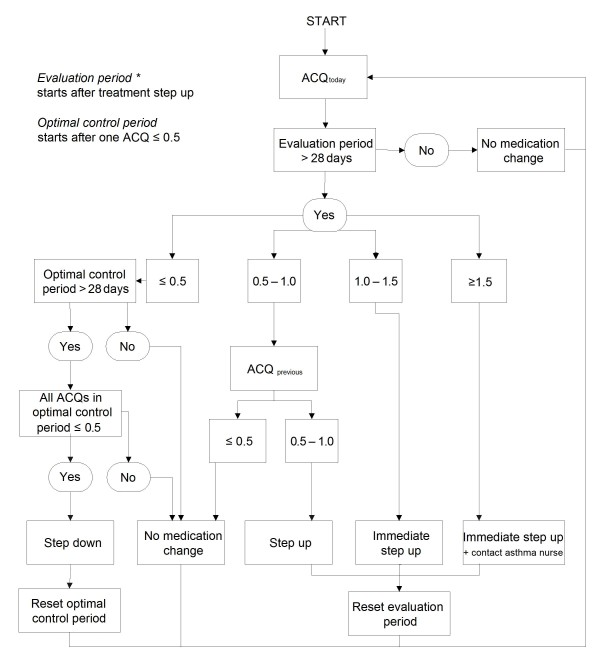
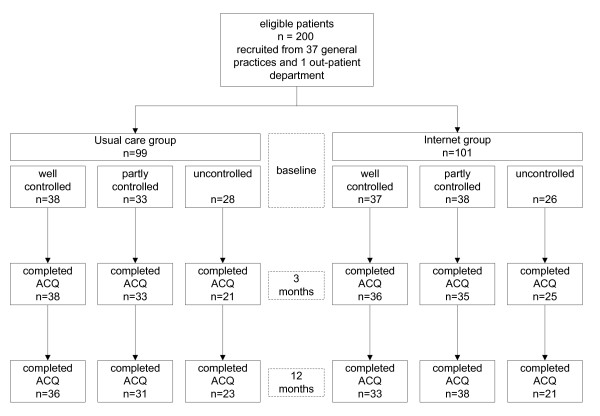
In a 1-year randomised controlled trial involving 200 adults (18-50 years) with mild to moderate persistent asthma we evaluated the adherence with weekly monitoring and effect on asthma control and pharmacological treatment of a self-management algorithm based on the Asthma Control Questionnaire (ACQ). Participants were assigned either to the Internet group (n = 101) that monitored asthma control weekly with the ACQ on the Internet and adjusted treatment using a self-management algorithm supervised by an asthma nurse specialist or to the usual care group (UC) (n = 99). We analysed 3 subgroups: patients with well controlled (ACQ <or= 0.75), partly controlled (0.75>ACQ <or= 1.5) or uncontrolled (ACQ>1.5) asthma at baseline.
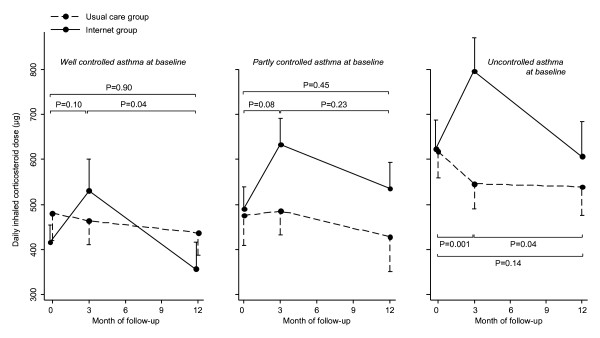
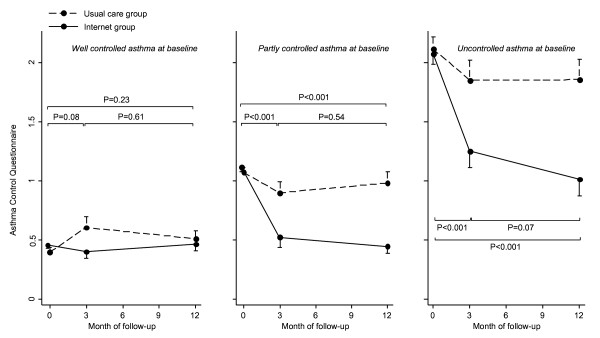
Overall monitoring adherence was 67% (95% CI, 60% to 74%). Improvements in ACQ score after 12 months were -0.14 (p = 0.23), -0.52 (p < 0.001) and -0.82 (p < 0.001) in the Internet group compared to usual care for patients with well, partly and uncontrolled asthma at baseline, respectively. Daily inhaled corticosteroid dose significantly increased in the Internet group compared to usual care in the first 3 months in patients with uncontrolled asthma (+278 microg, p = 0.001), but not in patients with well or partly controlled asthma. After one year there were no differences in daily inhaled corticosteroid use or long-acting beta2-agonists between the Internet group and usual care.
Weekly self-monitoring and subsequent treatment adjustment leads to improved asthma control in patients with partly and uncontrolled asthma at baseline and tailors asthma medication to individual patients' needs.
基于互联网的自我管理已被证明可以改善哮喘控制和哮喘相关生活质量,但总体而言,改善程度仅具有轻微的临床意义。我们假设,通过每周监测哮喘控制来指导的自我管理可以根据个人需求调整药物治疗,从而改善部分控制或未控制的哮喘患者的哮喘控制。
在一项涉及 200 名(18-50 岁)轻度至中度持续性哮喘成人的为期 1 年的随机对照试验中,我们评估了每周通过哮喘控制问卷(ACQ)进行哮喘控制自我监测的依从性,以及基于哮喘控制问卷的自我管理算法对哮喘控制和药物治疗的影响。参与者被分配到互联网组(n=101)或常规护理组(UC)(n=99)。互联网组每周通过互联网使用哮喘控制问卷监测哮喘控制情况,并通过哮喘专科护士监督的自我管理算法调整治疗方案;UC 组则接受常规护理。我们分析了 3 个亚组:基线时哮喘控制良好(ACQ≤0.75)、部分控制(0.75<ACQ<1.5)或未控制(ACQ>1.5)的患者。
总体监测依从率为 67%(95%CI,60%-74%)。在基线时哮喘控制良好、部分控制和未控制的患者中,12 个月后 ACQ 评分的改善分别为 -0.14(p=0.23)、-0.52(p<0.001)和 -0.82(p<0.001),互联网组优于 UC 组。在未控制哮喘患者中,与 UC 组相比,互联网组在前 3 个月中每日吸入皮质激素剂量显著增加(+278μg,p=0.001),但在哮喘控制良好或部分控制的患者中没有差异。一年后,互联网组与 UC 组之间在每日吸入皮质激素使用或长效β2-激动剂方面没有差异。
每周自我监测和随后的治疗调整可改善基线时部分控制和未控制哮喘患者的哮喘控制,并根据患者的个体需求调整哮喘药物治疗。