Department of Orthopaedics, University Medical Center Utrecht, Heidelberglaan 100, 3584 CX Utrecht, The Netherlands.
Arthritis Res Ther. 2010;12(3):R114. doi: 10.1186/ar3050. Epub 2010 Jun 10.
Intraarticular administration of autologous conditioned serum (ACS) recently demonstrated some clinical effectiveness in treatment of osteoarthritis (OA). The current study aims to evaluate the in vitro effects of ACS on cartilage proteoglycan (PG) metabolism, its composition and the effects on synovial fluid (SF) cytokine levels following intraarticular ACS administration.
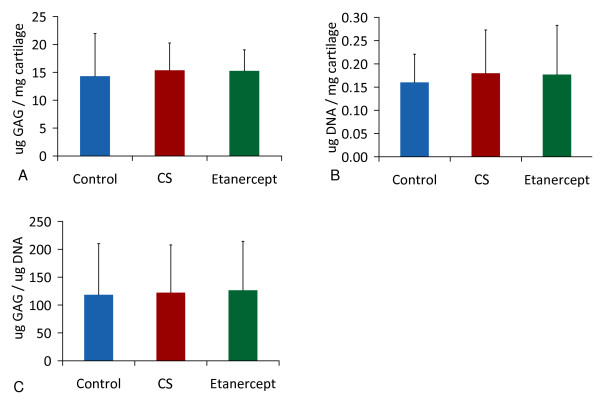
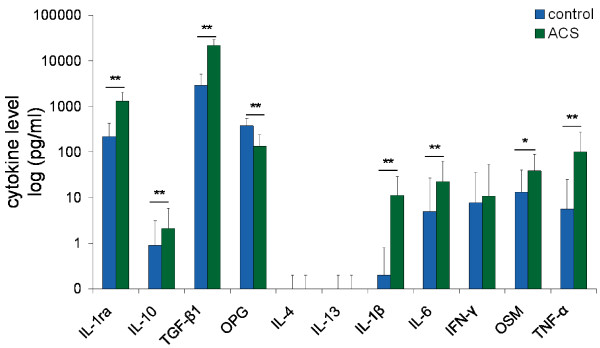
The effect of conditioned serum on PG metabolism of cultured OA cartilage explants was compared to unconditioned serum. The effect of serum conditioning on levels of interleukin-1beta (IL-1beta), IL-4, IL-6, IL-10, IL-13, interferon gamma (IFN-gamma), tumor necrosis factor alpha (TNF-alpha), osteoprotegerin (OPG), oncostatin M (OSM), interleukin-1 receptor (IL-1ra) and transforming growth factor beta (TGF-beta) were measured by multiplex ELISA. As TNF-alpha levels were found to be increased in conditioned serum, the effect of TNF-alpha inhibition by etanercept on PG metabolism was studied in cartilage explants cultured in the presence of conditioned serum. Furthermore, cytokine levels in SF were measured three days after intraarticular ACS injection in OA patients to verify their retention time in the joint space.
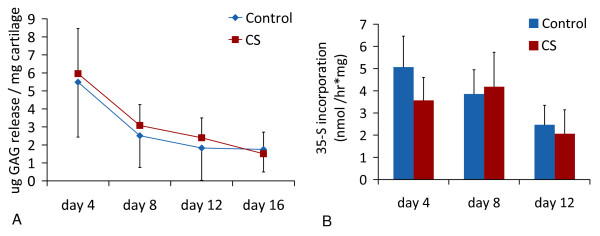
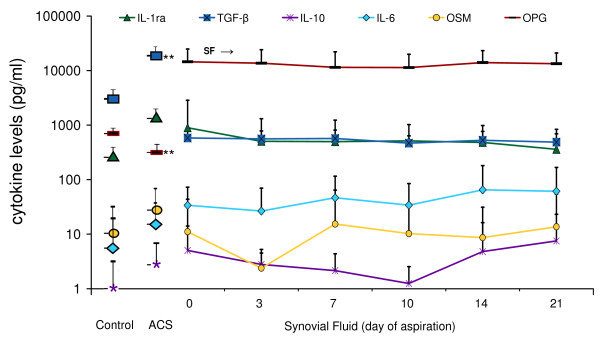
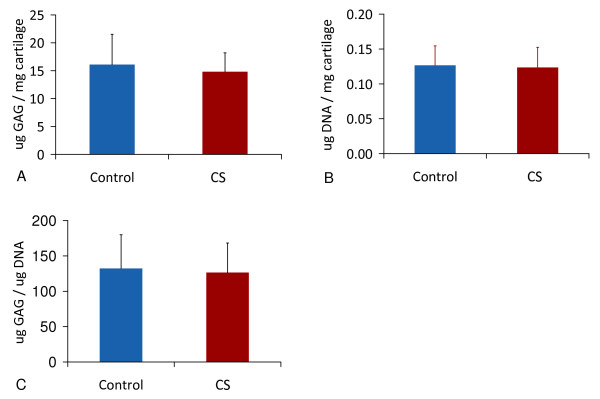
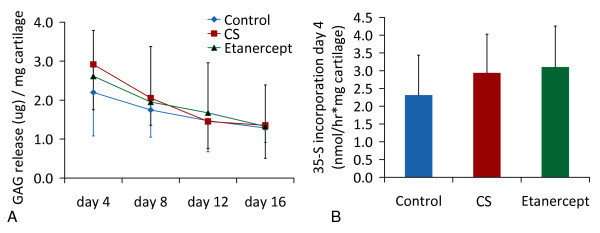
PG metabolism was not different in the presence of conditioned serum compared to unconditioned serum. Levels of the anti-inflammatory cytokines IL-1ra, TGF-beta, IL-10 as well as of pro-inflammatory cytokines IL-1beta, IL-6, TNF-alpha and OSM were increased. IL-4, IL-13 and IFN-gamma levels remained similar, while OPG levels decreased. TNF-alpha inhibition did not influence PG metabolism in cartilage explant culture in the presence of conditioned serum. Although OPG levels were higher and TGF-beta levels were clearly lower in ACS than in SF, intraarticular ACS injection in OA patients did not result in significant changes in these cytokine levels.
ACS for treatment of osteoarthritis contains increased levels of anti-inflammatory as well as pro-inflammatory cytokines, in particular TNF-alpha, but conditioned serum does not seem to have a net direct effect on cartilage metabolism, even upon inhibition of TNF-alpha. The fast intraarticular clearance of cytokines in the injected ACS may explain the limited effects found previously in vivo.
关节内注射自体条件培养液(ACS)最近在治疗骨关节炎(OA)方面显示出一些临床疗效。本研究旨在评估 ACS 对软骨蛋白聚糖(PG)代谢、其组成的体外影响,以及 ACS 关节内注射后对滑液(SF)细胞因子水平的影响。
比较条件培养液对培养的 OA 软骨标本 PG 代谢的影响与未条件培养液的影响。通过多重 ELISA 法测量血清培养条件对白细胞介素-1β(IL-1β)、IL-4、IL-6、IL-10、IL-13、干扰素γ(IFN-γ)、肿瘤坏死因子-α(TNF-α)、护骨素(OPG)、肿瘤坏死因子受体(IL-1ra)和转化生长因子β(TGF-β)水平的影响。由于条件培养液中 TNF-α 水平升高,故研究了在条件培养液中培养的软骨标本中 TNF-α 抑制(依那西普)对 PG 代谢的影响。此外,还测量了 OA 患者关节内注射 ACS 3 天后 SF 中的细胞因子水平,以验证它们在关节腔内的保留时间。
与未条件培养液相比,PG 代谢在条件培养液中没有差异。抗炎细胞因子 IL-1ra、TGF-β、IL-10 以及促炎细胞因子 IL-1β、IL-6、TNF-α 和 OSM 的水平升高。IL-4、IL-13 和 IFN-γ 水平保持不变,而 OPG 水平下降。在条件培养液中培养的软骨标本中,TNF-α 抑制并不影响 PG 代谢。尽管 ACS 中的 OPG 水平较高,TGF-β 水平明显较低,但 OA 患者关节内注射 ACS 并未导致这些细胞因子水平显著变化。
用于治疗骨关节炎的 ACS 含有较高水平的抗炎和促炎细胞因子,特别是 TNF-α,但条件血清似乎对软骨代谢没有直接的净影响,即使抑制 TNF-α 也是如此。注射 ACS 中细胞因子的快速关节内清除可能解释了之前在体内发现的有限作用。