Division of Medicinal Chemistry, Leiden/Amsterdam Center for Drug Research, Leiden University, 2333CC, The Netherlands.
BMC Bioinformatics. 2010 Jun 10;11:316. doi: 10.1186/1471-2105-11-316.
G protein-coupled receptors (GPCRs) represent a family of well-characterized drug targets with significant therapeutic value. Phylogenetic classifications may help to understand the characteristics of individual GPCRs and their subtypes. Previous phylogenetic classifications were all based on the sequences of receptors, adding only minor information about the ligand binding properties of the receptors. In this work, we compare a sequence-based classification of receptors to a ligand-based classification of the same group of receptors, and evaluate the potential to use sequence relatedness as a predictor for ligand interactions thus aiding the quest for ligands of orphan receptors.
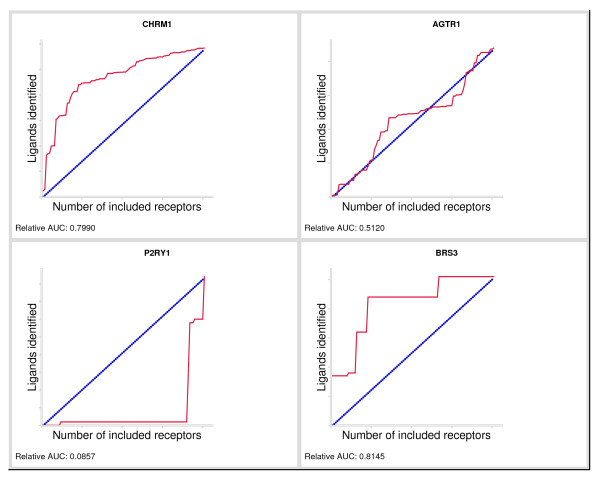
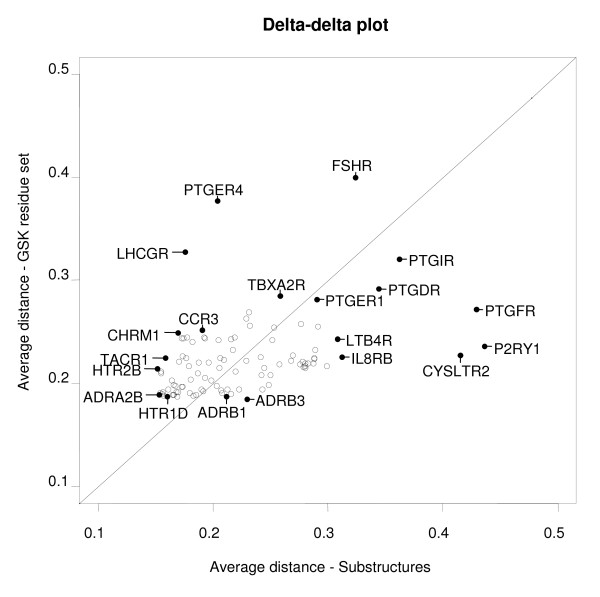
We present a classification of GPCRs that is purely based on their ligands, complementing sequence-based phylogenetic classifications of these receptors. Targets were hierarchically classified into phylogenetic trees, for both sequence space and ligand (substructure) space. The overall organization of the sequence-based tree and substructure-based tree was similar; in particular, the adenosine receptors cluster together as well as most peptide receptor subtypes (e.g. opioid, somatostatin) and adrenoceptor subtypes. In ligand space, the prostanoid and cannabinoid receptors are more distant from the other targets, whereas the tachykinin receptors, the oxytocin receptor, and serotonin receptors are closer to the other targets, which is indicative for ligand promiscuity. In 93% of the receptors studied, de-orphanization of a simulated orphan receptor using the ligands of related receptors performed better than random (AUC > 0.5) and for 35% of receptors de-orphanization performance was good (AUC > 0.7).
We constructed a phylogenetic classification of GPCRs that is solely based on the ligands of these receptors. The similarities and differences with traditional sequence-based classifications were investigated: our ligand-based classification uncovers relationships among GPCRs that are not apparent from the sequence-based classification. This will shed light on potential cross-reactivity of GPCR ligands and will aid the design of new ligands with the desired activity profiles. In addition, we linked the ligand-based classification with a ligand-focused sequence-based classification described in literature and proved the potential of this method for de-orphanization of GPCRs.
G 蛋白偶联受体(GPCR)是一组经过充分研究的药物靶点,具有重要的治疗价值。系统发生分类有助于了解单个 GPCR 及其亚型的特征。以前的系统发生分类都是基于受体序列,仅添加了有关受体配体结合特性的少量信息。在这项工作中,我们将受体的序列分类与同一组受体的基于配体的分类进行了比较,并评估了将序列相关性用作预测配体相互作用的可能性,从而有助于寻找孤儿受体的配体。
我们提出了一种完全基于配体的 GPCR 分类方法,补充了这些受体的基于序列的系统发生分类。将目标分为基于序列的树和基于配体(亚结构)的树的层次结构。基于序列的树和基于亚结构的树的整体组织相似;特别是,腺苷受体以及大多数肽受体亚型(例如阿片样物质、生长抑素)和肾上腺素受体亚型聚集在一起。在配体空间中,前列腺素和大麻素受体与其他靶标相距较远,而速激肽受体、催产素受体和 5-羟色胺受体与其他靶标较近,这表明配体的混杂性。在所研究的 93%的受体中,使用相关受体的配体对模拟孤儿受体进行去孤儿化的效果优于随机(AUC>0.5),并且对于 35%的受体,去孤儿化性能良好(AUC>0.7)。
我们构建了一种完全基于这些受体配体的 GPCR 系统发生分类。研究了与传统基于序列的分类的相似性和差异:我们的基于配体的分类揭示了基于序列的分类中不明显的 GPCR 之间的关系。这将揭示 GPCR 配体的潜在交叉反应性,并有助于设计具有所需活性谱的新型配体。此外,我们将基于配体的分类与文献中描述的基于配体的序列分类联系起来,并证明了该方法对 GPCR 去孤儿化的潜力。