IBB/CGB - Universidade do Algarve, Campus de Gambelas, 8005-139 FARO Portugal.
Genet Sel Evol. 2010 Jun 11;42(1):18. doi: 10.1186/1297-9686-42-18.
Decisions to initiate conservation programmes need to account for extant variability, diversity loss and cultural and economic aspects. Molecular markers were used to investigate if putative Algarvia animals could be identified for use as progenitors in a breeding programme to recover this nearly extinct breed.
46 individuals phenotypically representative of Algarvia cattle were genotyped for 27 microsatellite loci and compared with 11 Portuguese autochthonous and three imported breeds. Genetic distances and factorial correspondence analyses (FCA) were performed to investigate the relationship among Algarvia and related breeds. Assignment tests were done to identify representative individuals of the breed. Y chromosome and mtDNA analyses were used to further characterize Algarvia animals. Gene- and allelic-based conservation analyses were used to determine breed contributions to overall genetic diversity.
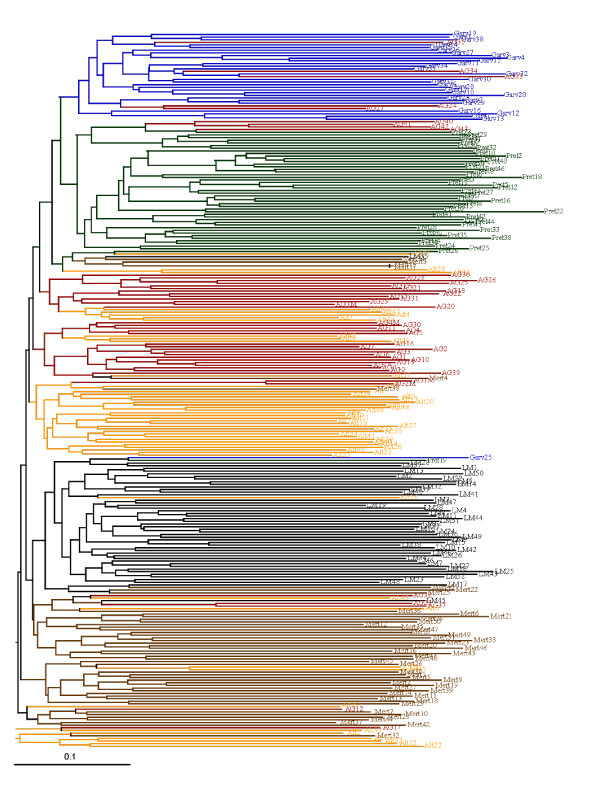
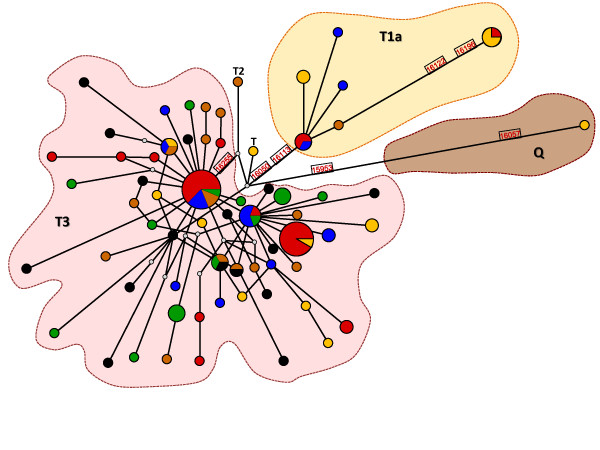
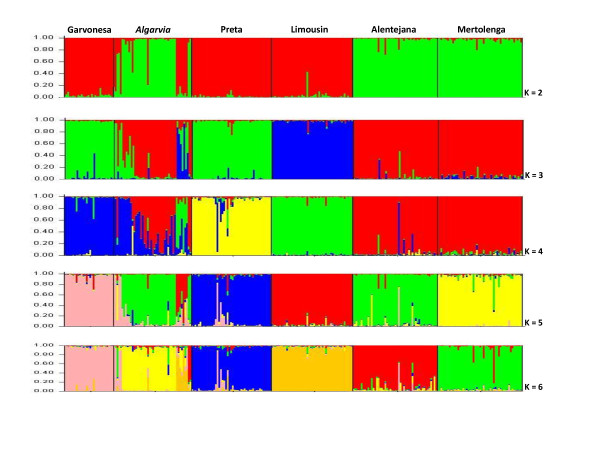
Genetic distance and FCA results confirmed the close relationship between Algarvia and southern Portuguese breeds. Assignment tests without breed information classified 17 Algarvia animals in this cluster with a high probability (q > 0.95). With breed information, 30 cows and three bulls were identified (q > 0.95) that could be used to reconstitute the Algarvia breed. Molecular and morphological results were concordant. These animals showed intermediate levels of genetic diversity (MNA = 6.0 +/- 1.6, Rt = 5.7 +/- 1.4, Ho = 0.63 +/- 0.19 and He = 0.69 +/- 0.10) relative to other Portuguese breeds. Evidence of inbreeding was also detected (Fis = 0.083, P < 0.001). The four Algarvia bulls had Y-haplotypes H6Y2 and H11Y2, common in Portuguese cattle. The mtDNA composition showed prevalence of T3 matrilines and presence of the African-derived T1a haplogroup. This analysis confirmed the genetic proximity of Algarvia and Garvonesa breeds (Fst = 0.028, P > 0.05). Algarvia cattle provide an intermediate contribution (CB = 6.18, CW = -0.06 and D1 = 0.50) to the overall gene diversity of Portuguese cattle. Algarvia and seven other autochthonous breeds made no contribution to the overall allelic diversity.
Molecular analyses complemented previous morphological findings to identify 33 animals that can be considered remnants of the Algarvia breed. Results of genetic diversity and conservation analyses provide objective information to establish a management program to reconstitute the Algarvia breed.
启动保护计划需要考虑现存的变异性、多样性损失以及文化和经济方面。分子标记被用于研究假定的 Algarvia 动物是否可以被确定为繁殖计划的祖本来恢复这个几乎灭绝的品种。
46 只表型上代表 Algarvia 牛的个体被用于 27 个微卫星标记的基因型分析,并与 11 个葡萄牙本土品种和 3 个进口品种进行比较。遗传距离和因子对应分析(FCA)用于研究 Algarvia 与相关品种之间的关系。分配测试用于识别该品种的代表性个体。Y 染色体和 mtDNA 分析用于进一步描述 Algarvia 动物。基于基因和等位基因的保护分析用于确定品种对总体遗传多样性的贡献。
遗传距离和 FCA 结果证实了 Algarvia 与葡萄牙南部品种之间的密切关系。在没有品种信息的情况下,分配测试将 17 只 Algarvia 动物归类为这个群体,概率很高(q > 0.95)。有了品种信息,有 30 头母牛和 3 头公牛被确定(q > 0.95),可以用来重建 Algarvia 品种。分子和形态学结果是一致的。这些动物表现出中等水平的遗传多样性(MNA = 6.0 +/- 1.6,Rt = 5.7 +/- 1.4,Ho = 0.63 +/- 0.19 和 He = 0.69 +/- 0.10),与其他葡萄牙品种相比。也检测到近亲繁殖的证据(Fis = 0.083,P < 0.001)。四只 Algarvia 公牛具有 H6Y2 和 H11Y2 等 Y 染色体单倍型,在葡萄牙牛中常见。mtDNA 组成显示 T3 母系的流行和非洲衍生的 T1a 单倍群的存在。该分析证实了 Algarvia 和 Garvonesa 品种之间的遗传亲缘关系(Fst = 0.028,P > 0.05)。Algarvia 牛对葡萄牙牛的总体基因多样性有中等贡献(CB = 6.18,CW = -0.06 和 D1 = 0.50)。Algarvia 和其他七个本土品种对总体等位基因多样性没有贡献。
分子分析补充了先前的形态学发现,确定了 33 只可以被认为是 Algarvia 品种残余的动物。遗传多样性和保护分析的结果提供了客观的信息,以建立一个管理计划来重建 Algarvia 品种。