van Asch Barbara, Pereira Luísa, Pereira Filipe, Santa-Rita Pedro, Lima Manuela, Amorim António
Instituto de Patologia e Imunologia Molecular da Universidade do Porto (IPATIMUP), Portugal.
BMC Genet. 2005 Jun 22;6:37. doi: 10.1186/1471-2156-6-37.
The picture of dog mtDNA diversity, as obtained from geographically wide samplings but from a small number of individuals per region or breed, has revealed weak geographic correlation and high degree of haplotype sharing between very distant breeds. We aimed at a more detailed picture through extensive sampling (n = 143) of four Portuguese autochthonous breeds - Castro Laboreiro Dog, Serra da Estrela Mountain Dog, Portuguese Sheepdog and Azores Cattle Dog-and comparatively reanalysing published worldwide data.
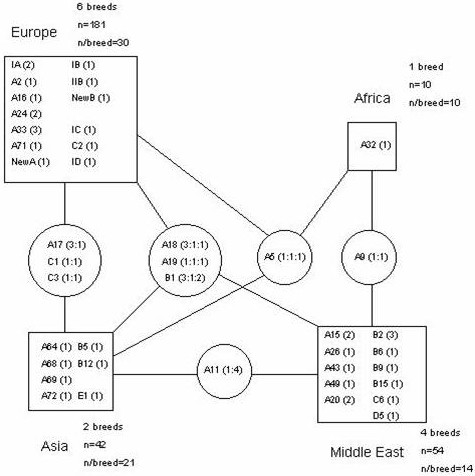
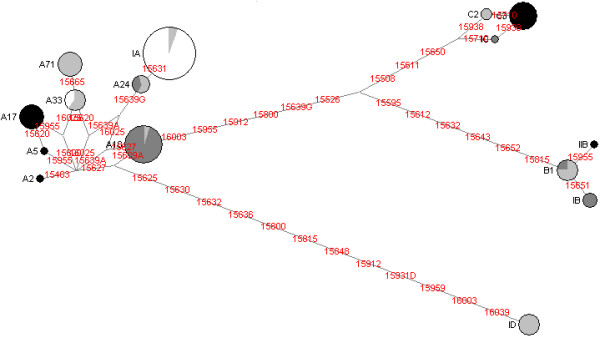
Fifteen haplotypes belonging to four major haplogroups were found in these breeds, of which five are newly reported. The Castro Laboreiro Dog presented a 95% frequency of a new A haplotype, while all other breeds contained a diverse pool of existing lineages. The Serra da Estrela Mountain Dog, the most heterogeneous of the four Portuguese breeds, shared haplotypes with the other mainland breeds, while Azores Cattle Dog shared no haplotypes with the other Portuguese breeds.A review of mtDNA haplotypes in dogs across the world revealed that: (a) breeds tend to display haplotypes belonging to different haplogroups; (b) haplogroup A is present in all breeds, and even uncommon haplogroups are highly dispersed among breeds and continental areas; (c) haplotype sharing between breeds of the same region is lower than between breeds of different regions and (d) genetic distances between breeds do not correlate with geography.
MtDNA haplotype sharing occurred between Serra da Estrela Mountain dogs (with putative origin in the centre of Portugal) and two breeds in the north and south of the country-with the Castro Laboreiro Dog (which behaves, at the mtDNA level, as a sub-sample of the Serra da Estrela Mountain Dog) and the southern Portuguese Sheepdog. In contrast, the Azores Cattle Dog did not share any haplotypes with the other Portuguese breeds, but with dogs sampled in Northern Europe. This suggested that the Azores Cattle Dog descended maternally from Northern European dogs rather than Portuguese mainland dogs. A review of published mtDNA haplotypes identified thirteen non-Portuguese breeds with sufficient data for comparison. Comparisons between these thirteen breeds, and the four Portuguese breeds, demonstrated widespread haplotype sharing, with the greatest diversity among Asian dogs, in accordance with the central role of Asia in canine domestication.
通过在地理上广泛采样,但每个地区或品种的个体数量较少,所获得的犬线粒体DNA(mtDNA)多样性图谱显示出地理相关性较弱,且相距甚远的品种之间单倍型共享程度较高。我们旨在通过对四个葡萄牙本土品种——卡斯特罗·拉博雷罗犬、埃什特雷拉山犬、葡萄牙牧羊犬和亚速尔牧牛犬——进行广泛采样(n = 143),并对已发表的全球数据进行比较重新分析,以获得更详细的图谱。
在这些品种中发现了属于四个主要单倍群的15种单倍型,其中5种是新报道的。卡斯特罗·拉博雷罗犬中一种新的A单倍型频率为95%,而所有其他品种包含多种现有的谱系。埃什特雷拉山犬是四个葡萄牙品种中最具异质性的,它与其他大陆品种共享单倍型,而亚速尔牧牛犬与其他葡萄牙品种没有共享单倍型。对全球犬类mtDNA单倍型的综述表明:(a)品种倾向于显示属于不同单倍群的单倍型;(b)A单倍群存在于所有品种中,甚至不常见的单倍群在品种和大陆地区之间也高度分散;(c)同一地区品种之间的单倍型共享低于不同地区品种之间的单倍型共享;(d)品种之间的遗传距离与地理不相关。
埃什特雷拉山犬(推测起源于葡萄牙中部)与该国北部和南部的两个品种——卡斯特罗·拉博雷罗犬(在mtDNA水平上表现为埃什特雷拉山犬的一个子样本)和葡萄牙南部牧羊犬——之间存在mtDNA单倍型共享。相比之下,亚速尔牧牛犬与其他葡萄牙品种没有共享任何单倍型,但与在北欧采样的数据共享。这表明亚速尔牧牛犬在母系上起源于北欧犬类而非葡萄牙大陆犬类。对已发表的mtDNA单倍型的综述确定了13个有足够数据进行比较的非葡萄牙品种。这13个品种与四个葡萄牙品种之间的比较表明存在广泛的单倍型共享,亚洲犬类的多样性最大,这与亚洲在犬类驯化中的核心作用一致。