Centro de Biologia Ambiental, Faculdade de Ciências, Universidade de Lisboa, Lisboa, Portugal.
Genet Sel Evol. 2013 Sep 30;45(1):35. doi: 10.1186/1297-9686-45-35.
Determining the value of livestock breeds is essential to define conservation priorities, manage genetic diversity and allocate funds. Within- and between-breed genetic diversity need to be assessed to preserve the highest intra-specific variability. Information on genetic diversity and risk status is still lacking for many Creole cattle breeds from the Americas, despite their distinct evolutionary trajectories and adaptation to extreme environmental conditions.
A comprehensive genetic analysis of 67 Iberoamerican cattle breeds was carried out with 19 FAO-recommended microsatellites to assess conservation priorities. Contributions to global diversity were investigated using alternative methods, with different weights given to the within- and between-breed components of genetic diversity. Information on Iberoamerican plus 15 worldwide cattle breeds was used to investigate the contribution of geographical breed groups to global genetic diversity.
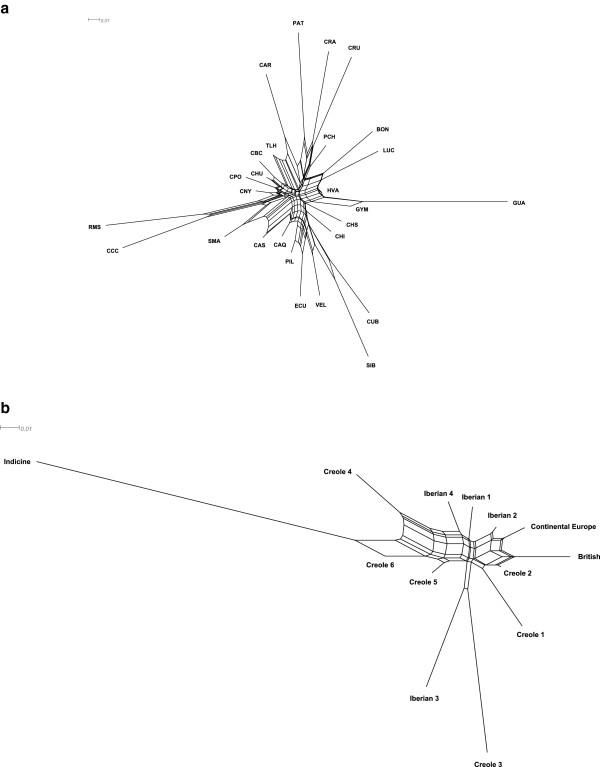
Overall, Creole cattle breeds showed a high level of genetic diversity with the highest level found in breeds admixed with zebu cattle, which were clearly differentiated from all other breeds. Within-breed kinships revealed seven highly inbred Creole breeds for which measures are needed to avoid further genetic erosion. However, if contribution to heterozygosity was the only criterion considered, some of these breeds had the lowest priority for conservation decisions. The Weitzman approach prioritized highly differentiated breeds, such as Guabalá, Romosinuano, Cr. Patagonico, Siboney and Caracú, while kinship-based methods prioritized mainly zebu-related breeds. With the combined approaches, breed ranking depended on the weights given to the within- and between-breed components of diversity. Overall, the Creole groups of breeds were generally assigned a higher priority for conservation than the European groups of breeds.
Conservation priorities differed significantly according to the weight given to within- and between-breed genetic diversity. Thus, when establishing conservation programs, it is necessary to also take into account other features. Creole cattle and local isolated breeds retain a high level of genetic diversity. The development of sustainable breeding and crossbreeding programs for Creole breeds, and the added value resulting from their products should be taken into consideration to ensure their long-term survival.
确定家畜品种的价值对于确定保护重点、管理遗传多样性和分配资金至关重要。为了保留最高的种内变异性,需要评估品种内和品种间的遗传多样性。尽管美洲的克里奥尔牛品种具有独特的进化轨迹和对极端环境条件的适应能力,但它们的遗传多样性和风险状况信息仍然缺乏。
利用 19 个粮农组织推荐的微卫星对 67 个伊比利亚美洲牛品种进行了全面的遗传分析,以评估保护重点。利用替代方法研究了对全球多样性的贡献,其中对遗传多样性的品种内和品种间成分赋予不同的权重。利用伊比利亚美洲加 15 个世界牛品种的信息,研究了地理品种群体对全球遗传多样性的贡献。
总体而言,克里奥尔牛品种表现出高水平的遗传多样性,与瘤牛杂交的品种遗传多样性最高,与所有其他品种明显不同。品种内亲缘关系揭示了 7 个高度近交的克里奥尔品种,需要采取措施避免进一步的遗传侵蚀。然而,如果对杂合度的贡献是唯一考虑的标准,那么其中一些品种在保护决策中的优先级最低。Weitzman 方法优先考虑高度分化的品种,如 Guabalá、Romosinuano、Cr. Patagonico、Siboney 和 Caracú,而基于亲缘关系的方法则优先考虑主要与瘤牛相关的品种。综合使用这两种方法,品种的排名取决于对多样性的品种内和品种间成分赋予的权重。总体而言,与欧洲品种相比,克里奥尔品种群体通常被赋予更高的保护优先级。
根据品种内和品种间遗传多样性的权重不同,保护重点有显著差异。因此,在制定保护计划时,还需要考虑其他因素。克里奥尔牛和当地孤立的品种保留了高水平的遗传多样性。应考虑制定可持续的克里奥尔品种繁殖和杂交计划,以及从其产品中获得的附加值,以确保其长期生存。