• 文献检索
  • 文档翻译
  • 深度研究
  • 学术资讯
  • Suppr Zotero 插件Zotero 插件
  • 邀请有礼
  • 套餐&价格
  • 历史记录
应用&插件
Suppr Zotero 插件Zotero 插件浏览器插件Mac 客户端Windows 客户端微信小程序
定价
高级版会员购买积分包购买API积分包
服务
文献检索文档翻译深度研究API 文档MCP 服务
关于我们
关于 Suppr公司介绍联系我们用户协议隐私条款
关注我们

Suppr 超能文献

核心技术专利:CN118964589B侵权必究
粤ICP备2023148730 号-1Suppr @ 2026

文献检索

告别复杂PubMed语法,用中文像聊天一样搜索,搜遍4000万医学文献。AI智能推荐,让科研检索更轻松。

立即免费搜索

文件翻译

保留排版,准确专业,支持PDF/Word/PPT等文件格式,支持 12+语言互译。

免费翻译文档

深度研究

AI帮你快速写综述,25分钟生成高质量综述,智能提取关键信息,辅助科研写作。

立即免费体验

膝关节骨关节炎患者向前与向后下楼梯方式对膝关节力的影响:一项临床对照研究。

Effects of methods of descending stairs forwards versus backwards on knee joint force in patients with osteoarthritis of the knee: a clinical controlled study.

作者信息

Hasegawa Masaki, Chin Takaaki, Oki Sadaaki, Kanai Shusaku, Shimatani Koji, Shimada Tomoaki

机构信息

Department of Physical Therapy, Faculty of Health and Welfare, Prefectural University of Hiroshima, 1-1 Gakuen-cho, Mihara City, Hiroshima 723-0053, Japan.

Department of Rehabilitation Science, Kobe University Graduate School of Medicine, 7-10-2 Tomogaoka, Suma-ku, Kobe City, Hyogo 654-0142, Japan.

出版信息

Sports Med Arthrosc Rehabil Ther Technol. 2010 Jun 11;2:14. doi: 10.1186/1758-2555-2-14.

DOI:10.1186/1758-2555-2-14
PMID:20540753
原文链接:https://pmc.ncbi.nlm.nih.gov/articles/PMC2894014/
Abstract

BACKGROUND

The aim of this study was to investigate the kinetic characteristics of compensatory backward descending movement performed by patients with osteoarthritis of the knee.

METHODS

Using a three-dimensional motion analysis system, we investigated lower extremity joint angles, joint moments, joint force of the support leg in forward and backward descending movements on stairs, and joint force of the leading leg at landing in 7 female patients with osteoarthritis of the knee.

RESULTS

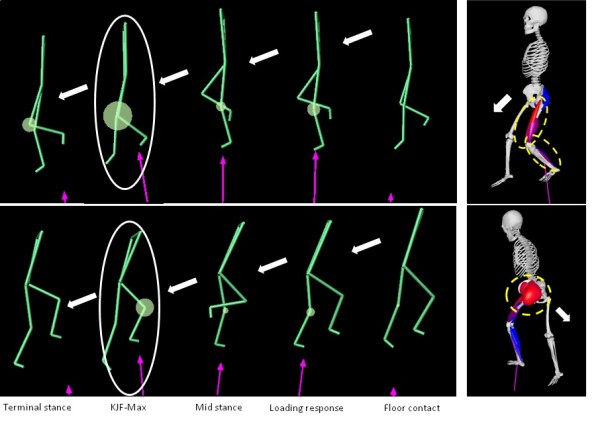
Compared with the forward descending movement, knee joint angle, joint moment and joint force of the support leg all decreased in the backward descending movement. Joint force of the leading leg at landing was also reduced in the backward descending movement. In addition, we confirmed that the center of body mass was mainly controlled by the knee and ankle joints in the forward descending movement, and by the hip joint in the backward descending movement.

CONCLUSIONS

Since it has been reported that knee flexion angle and extensor muscle strength are decreased in patients with osteoarthritis of the knee, we believe that backward descending movement is an effective method to use the hip joint to compensate for these functional defects. In addition, due to the decreased knee joint force both in the leading and support legs in backward descending movement, the effectiveness of compensatory motion for pain control and knee joint protection was also suggested.

摘要

背景

本研究旨在探究膝关节骨关节炎患者进行代偿性向后下楼梯运动的动力学特征。

方法

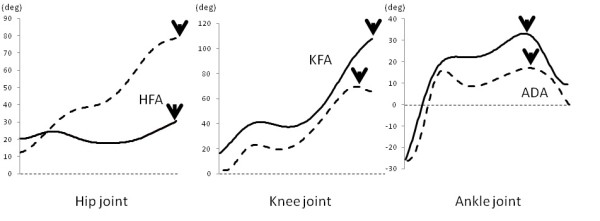
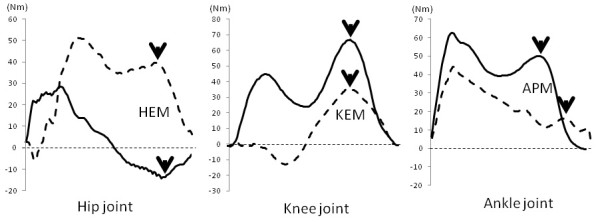
我们使用三维运动分析系统,对7名膝关节骨关节炎女性患者在下楼梯时向前和向后下楼梯运动中支撑腿的下肢关节角度、关节力矩、关节力以及着地时前导腿的关节力进行了研究。

结果

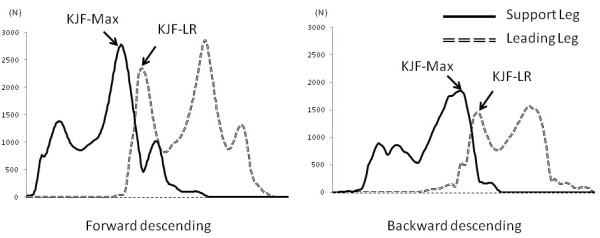
与向前下楼梯运动相比,向后下楼梯运动中支撑腿的膝关节角度、关节力矩和关节力均降低。向后下楼梯运动中着地时前导腿的关节力也降低。此外,我们证实,向前下楼梯运动中身体重心主要由膝关节和踝关节控制,而向后下楼梯运动中则由髋关节控制。

结论

鉴于已有报道称膝关节骨关节炎患者的膝关节屈曲角度和伸肌力量会降低,我们认为向后下楼梯运动是一种利用髋关节来代偿这些功能缺陷的有效方法。此外,由于向后下楼梯运动中前导腿和支撑腿的膝关节力均降低,这也提示了代偿运动在控制疼痛和保护膝关节方面的有效性。
https://cdn.ncbi.nlm.nih.gov/pmc/blobs/8d7d/2894014/ac5a1062686f/1758-2555-2-14-5.jpg
https://cdn.ncbi.nlm.nih.gov/pmc/blobs/8d7d/2894014/27c67f8cb375/1758-2555-2-14-1.jpg
https://cdn.ncbi.nlm.nih.gov/pmc/blobs/8d7d/2894014/e1a7b69efee7/1758-2555-2-14-2.jpg
https://cdn.ncbi.nlm.nih.gov/pmc/blobs/8d7d/2894014/a5427cd9b047/1758-2555-2-14-3.jpg
https://cdn.ncbi.nlm.nih.gov/pmc/blobs/8d7d/2894014/488173646fc8/1758-2555-2-14-4.jpg
https://cdn.ncbi.nlm.nih.gov/pmc/blobs/8d7d/2894014/ac5a1062686f/1758-2555-2-14-5.jpg
https://cdn.ncbi.nlm.nih.gov/pmc/blobs/8d7d/2894014/27c67f8cb375/1758-2555-2-14-1.jpg
https://cdn.ncbi.nlm.nih.gov/pmc/blobs/8d7d/2894014/e1a7b69efee7/1758-2555-2-14-2.jpg
https://cdn.ncbi.nlm.nih.gov/pmc/blobs/8d7d/2894014/a5427cd9b047/1758-2555-2-14-3.jpg
https://cdn.ncbi.nlm.nih.gov/pmc/blobs/8d7d/2894014/488173646fc8/1758-2555-2-14-4.jpg
https://cdn.ncbi.nlm.nih.gov/pmc/blobs/8d7d/2894014/ac5a1062686f/1758-2555-2-14-5.jpg

相似文献

1
Effects of methods of descending stairs forwards versus backwards on knee joint force in patients with osteoarthritis of the knee: a clinical controlled study.膝关节骨关节炎患者向前与向后下楼梯方式对膝关节力的影响:一项临床对照研究。
Sports Med Arthrosc Rehabil Ther Technol. 2010 Jun 11;2:14. doi: 10.1186/1758-2555-2-14.
2
Contributions to the understanding of gait control.对步态控制理解的贡献。
Dan Med J. 2014 Apr;61(4):B4823.
3
Mid-flight trunk flexion and extension altered segment and lower extremity joint movements and subsequent landing mechanics.飞行途中躯干屈伸改变了节段和下肢关节运动以及随后的落地力学。
J Sci Med Sport. 2019 Aug;22(8):955-961. doi: 10.1016/j.jsams.2019.03.001. Epub 2019 Mar 8.
4
Individuals With an Anterior Cruciate Ligament-Reconstructed Knee Display Atypical Whole Body Movement Strategies but Normal Knee Robustness During Side-Hop Landings: A Finite Helical Axis Analysis.前交叉韧带重建膝关节患者在侧跳落地时表现出非典型的全身运动策略,但膝关节稳定性正常:有限螺旋轴线分析。
Am J Sports Med. 2020 Apr;48(5):1117-1126. doi: 10.1177/0363546520910428. Epub 2020 Mar 13.
5
Kinetic analysis of forwards and backwards stair descent.上下楼梯的动力学分析。
Gait Posture. 2008 May;27(4):564-71. doi: 10.1016/j.gaitpost.2007.07.010. Epub 2007 Sep 6.
6
Effects of changes in skiing posture on the kinetics of the knee joint.滑雪姿势变化对膝关节动力学的影响。
Knee Surg Sports Traumatol Arthrosc. 2006 Jan;14(1):88-93. doi: 10.1007/s00167-004-0609-2. Epub 2005 May 21.
7
Single-leg hop testing following fatiguing exercise: reliability and biomechanical analysis.疲劳运动后的单腿跳跃测试:可靠性及生物力学分析
Scand J Med Sci Sports. 2006 Apr;16(2):111-20. doi: 10.1111/j.1600-0838.2005.00446.x.
8
[Kinetic mechanism of electroacupuncture for stair climbing in knee osteoarthritis patients].[电针对膝骨关节炎患者爬楼梯的动力学机制]
Zhongguo Zhen Jiu. 2017 Oct 12;37(10):1027-34. doi: 10.13703/j.0255-2930.2017.10.001.
9
Lower extremity control and dynamics during backward angular impulse generation in forward translating tasks.向前平移任务中向后角向冲量产生过程中的下肢控制与动力学
J Biomech. 2006;39(6):990-1000. doi: 10.1016/j.jbiomech.2005.02.022.
10
Biomechanical analysis of stair descent in patients with knee osteoarthritis.膝关节骨关节炎患者下楼梯的生物力学分析。
J Phys Ther Sci. 2014 May;26(5):629-31. doi: 10.1589/jpts.26.629. Epub 2014 May 29.

引用本文的文献

1
Effects of initial foot position on neuromuscular and biomechanical control during the stand-to-sit movement: Implications for rehabilitation strategies.起始足部位置对从站立到坐下动作期间神经肌肉及生物力学控制的影响:对康复策略的启示
PLoS One. 2025 Feb 14;20(2):e0315738. doi: 10.1371/journal.pone.0315738. eCollection 2025.
2
Efficacy of Mulligan joint mobilizations and trunk stabilization exercises versus isometric knee strengthening in the management of knee osteoarthritis: a randomized controlled trial.穆利根关节松动术与躯干稳定训练对比等长膝关节强化训练对膝骨关节炎的疗效:一项随机对照试验
BMC Sports Sci Med Rehabil. 2024 May 7;16(1):105. doi: 10.1186/s13102-024-00893-7.
3

本文引用的文献

1
Achieving deep flexion after primary total knee arthroplasty.实现初次全膝关节置换术后的深度屈膝。
J Arthroplasty. 2010 Feb;25(2):219-24. doi: 10.1016/j.arth.2008.11.013. Epub 2008 Dec 23.
2
Physical function and properties of quadriceps femoris muscle in men with knee osteoarthritis.膝关节骨关节炎男性患者股四头肌的身体功能及特性
Arch Phys Med Rehabil. 2008 Nov;89(11):2185-94. doi: 10.1016/j.apmr.2008.04.012.
3
Osteoarthritis.骨关节炎
[Research progress on pathological mechanism and clinical correlation between medial meniscus posterior root tear and tibial rotation].
内侧半月板后根撕裂与胫骨旋转的病理机制及临床相关性研究进展
Zhongguo Xiu Fu Chong Jian Wai Ke Za Zhi. 2024 Mar 15;38(3):368-372. doi: 10.7507/1002-1892.202311035.
4
Meniscus extrusion is a predisposing factor for determining arthroscopic treatments in partial medial meniscus posterior root tears.半月板挤出是决定部分内侧半月板后根撕裂关节镜治疗的一个诱发因素。
Knee Surg Relat Res. 2023 Mar 14;35(1):8. doi: 10.1186/s43019-023-00182-6.
5
Biomechanical analysis of stair descent in patients with knee osteoarthritis.膝关节骨关节炎患者下楼梯的生物力学分析。
J Phys Ther Sci. 2014 May;26(5):629-31. doi: 10.1589/jpts.26.629. Epub 2014 May 29.
Best Pract Res Clin Rheumatol. 2008 Aug;22(4):657-75. doi: 10.1016/j.berh.2008.07.002.
4
How critical are the tibiofemoral joint reaction forces during frequent squatting in Asian populations?在亚洲人群频繁深蹲过程中,胫股关节反应力有多关键?
Knee. 2008 Aug;15(4):286-94. doi: 10.1016/j.knee.2008.04.006. Epub 2008 Jun 4.
5
Kinetic analysis of forwards and backwards stair descent.上下楼梯的动力学分析。
Gait Posture. 2008 May;27(4):564-71. doi: 10.1016/j.gaitpost.2007.07.010. Epub 2007 Sep 6.
6
Knee osteoarthritis: influence of work involving heavy lifting, kneeling, climbing stairs or ladders, or kneeling/squatting combined with heavy lifting.膝骨关节炎:涉及重物搬运、跪姿、爬楼梯或梯子,或跪姿/蹲姿与重物搬运相结合的工作的影响。
Occup Environ Med. 2008 Feb;65(2):72-89. doi: 10.1136/oem.2007.032466. Epub 2007 Jul 18.
7
Tibiofemoral joint contact forces and knee kinematics during squatting.深蹲过程中的胫股关节接触力和膝关节运动学
Gait Posture. 2008 Apr;27(3):376-86. doi: 10.1016/j.gaitpost.2007.05.004. Epub 2007 Jun 20.
8
Experimental measurement of tibiofemoral contact area in a meniscectomized ovine model using a resistive pressure measuring sensor.使用电阻式压力测量传感器在半月板切除羊模型中对胫股接触面积进行实验测量。
Ann Biomed Eng. 2006 Oct;34(10):1607-14. doi: 10.1007/s10439-006-9200-y. Epub 2006 Sep 30.
9
Biomechanics of the knee joint in flexion under various quadriceps forces.不同股四头肌力量下膝关节屈曲时的生物力学
Knee. 2005 Dec;12(6):424-34. doi: 10.1016/j.knee.2005.03.004. Epub 2005 Jun 6.
10
Contact stresses in the knee joint in deep flexion.膝关节深度屈曲时的接触应力。
Med Eng Phys. 2005 May;27(4):329-35. doi: 10.1016/j.medengphy.2004.09.002.