Physiotherapy Unit, Department of Community Medicine and Rehabilitation, Umeå University, Umeå, Sweden.
Department of Radiation Sciences, Biomedical Engineering and Physics, Umeå University, Umeå, Sweden.
Am J Sports Med. 2020 Apr;48(5):1117-1126. doi: 10.1177/0363546520910428. Epub 2020 Mar 13.
Atypical knee joint biomechanics after anterior cruciate ligament reconstruction (ACLR) are common. It is, however, unclear whether knee robustness (ability to tolerate perturbation and maintain joint configuration) and whole body movement strategies are compromised after ACLR.
To investigate landing control after ACLR with regard to dynamic knee robustness and whole body movement strategies during sports-mimicking side hops, and to evaluate functional performance of hop tests and knee strength.
Controlled laboratory study.
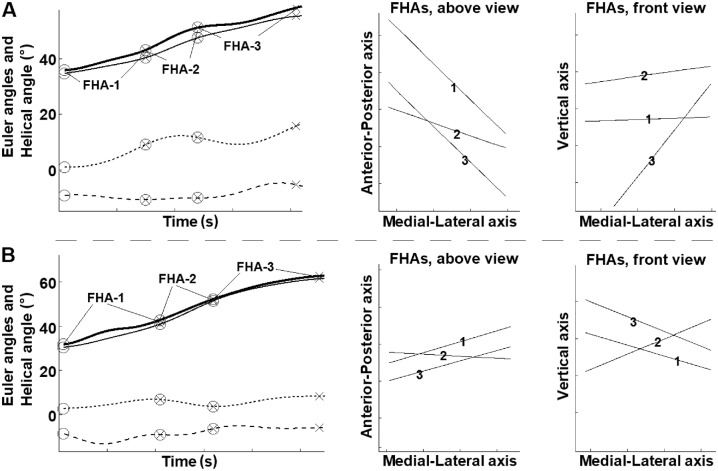
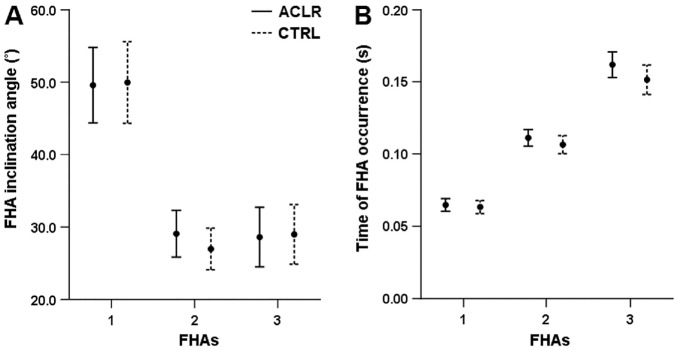
An 8-camera motion capture system and 2 synchronized force plates were used to calculate joint angles and moments during standardized rebound side-hop landings performed by 32 individuals with an ACL-reconstructed knee (ACLR group; median, 16.0 months after reconstruction with hamstring tendon graft [interquartile range, 35.2 months]) and 32 matched asymptomatic controls (CTRL). Dynamic knee robustness was quantified using a finite helical axis approach, providing discrete values quantifying divergence of knee joint movements from flexion-extension (higher relative frontal and/or transverse plane motion equaled lower robustness) during momentary helical rotation intervals of 10°. Multivariate analyses of movement strategies included trunk, hip, and knee angles at initial contact and during landing and hip and knee peak moments during landing, comparing ACLR and CTRL, as well as legs within groups.
Knee robustness was lower for the first 10° motion interval after initial contact and then successively stabilized for both groups and legs. When landing with the injured leg, the ACLR group, as compared with the contralateral leg and/or CTRL, demonstrated significantly greater flexion of the trunk, hip, and knee; greater hip flexion moment; less knee flexion moment; and smaller angle but greater moment of knee internal rotation. The ACLR group also had lower but acceptable hop and strength performances (ratios to noninjured leg >90%) except for knee flexion strength (12% deficit).
Knee robustness was not affected by ACLR during side-hop landings, but alterations in movement strategies were seen for the trunk, hip, and knee, as well as long-term deficits in knee flexion strength.
Knee robustness is lowest immediately after landing for both the ACLR group and the CTRL and should be targeted in training to reduce knee injury risk. Assessment of movement strategies during side-hop landings after ACLR should consider a whole body approach.
前交叉韧带重建(ACL)后膝关节生物力学表现通常是非典型的。但是,ACL 重建后,膝关节的稳定性(耐受干扰和维持关节结构的能力)和整体运动策略是否会受到影响尚不清楚。
探讨 ACL 重建后在模拟运动的侧跳中膝关节稳定性和整体运动策略的变化,以及评估跳跃测试和膝关节力量的功能表现。
对照实验室研究。
使用 8 个摄像机运动捕捉系统和 2 个同步力板,计算 32 名 ACL 重建膝关节(ACL 组;中位数,重建后 16.0 个月,采用腘绳肌腱移植物[四分位距,35.2 个月])和 32 名匹配的无症状对照者(CTRL)进行标准化反弹侧跳着陆时的关节角度和力矩。使用有限螺旋轴方法量化膝关节稳定性,在 10°瞬间螺旋旋转间隔内,提供离散值来量化膝关节运动从屈曲-伸展的发散情况(正面和/或横向平面运动较高表示稳定性较低)。多变量运动策略分析包括初始接触和着陆时的躯干、臀部和膝关节角度,以及着陆时的髋关节和膝关节峰值力矩,比较 ACLR 和 CTRL,以及组内的双腿。
两组和双腿的初始接触后最初的 10°运动间隔内膝关节稳定性较低,然后逐渐稳定。当受伤腿着地时,与对侧腿和/或 CTRL 相比,ACL 组的躯干、臀部和膝关节屈曲角度更大;髋关节屈曲力矩更大;膝关节屈曲力矩更小;膝关节内旋角度更小,但力矩更大。ACL 组的跳跃和力量表现也较低(与未受伤腿的比值>90%),但膝关节屈曲力量除外(12%的缺陷)。
在模拟侧跳着陆时,ACL 重建并不影响膝关节稳定性,但在躯干、臀部和膝关节的运动策略以及膝关节屈曲力量的长期缺陷方面存在改变。
ACL 重建后,ACL 组和 CTRL 组在着陆后最初的 10 秒内膝关节稳定性最低,应在训练中针对该阶段进行干预,以降低膝关节受伤风险。在 ACL 重建后的侧跳着陆中评估运动策略时,应考虑整体方法。