Sleep Research and Treatment Center, Department of Psychiatry, Penn State College of Medicine, Hershey, PA 17033, USA.
J Sleep Res. 2010 Dec;19(4):552-8. doi: 10.1111/j.1365-2869.2010.00844.x.
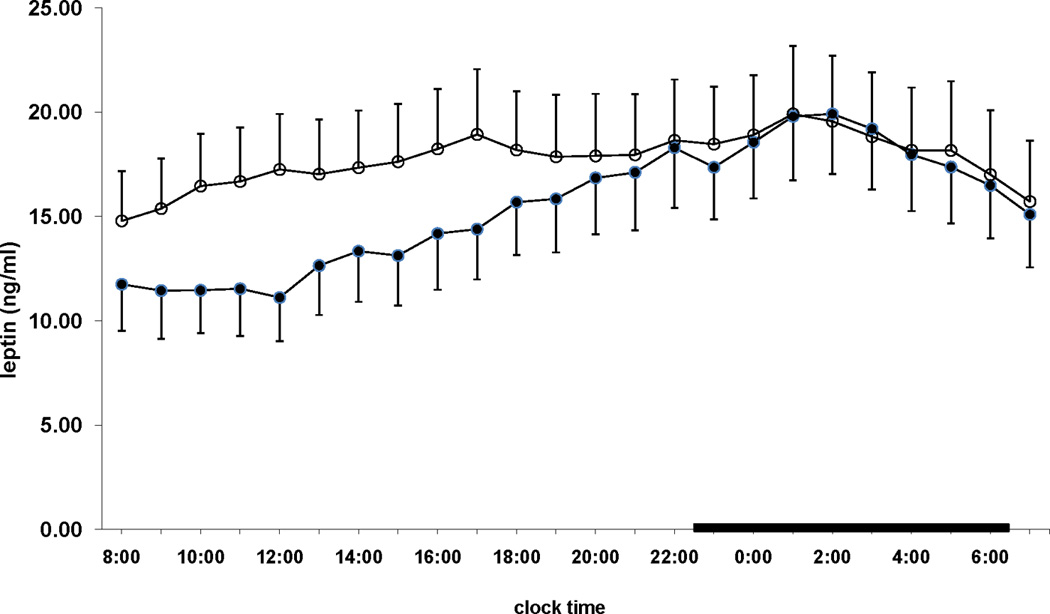
Short-term sleep curtailment associated with activation of the stress system in healthy, young adults has been shown to be associated with decreased leptin levels, impaired insulin sensitivity, and increased hunger and appetite. To assess the effects of one night of sleep loss in a less stressful environment on hunger, leptin, adiponectin, cortisol and blood pressure/heart rate, and whether a 2-h mid-afternoon nap reverses the changes associated with sleep loss, 21 young healthy individuals (10 men, 11 women) participated in a 7-day sleep deprivation experiment (four consecutive nights followed by one night of sleep loss and two recovery nights). Half of the subjects were randomly assigned to take a mid-afternoon nap (14:00-16:00 hours) the day following the night of total sleep loss. Serial 24-h blood sampling and hunger scales were completed on the fourth (predeprivation) and sixth day (postdeprivation). Leptin levels were significantly increased after one night of total sleep loss, whereas adiponectin, cortisol levels, blood pressure/heart rate, and hunger were not affected. Daytime napping did not influence the effects of sleep loss on leptin, adiponectin, or hunger. Acute sleep loss, in a less stressful environment, influences leptin levels in an opposite manner from that of short-term sleep curtailment associated with activation of the stress system. It appears that sleep loss associated with activation of the stress system but not sleep loss per se may lead to increased hunger and appetite and hormonal changes, which ultimately may lead to increased consumption of 'comfort' food and obesity.
短期睡眠剥夺与健康年轻成年人应激系统的激活有关,已被证明与瘦素水平降低、胰岛素敏感性受损以及饥饿感和食欲增加有关。为了评估在压力较小的环境中一夜睡眠缺失对饥饿感、瘦素、脂联素、皮质醇和血压/心率的影响,以及下午两点的短暂小睡是否能逆转与睡眠缺失相关的变化,21 名健康年轻成年人(10 名男性,11 名女性)参加了为期 7 天的睡眠剥夺实验(连续 4 个晚上,然后是一个晚上的睡眠缺失和两个恢复晚上)。一半的受试者被随机分配在睡眠缺失的第二天下午 2 点到 4 点之间小睡。在第四天(剥夺前)和第六天(剥夺后)完成了 24 小时连续血液采样和饥饿量表。一夜的总睡眠缺失后,瘦素水平显著升高,而脂联素、皮质醇水平、血压/心率和饥饿感不受影响。白天小睡并不影响睡眠缺失对瘦素、脂联素或饥饿感的影响。在压力较小的环境中,急性睡眠缺失会以与应激系统激活相关的短期睡眠剥夺相反的方式影响瘦素水平。似乎与应激系统激活相关的睡眠缺失而不是单纯的睡眠缺失可能会导致饥饿感和食欲增加以及激素变化,这最终可能导致“舒适”食物的摄入增加和肥胖。