Ahn Hee-Jung, Han Kyung-Ah, Kwon Hwi-Ryun, Koo Bo-Kyung, Kim Hyun-Jin, Park Kang-Seo, Min Kyung-Wan
Diabetes Center, Eulji Hospital, Seoul, Korea.
Korean Diabetes J. 2010 Apr;34(2):86-94. doi: 10.4093/kdj.2010.34.2.86. Epub 2010 Apr 30.
The Korean National Health and Nutrition Examination Surveys reported 65% of daily energy intake (EI) as carbohydrate (CHO) in the Korean population and main source of CHO was cooked rice. We used a standardized-small sized rice bowl for diet education and investigated its effectiveness on body weight, glucose and lipid, compared to the conventional food exchange system in type 2 diabetes obese women.
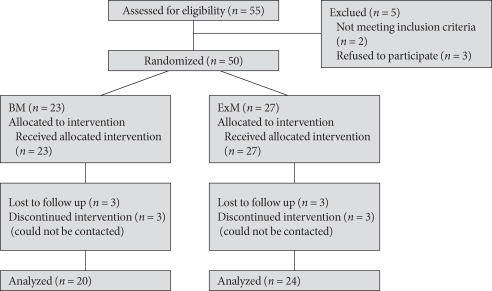
Type 2 diabetic women with body mass index >/= 23 kg/m(2) were randomly assigned to small rice bowl-based meal plan (BM) and food exchange-based meal plan (ExM) group. Both groups were asked to reduce their EI by 500 kcal/day for 12 weeks. The macronutrient composition was instructed: 55 to 60% of EI as CHO, 15 to 20% as protein, and 20 to 25% as fat. BM group received only a simple instruction for application of the rice bowl. Nutrient intake was estimated with the 3-day dietary records.
Finally, 44 subjects finished the study. The percent reduction of body weight was significant both BM group (-5.1 +/- 2.6%) and ExM group (-4.8 +/- 2.8%) after 12 weeks (P < 0.001) but there was no difference between the groups. There was no difference in the proportional change of CHO, protein and fat in EI between the groups. Additionally, the change of HbA1c and low density lipoprotein-cholesterol were not significantly different between the two groups.
The BM group was as effective as ExM for body weight and glucose control in type 2 diabetes obese women.
韩国国家健康与营养检查调查显示,韩国人群每日能量摄入(EI)的65%为碳水化合物(CHO),而CHO的主要来源是米饭。我们使用标准化小碗进行饮食教育,并与2型糖尿病肥胖女性的传统食物交换系统相比,研究其对体重、血糖和血脂的影响。
将体重指数≥23kg/m²的2型糖尿病女性随机分为小碗米饭饮食计划组(BM)和食物交换饮食计划组(ExM)。两组均被要求在12周内将EI减少500千卡/天。指导了宏量营养素的组成:EI的55%至60%为CHO,15%至20%为蛋白质,20%至25%为脂肪。BM组仅接受了关于使用小碗米饭的简单指导。通过3天饮食记录估算营养素摄入量。
最终,44名受试者完成了研究。12周后,BM组(-5.1±2.6%)和ExM组(-4.8±2.8%)的体重减轻百分比均显著(P<0.001),但两组之间无差异。两组之间EI中CHO、蛋白质和脂肪的比例变化无差异。此外,两组之间糖化血红蛋白(HbA1c)和低密度脂蛋白胆固醇的变化无显著差异。
在2型糖尿病肥胖女性中,BM组在体重和血糖控制方面与ExM组同样有效。