Oncology Institute of Southern Switzerland, Medical Physics Unit, Bellinzona, Switzerland.
Radiat Oncol. 2010 Jun 16;5:54. doi: 10.1186/1748-717X-5-54.
To report about initial clinical experience in radiation treatment of carcinoma of prostate with volumetric modulated arcs with the RapidArc (RA) technology.
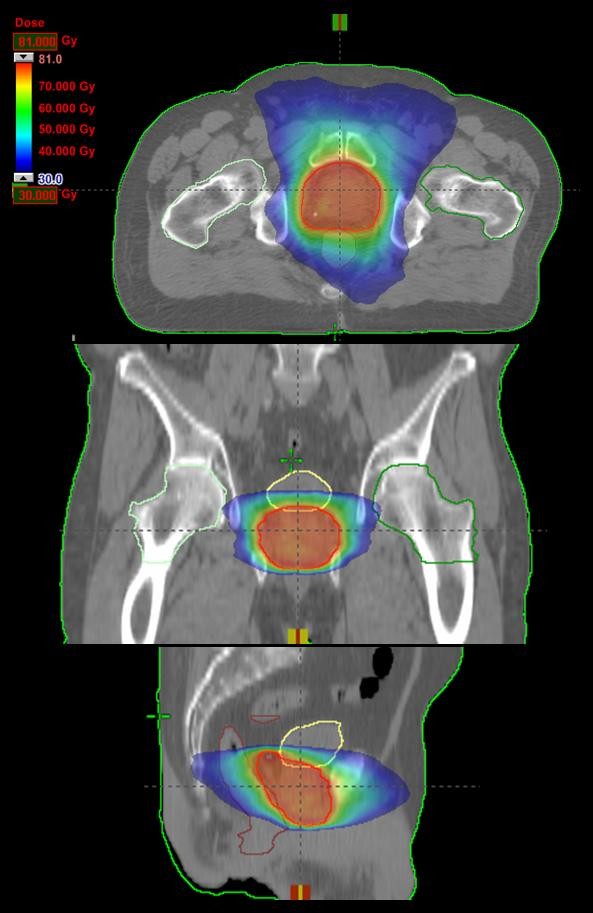
Forty-five patients with a median age of 72 +/- 3, affected by prostate carcinoma (T1c: 22 patients, T2a-b: 17 patients, T3a-b: 6 patients. N0: 43 patients, N1-Nx: 2 patients, all M0), with initial PSA of 10.0 +/- 3.0 ng/mL, were treated with RapidArc in a feasibility study. All patients were treated with single arc using 6MV photons. Dose prescription ranged between 76 (7 patients) and 78 Gy (38 patients) in 2 Gy/fraction. Plan quality was assessed by means of Dose Volume Histogram (DVH) analysis. Technical parameters of arcs and pre-treatment quality assurance results (Gamma Agreement Index, GAI) are reported to describe delivery features. Early toxicity was scored (according to the Common Terminology Criteria of Adverse Effects scale, CTCAE, scale) at the end of treatment together with biochemical outcome (PSA).
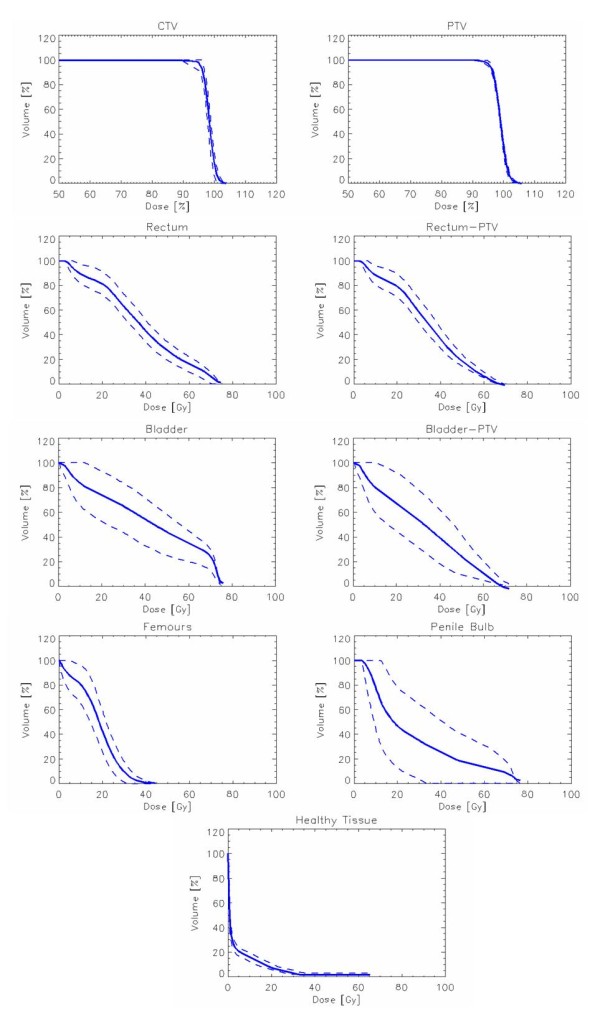
From DVH data, target coverage was fulfilling planning objectives: V95% was in average higher than 98% and V107% approximately 0.0% (D2% approximately 104.0% in average). Homogeneity D5%-D95% ranged between 6.2 +/- 1.0% to 6.7 +/- 1.3%. For rectum, all planning objectives were largely met (e.g. V70Gy = 10.7 +/- 5.5% against an objective of < 25%) similarly for bladder (e.g. D2% = 79.4 +/- 1.2 Gy against an objective of 80.0 Gy). Maximum dose to femurs was D2% = 36.7 +/- 5.4 Gy against an objective of 47 Gy. Monitor Units resulted: MU/Gy = 239 +/- 37. Average beam on time was 1.24 +/- 0.0 minutes. Pre-treatment GAI resulted in 98.1 +/- 1.1%. Clinical data were recorded as PSA at 6 weeks after RT, with median values of 0.4 +/- 0.4 ng/mL. Concerning acute toxicity, no patient showed grade 2-3 rectal toxicity; 5/42 (12%) patients experienced grade 2 dysuria; 18/41 (44%) patients preserved complete or partial erectile function.
RapidArc proved to be a safe, qualitative and advantageous treatment modality for prostate cancer.
报告使用容积调强弧形治疗(RapidArc)技术治疗前列腺癌的初步临床经验。
45 名年龄中位数为 72±3 岁的前列腺癌患者(T1c:22 例,T2a-b:17 例,T3a-b:6 例。N0:43 例,N1-Nx:2 例,均为 M0),初始 PSA 为 10.0±3.0ng/mL,采用 RapidArc 进行可行性研究。所有患者均采用 6MV 光子进行单弧治疗。处方剂量范围为 76(7 例)至 78Gy(38 例),分 2Gy/次。通过剂量体积直方图(DVH)分析评估计划质量。报告弧形的技术参数和治疗前质量保证结果(Gamma 符合指数,GAI),以描述传递特征。在治疗结束时,根据不良事件常用术语标准(CTCAE)量表,对早期毒性进行评分,并与生化结果(PSA)一起评估。
从 DVH 数据来看,靶区覆盖满足了计划目标:V95%平均高于 98%,V107%约为 0.0%(D2%平均为 104.0%)。D5%-D95%的均匀性为 6.2±1.0%至 6.7±1.3%。对于直肠,所有计划目标都得到了很好的满足(例如,V70Gy=10.7±5.5%,而目标值<25%),膀胱情况也类似(例如,D2%=79.4±1.2Gy,而目标值为 80.0Gy)。股骨的最大剂量为 D2%=36.7±5.4Gy,目标值为 47Gy。MU/Gy 为 239±37。平均照射时间为 1.24±0.0 分钟。治疗前 GAI 结果为 98.1±1.1%。临床数据记录为放射治疗后 6 周的 PSA,中位数为 0.4±0.4ng/mL。关于急性毒性,没有患者出现 2-3 级直肠毒性;5/42(12%)例患者出现 2 级排尿困难;18/41(44%)例患者保留了完整或部分勃起功能。
RapidArc 被证明是一种安全、高质量和有利的前列腺癌治疗方法。