Department of Public and Environmental Health, Hawassa University, Ethiopia.
Malar J. 2010 Jun 16;9:166. doi: 10.1186/1475-2875-9-166.
Malaria transmission is complex and is believed to be associated with local climate changes. However, simple attempts to extrapolate malaria incidence rates from averaged regional meteorological conditions have proven unsuccessful. Therefore, the objective of this study was to determine if variations in specific meteorological factors are able to consistently predict P. falciparum malaria incidence at different locations in south Ethiopia.
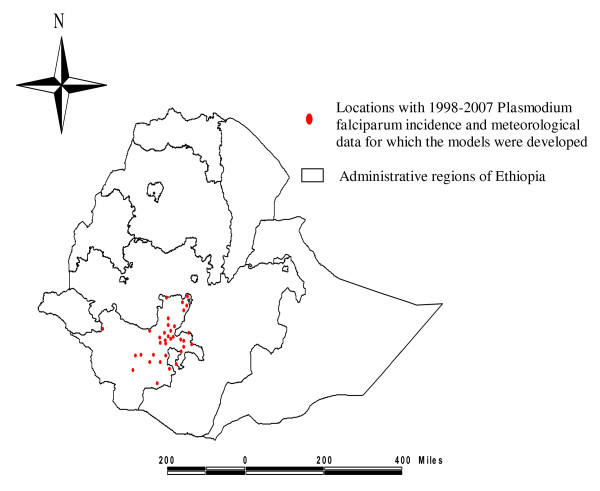
Retrospective data from 42 locations were collected including P. falciparum malaria incidence for the period of 1998-2007 and meteorological variables such as monthly rainfall (all locations), temperature (17 locations), and relative humidity (three locations). Thirty-five data sets qualified for the analysis. Ljung-Box Q statistics was used for model diagnosis, and R squared or stationary R squared was taken as goodness of fit measure. Time series modelling was carried out using Transfer Function (TF) models and univariate auto-regressive integrated moving average (ARIMA) when there was no significant predictor meteorological variable.
Of 35 models, five were discarded because of the significant value of Ljung-Box Q statistics. Past P. falciparum malaria incidence alone (17 locations) or when coupled with meteorological variables (four locations) was able to predict P. falciparum malaria incidence within statistical significance. All seasonal AIRMA orders were from locations at altitudes above 1742 m. Monthly rainfall, minimum and maximum temperature was able to predict incidence at four, five and two locations, respectively. In contrast, relative humidity was not able to predict P. falciparum malaria incidence. The R squared values for the models ranged from 16% to 97%, with the exception of one model which had a negative value. Models with seasonal ARIMA orders were found to perform better. However, the models for predicting P. falciparum malaria incidence varied from location to location, and among lagged effects, data transformation forms, ARIMA and TF orders.
This study describes P. falciparum malaria incidence models linked with meteorological data. Variability in the models was principally attributed to regional differences, and a single model was not found that fits all locations. Past P. falciparum malaria incidence appeared to be a superior predictor than meteorology. Future efforts in malaria modelling may benefit from inclusion of non-meteorological factors.
疟疾传播较为复杂,被认为与当地气候变化有关。然而,简单地从平均区域气象条件推断疟疾发病率的尝试并未成功。因此,本研究的目的是确定特定气象因素的变化是否能够始终如一地预测埃塞俄比亚南部不同地点的恶性疟原虫疟疾发病率。
收集了 42 个地点的回顾性数据,包括 1998-2007 年期间的恶性疟原虫疟疾发病率以及气象变量,如每月降雨量(所有地点)、温度(17 个地点)和相对湿度(3 个地点)。有 35 个数据集符合分析要求。Ljung-Box Q 统计量用于模型诊断,R 平方或固定 R 平方作为拟合优度的度量。当没有显著的预测气象变量时,使用传递函数(TF)模型和单变量自回归积分移动平均(ARIMA)进行时间序列建模。
在 35 个模型中,有 5 个因 Ljung-Box Q 统计量的显著值而被丢弃。仅过去的恶性疟原虫疟疾发病率(17 个地点)或与气象变量结合时(4 个地点)能够在统计上预测恶性疟原虫疟疾发病率。所有季节性 ARIMA 阶的位置都在海拔 1742 米以上。每月降雨量、最低和最高温度分别能够预测 4、5 和 2 个地点的发病率。相比之下,相对湿度不能预测恶性疟原虫疟疾发病率。模型的 R 平方值范围从 16%到 97%,除了一个模型为负值。具有季节性 ARIMA 阶的模型表现更好。然而,预测恶性疟原虫疟疾发病率的模型因地点而异,滞后效应、数据转换形式、ARIMA 和 TF 阶之间存在差异。
本研究描述了与气象数据相关的恶性疟原虫疟疾发病率模型。模型的可变性主要归因于区域差异,没有找到适合所有地点的单一模型。过去的恶性疟原虫疟疾发病率似乎比气象因素更能预测。未来的疟疾建模工作可能受益于纳入非气象因素。