Department of Medical Laboratory Sciences and Pathology, Jimma University, Jimma, Ethiopia.
Parasit Vectors. 2011 Mar 2;4:30. doi: 10.1186/1756-3305-4-30.
In Ethiopia, malaria is seasonal and unstable, causing frequent epidemics. It usually occurs at altitudes < 2,000 m above sea level. Occasionally, transmission of malaria occurs in areas previously free of malaria, including areas > 2,000 m above sea level. For transmission of malaria parasite, climatic factors are important determinants as well as non-climatic factors that can negate climatic influences. Indeed, there is a scarcity of information on the correlation between climatic variability and malaria transmission risk in Ethiopia in general and in the study area in particular. Therefore, the aim of this study was to determine the level of correlation between meteorological variables and malaria cases.
Time-series analysis was conducted using data on monthly meteorological variables and monthly total malaria in Jimma town, south west Ethiopia, for the period 2000-2009. All the data were entered and analyzed using SPSS-15 database program. Spearman correlation and linear regression analysis were used to asses association between the variables.
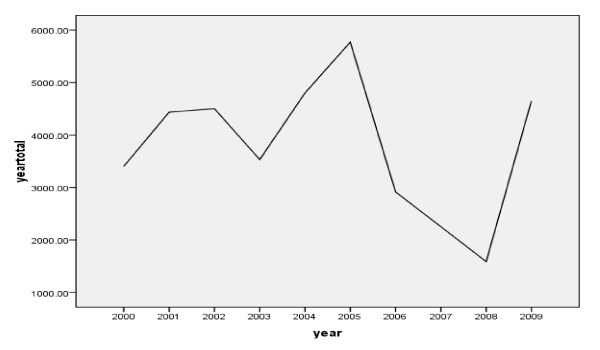
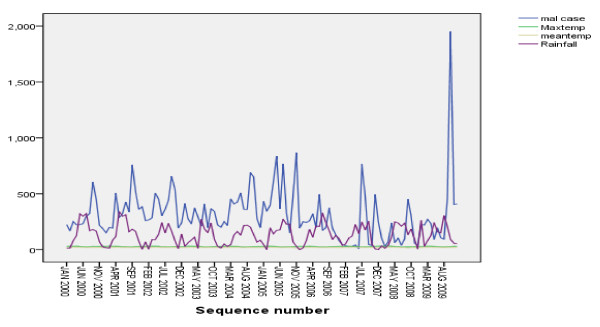
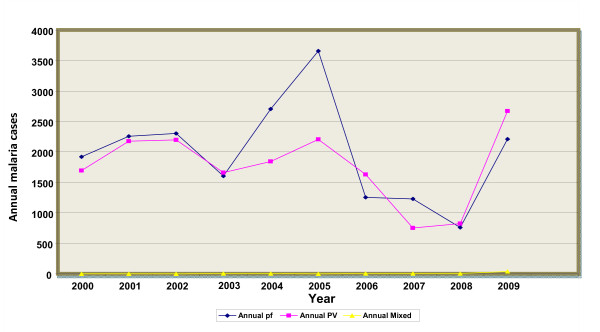
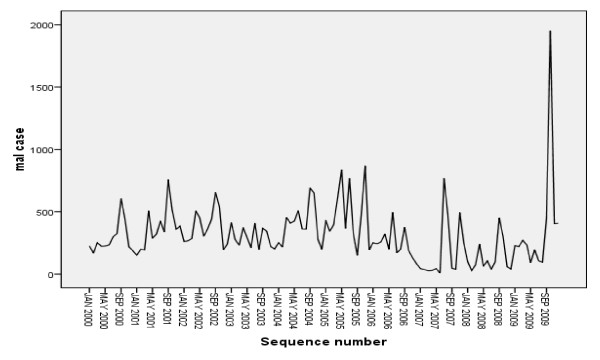
During last ten years (2000-2009), a fluctuating trend of malaria transmission was observed with P.vivax becoming predominant species. Spearman correlation analysis showed that monthly minimum temperature, total rainfall and two measures of relative humidity were positively related with malaria but monthly maximum temperature negatively related. Also regression analysis suggested that monthly minimum (p = 0.008), monthly maximum temperature (p = 0.013) and monthly total rainfall (p = 0.040), at one month lagged effect, were significant meteorological factors for transmission of malaria in the study area.
Malaria incidences in the last decade seem to have a significant association with meteorological variables. In future, prospective and multidisciplinary cooperative research involving researchers from the fields of parasitology, epidemiology, botany, agriculture and climatology is necessary to identify the real effect of meteorological factors on vector- borne diseases like malaria.
在埃塞俄比亚,疟疾具有季节性和不稳定性,导致频繁爆发。它通常发生在海拔 2000 米以下的地区。偶尔,疟疾也会在以前没有疟疾的地区传播,包括海拔 2000 米以上的地区。对于疟原虫的传播,气候因素是重要的决定因素,而非气候因素也可以否定气候的影响。事实上,关于埃塞俄比亚一般地区和研究地区的气候变异性与疟疾传播风险之间的相关性的信息很少。因此,本研究旨在确定气象变量与疟疾病例之间的相关程度。
使用 2000-2009 年期间埃塞俄比亚西南部吉姆马镇的每月气象变量和每月总疟疾数据进行时间序列分析。所有数据均使用 SPSS-15 数据库程序输入和分析。使用 Spearman 相关性和线性回归分析评估变量之间的关联。
在过去十年(2000-2009 年)中,观察到疟疾传播呈波动趋势,间日疟原虫成为主要物种。Spearman 相关性分析表明,每月最低温度、总降雨量和两种相对湿度测量值与疟疾呈正相关,而每月最高温度则呈负相关。回归分析还表明,滞后一个月的每月最低温度(p = 0.008)、每月最高温度(p = 0.013)和每月总降雨量(p = 0.040)是研究地区疟疾传播的重要气象因素。
过去十年中,疟疾发病率似乎与气象变量有显著关联。未来,需要涉及寄生虫学、流行病学、植物学、农业和气候学等领域的研究人员进行前瞻性和多学科合作研究,以确定气象因素对疟疾等虫媒疾病的实际影响。