Department of Rehabilitation Medicine, University of Washington, Box 357920, Seattle, WA 98195-7920, USA Center for Health Outcomes Research, United BioSource Corporation, Bethesda, MD, USA Department of Medical Social Sciences, Northwestern University Feinberg School of Medicine, Chicago, IL, USA Departments of Psychiatry and Behavioral Sciences, Anesthesiology, Medicine and Psychology and Neuroscience: Social and Health Sciences, Duke University and Duke University Medical Center, Durham, NC, USA Departments of Medicine, Orthopaedics, and Social Medicine and Thurston Arthritis Research Center, University of North Carolina, Chapel Hill, NC, USA.
Pain. 2010 Jul;150(1):173-182. doi: 10.1016/j.pain.2010.04.025.
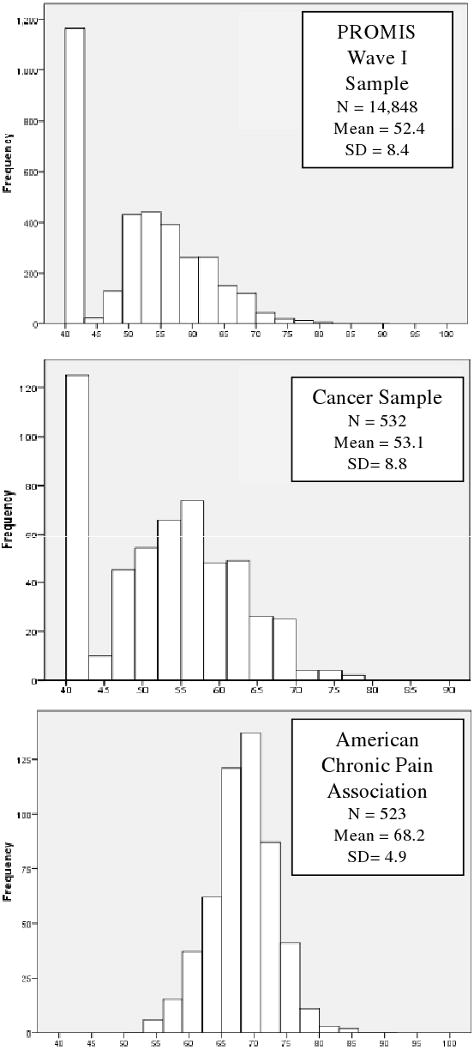
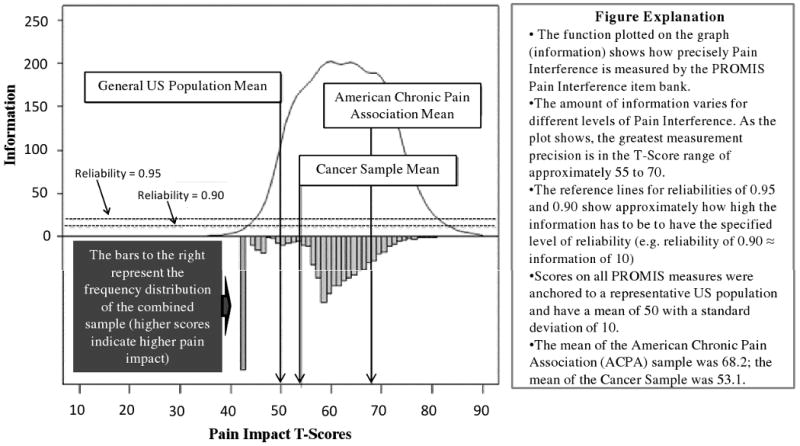
This paper describes the psychometric properties of the PROMIS-pain interference (PROMIS-PI) bank. An initial candidate item pool (n=644) was developed and evaluated based on the review of existing instruments, interviews with patients, and consultation with pain experts. From this pool, a candidate item bank of 56 items was selected and responses to the items were collected from large community and clinical samples. A total of 14,848 participants responded to all or a subset of candidate items. The responses were calibrated using an item response theory (IRT) model. A final 41-item bank was evaluated with respect to IRT assumptions, model fit, differential item function (DIF), precision, and construct and concurrent validity. Items of the revised bank had good fit to the IRT model (CFI and NNFI/TLI ranged from 0.974 to 0.997), and the data were strongly unidimensional (e.g., ratio of first and second eigenvalue=35). Nine items exhibited statistically significant DIF. However, adjusting for DIF had little practical impact on score estimates and the items were retained without modifying scoring. Scores provided substantial information across levels of pain; for scores in the T-score range 50-80, the reliability was equivalent to 0.96-0.99. Patterns of correlations with other health outcomes supported the construct validity of the item bank. The scores discriminated among persons with different numbers of chronic conditions, disabling conditions, levels of self-reported health, and pain intensity (p<0.0001). The results indicated that the PROMIS-PI items constitute a psychometrically sound bank. Computerized adaptive testing and short forms are available.
本文描述了 PROMIS-pain interference(PROMIS-PI)库的心理测量特性。根据对现有工具的审查、患者访谈以及与疼痛专家的咨询,开发并评估了最初的候选项目库(n=644)。从该库中,选择了一个 56 项的候选项目库,并从大型社区和临床样本中收集了对这些项目的反应。共有 14848 名参与者对所有或部分候选项目做出了回应。使用项目反应理论(IRT)模型对这些反应进行了标定。对最终的 41 项项目库进行了IRT 假设、模型拟合、差异项目功能(DIF)、精度以及结构和同时效度的评估。修订后的项目库中的项目与 IRT 模型拟合良好(CFI 和 NNFI/TLI 范围从 0.974 到 0.997),数据具有很强的单维性(例如,第一和第二特征值的比值=35)。有 9 个项目表现出统计学意义上的 DIF。然而,对 DIF 进行调整对分数估计的实际影响很小,因此在不修改评分的情况下保留了这些项目。分数在疼痛水平上提供了大量信息;在 T 分数范围为 50-80 的情况下,可靠性相当于 0.96-0.99。与其他健康结果的相关模式支持了项目库的结构效度。分数在具有不同数量的慢性疾病、残疾状况、自我报告健康水平和疼痛强度的人群中具有区分度(p<0.0001)。结果表明,PROMIS-PI 项目构成了一个具有心理测量学意义的库。提供了计算机化自适应测试和简短形式。