Department of Population Medicine and Diagnostic Sciences, Cornell University, Ithaca, NY 14853, USA.
Vet J. 2011 May;188(2):237-9. doi: 10.1016/j.tvjl.2010.05.002. Epub 2010 May 31.
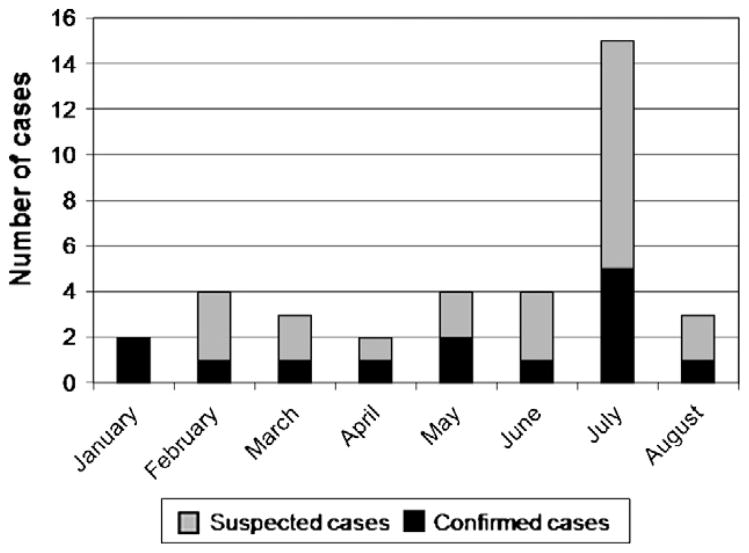
Naturally acquired acute leptospirosis in monkeys is uncommon. This study reports an outbreak of severe leptospirosis among 52 capuchin (Cebus) monkeys that had been rescued from homes and housed in a wildlife rehabilitation center in Colombia in 2007. Case confirmation consisted of Leptospira isolation followed by a polymerase chain reaction targeting the LipL32 gene. The attack and mortality rates were 71% and 27%, respectively. Sixteen cases were confirmed. Necropsy revealed diffuse jaundice and pulmonary hemorrhage. Multi-locus sequence typing identified the agent to be Leptospira interrogans sequence type 17, indicating rats as the source of infection. An environmental survey confirmed rodent infestation as the cause of the outbreak. The extent of Leptospira transmission between humans and monkeys is unknown. Improper husbandry of non-human primates could create new reservoirs and transmission routes for Leptospira threatening conservation efforts and public health.
自然发生的猴类急性钩端螺旋体病并不常见。本研究报告了 2007 年在哥伦比亚的一个野生动物康复中心,52 只从家中救出并饲养的卷尾猴(Cebus)中爆发的严重钩端螺旋体病。病例确诊包括钩端螺旋体分离,随后针对 LipL32 基因进行聚合酶链反应。攻击率和死亡率分别为 71%和 27%。确诊了 16 例。尸检显示弥漫性黄疸和肺出血。多位点序列分型将病原体确定为问号钩端螺旋体 17 型,表明老鼠是感染源。环境调查证实啮齿动物侵扰是疫情爆发的原因。人类和猴子之间钩端螺旋体传播的程度尚不清楚。对非人类灵长类动物的不当饲养可能会为钩端螺旋体创造新的储存库和传播途径,从而威胁到保护工作和公共卫生。