Stahel Philip F, Flierl Michael A, Moore Ernest E
Department of Orthopaedic Surgery, Denver Health Medical Center, University of Colorado School of Medicine, 80204, USA.
Scand J Trauma Resusc Emerg Med. 2010 Jun 17;18:34. doi: 10.1186/1757-7241-18-34.
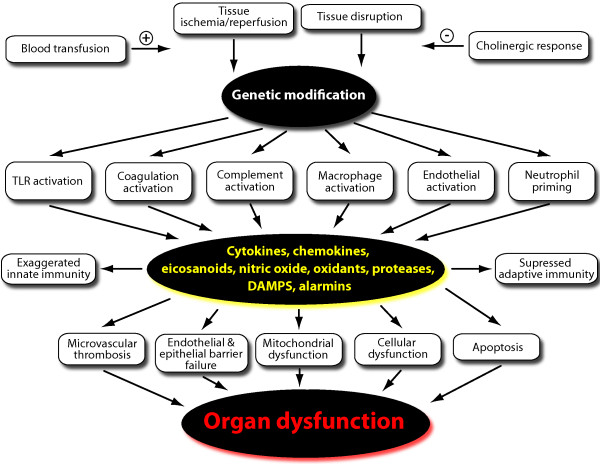
Metabolic changes after major trauma have a complex underlying pathophysiology. The early posttraumatic stress response is associated with a state of hyperinflammation, with increased oxygen consumption and energy expenditure. This hypercatabolic state must be recognized early and mandates an early nutritional management strategy. A proactive concept of early enteral "immunonutrition" in severely injured patients, is aimed at counterbalancing the negative aspects of hyperinflammation and hypercatabolism in order to reduce the risk of late complications, including infections and posttraumatic organ failure. Recently, the concept of "metabolic staging" has been advocated, which takes into account the distinct inflammatory phases and metabolic phenotypes after major trauma, including the "ischemia/reperfusion phenotype", the "leukocytic phenotype", and the "angiogenic phenotype". The potential clinical impact of metabolic staging, and of an appropriately adapted "metabolic control" and nutritional support, remains to be determined.
严重创伤后的代谢变化有着复杂的潜在病理生理学机制。创伤后早期应激反应与高炎症状态相关,氧消耗和能量消耗增加。这种高分解代谢状态必须尽早识别,并需要早期营养管理策略。对重伤患者采取积极的早期肠内“免疫营养”概念,旨在抵消高炎症和高分解代谢的负面影响,以降低包括感染和创伤后器官衰竭在内的晚期并发症风险。最近,“代谢分期”概念被提倡,它考虑了严重创伤后不同的炎症阶段和代谢表型,包括“缺血/再灌注表型”、“白细胞表型”和“血管生成表型”。代谢分期以及适当调整的“代谢控制”和营养支持的潜在临床影响仍有待确定。