Department of Epidemiology, Biostatistics and Occupational Health, McGill University, Montreal, QC H3A 2T7, Canada.
BMC Cancer. 2010 Jun 18;10:304. doi: 10.1186/1471-2407-10-304.
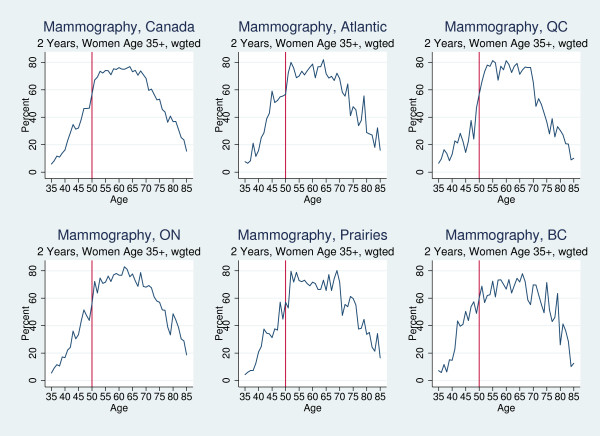
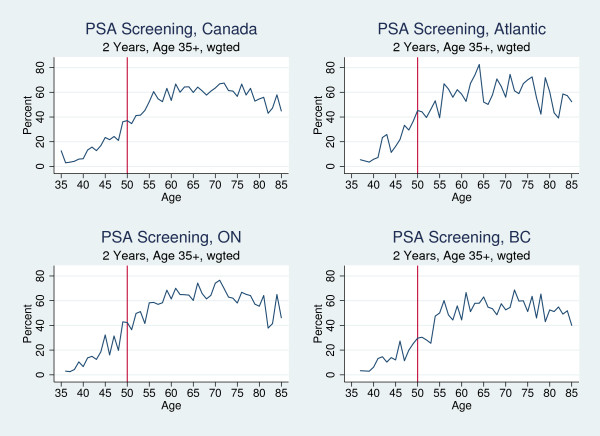
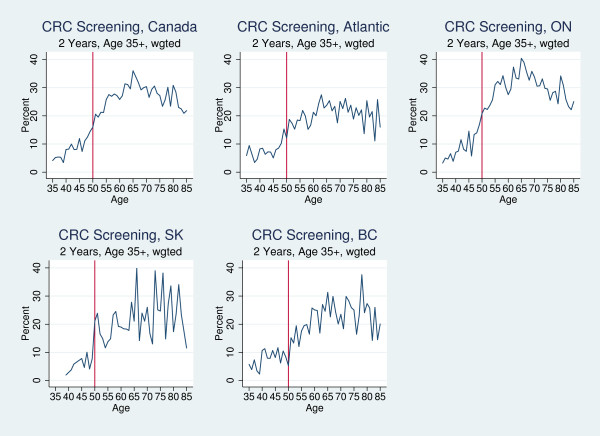
Cancer screening guidelines reflect the costs and benefits of population-based screening based on evidence from clinical trials. While most of the existing literature on compliance with cancer screening guidelines only measures raw screening rates in the target age groups, we used a novel approach to estimate degree of guideline compliance across Canadian provinces for breast, colorectal and prostate cancer screening. Measuring compliance as the change in age-specific screening rates at the guideline-recommended initiation age (50), we generally found screening patterns across Canadian provinces that were not consistent with guideline compliance.
We calculated age-cancer-specific screening rates for ages 40-60 using the Canadian Community Health Survey (2003 and 2005), a cross-sectional, nationally representative survey of health status, health care utilization and health determinants in the Canadian population. We estimated the degree of compliance using logistic regression to measure the change in adjusted screening rates at the guideline-recommended initiation age for each province in the sample.
For breast cancer, after adjusting for age trends and other covariates, being above age 50 in Quebec increased the probability of being screened by 19 percentage points, from an average screening rate of 24% among 40-49 year olds. None of the other regions exhibited a statistically significant change in screening rates at age 50. Additional analyses indicated that these patterns reflect asymptomatic screening and that Quebec's breast cancer screening program enhanced the degree of guideline compliance in that province. Colorectal cancer screening practice was consistent with guidelines only in Saskatchewan, as screening rates increased at age 50 by 12 percentage points, from an average rate of 6% among 40-49 year olds. For prostate cancer, the regions examined here are not compliant with Canadian guidelines since screening rates were quite high, and there was not a discrete increase at any particular age.
Screening practice for breast, colorectal and prostate cancer was generally not consistent with Canadian clinical guidelines. Quebec (breast) and Saskatchewan (colorectal) were exceptions to this, and the impact of Quebec's breast cancer screening program suggests a role for policy in improving screening guideline compliance.
癌症筛查指南反映了基于临床试验证据的人群为基础的筛查的成本效益。虽然大多数关于癌症筛查指南依从性的现有文献仅测量目标年龄组的原始筛查率,但我们使用了一种新方法来估计加拿大各省的乳腺癌、结直肠癌和前列腺癌筛查的指南依从程度。通过测量在推荐起始年龄(50 岁)时特定年龄的筛查率的变化来衡量依从性,我们发现加拿大各省的筛查模式与指南依从性不一致。
我们使用加拿大社区健康调查(2003 年和 2005 年)来计算 40-60 岁年龄的癌症特异性筛查率,这是一项在加拿大人群中进行的横断面、全国代表性的健康状况、卫生保健利用和健康决定因素调查。我们使用逻辑回归来估计依从性的程度,以衡量样本中每个省在推荐起始年龄时调整后的筛查率的变化。
对于乳腺癌,在调整了年龄趋势和其他协变量后,魁北克的年龄在 50 岁以上使筛查的可能性增加了 19 个百分点,从 40-49 岁年龄组的平均筛查率 24%增加到了 43%。其他地区在 50 岁时的筛查率没有出现统计学上显著的变化。进一步的分析表明,这些模式反映了无症状筛查,并且魁北克的乳腺癌筛查计划提高了该省的指南依从性程度。只有萨斯喀彻温省的结直肠癌筛查实践与指南一致,因为在 50 岁时筛查率增加了 12 个百分点,从 40-49 岁年龄组的平均 6%增加到了 18%。对于前列腺癌,这里检查的地区不符合加拿大的指南,因为筛查率相当高,而且在任何特定的年龄都没有明显的增加。
乳腺癌、结直肠癌和前列腺癌的筛查实践通常与加拿大的临床指南不一致。魁北克(乳腺癌)和萨斯喀彻温省(结直肠癌)是例外,魁北克的乳腺癌筛查计划表明政策在提高筛查指南依从性方面发挥了作用。