Department of Neurology, Medical College of Georgia, Augusta, GA, USA.
J Cell Mol Med. 2010 Apr;14(4):914-21. doi: 10.1111/j.1582-4934.2008.00671.x.
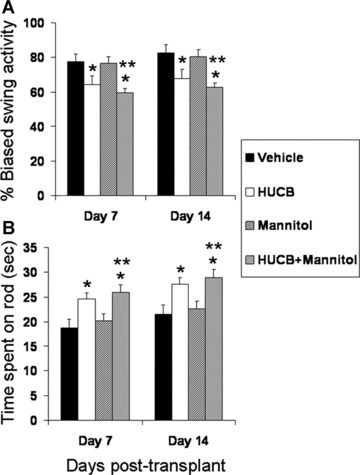
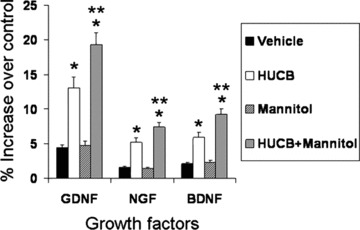
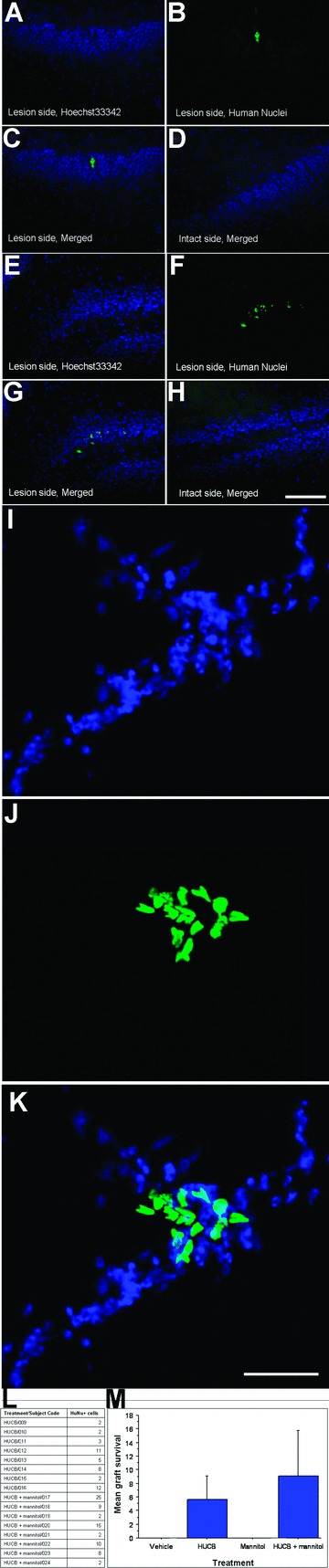
We recently demonstrated that blood-brain barrier permeabilization using mannitol enhances the therapeutic efficacy of systemically administered human umbilical cord blood (HUCB) by facilitating the entry of neurotrophic factors from the periphery into the adult stroke brain. Here, we examined whether the same blood-brain barrier manipulation approach increases the therapeutic effects of intravenously delivered HUCB in a neonatal hypoxic-ischaemic (HI) injury model. Seven-day-old Sprague-Dawley rats were subjected to unilateral HI injury and then at day 7 after the insult, animals intravenously received vehicle alone, mannitol alone, HUCB cells (15k mononuclear fraction) alone or a combination of mannitol and HUCB cells. Behavioural tests at post-transplantation days 7 and 14 showed that HI animals that received HUCB cells alone or when combined with mannitol were significantly less impaired in motor asymmetry and motor coordination compared with those that received vehicle alone or mannitol alone. Brain tissues from a separate animal cohort from the four treatment conditions were processed for enzyme-linked immunosorbent assay at day 3 post-transplantation, and revealed elevated levels of GDNF, NGF and BDNF in those that received HUCB cells alone or when combined with mannitol compared with those that received vehicle or mannitol alone, with the combined HUCB cells and mannitol exhibiting the most robust neurotropic factor up-regulation. Histological assays revealed only sporadic detection of HUCB cells, suggesting that the trophic factor-mediated mechanism, rather than cell replacement per se, principally contributed to the behavioural improvement. These findings extend the utility of blood-brain barrier permeabilization in facilitating cell therapy for treating neonatal HI injury.
我们最近证明,通过甘露醇使血脑屏障通透性增强,有助于外周神经营养因子进入成年中风大脑,从而增强系统给予人脐血(HUCB)的治疗效果。在这里,我们研究了相同的血脑屏障处理方法是否会增加静脉内给予 HUCB 在新生缺氧缺血(HI)损伤模型中的治疗效果。7 日龄 Sprague-Dawley 大鼠接受单侧 HI 损伤,然后在损伤后第 7 天,动物静脉内给予单独的载体、甘露醇、HUCB 细胞(15k 单核细胞部分)或甘露醇和 HUCB 细胞的组合。移植后第 7 天和第 14 天的行为测试表明,单独接受 HUCB 细胞或与甘露醇联合接受 HUCB 细胞的 HI 动物在运动不对称性和运动协调方面的损伤明显小于单独接受载体或甘露醇的动物。来自四个治疗组的另一组动物的脑组织在移植后第 3 天用于酶联免疫吸附测定,结果显示,单独接受 HUCB 细胞或与甘露醇联合接受 HUCB 细胞的动物的 GDNF、NGF 和 BDNF 水平明显高于单独接受载体或甘露醇的动物,而联合接受 HUCB 细胞和甘露醇的动物表现出最强的神经营养因子上调。组织学检测仅偶尔检测到 HUCB 细胞,这表明营养因子介导的机制,而不是细胞替代本身,主要有助于行为改善。这些发现扩展了血脑屏障通透性在促进细胞治疗治疗新生儿 HI 损伤中的作用。