Key Laboratory of Aquatic Biodiversity and Conservation, Institute of Hydrobiology, Chinese Academy of Sciences, Wuhan, China.
BMC Genomics. 2010 Jun 23;11:396. doi: 10.1186/1471-2164-11-396.
Variations in genome size within and between species have been observed since the 1950 s in diverse taxonomic groups. Serving as model organisms, smooth pufferfish possess the smallest vertebrate genomes. Interestingly, spiny pufferfish from its sister family have genome twice as large as smooth pufferfish. Therefore, comparative genomic analysis between smooth pufferfish and spiny pufferfish is useful for our understanding of genome size evolution in pufferfish.
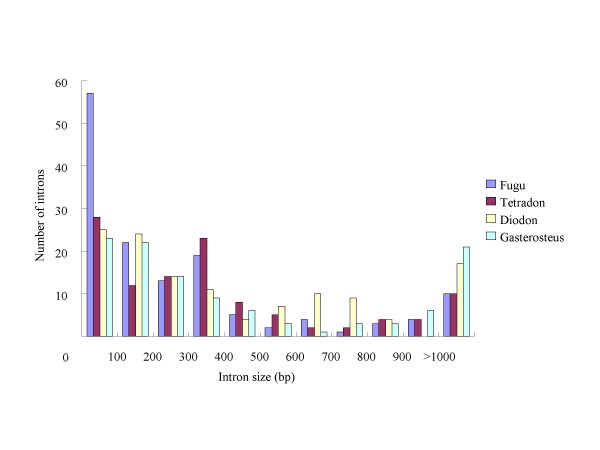
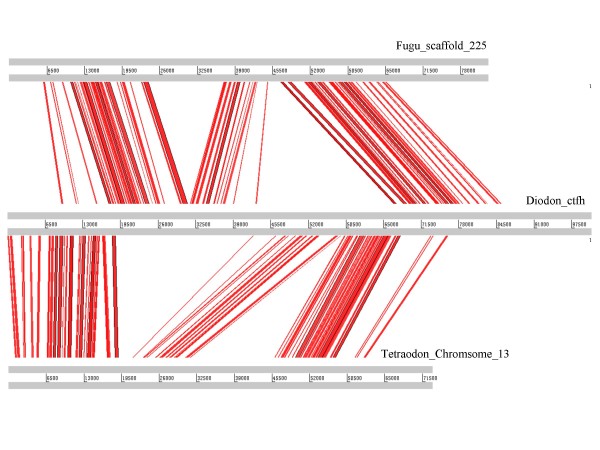
Ten BAC clones of a spiny pufferfish Diodon holocanthus were randomly selected and shotgun sequenced. In total, 776 kb of non-redundant sequences without gap representing 0.1% of the D. holocanthus genome were identified, and 77 distinct genes were predicted. In the sequenced D. holocanthus genome, 364 kb is homologous with 265 kb of the Takifugu rubripes genome, and 223 kb is homologous with 148 kb of the Tetraodon nigroviridis genome. The repetitive DNA accounts for 8% of the sequenced D. holocanthus genome, which is higher than that in the T. rubripes genome (6.89%) and that in the Te. nigroviridis genome (4.66%). In the repetitive DNA, 76% is retroelements which account for 6% of the sequenced D. holocanthus genome and belong to known families of transposable elements. More than half of retroelements were distributed within genes. In the non-homologous regions, repeat element proportion in D. holocanthus genome increased to 10.6% compared with T. rubripes and increased to 9.19% compared with Te. nigroviridis. A comparison of 10 well-defined orthologous genes showed that the average intron size (566 bp) in D. holocanthus genome is significantly longer than that in the smooth pufferfish genome (435 bp).
Compared with the smooth pufferfish, D. holocanthus has a low gene density and repeat elements rich genome. Genome size variation between D. holocanthus and the smooth pufferfish exhibits as length variation between homologous region and different accumulation of non-homologous sequences. The length difference of intron is consistent with the genome size variation between D. holocanthus and the smooth pufferfish. Different transposable element accumulation is responsible for genome size variation between D. holocanthus and the smooth pufferfish.
自 20 世纪 50 年代以来,在不同的分类群中已经观察到物种内和物种间基因组大小的变化。作为模式生物,光滑翻车鱼拥有最小的脊椎动物基因组。有趣的是,来自其姐妹科的刺鲀基因组大小是光滑翻车鱼的两倍。因此,对光滑翻车鱼和刺鲀之间的比较基因组分析有助于我们理解翻车鱼基因组大小的进化。
随机选择了 10 个棘鲀 Diodon holocanthus 的 BAC 克隆进行鸟枪法测序。总共鉴定出了 776 kb 无间隙的非冗余序列,代表 D. holocanthus 基因组的 0.1%,并预测了 77 个不同的基因。在测序的 D. holocanthus 基因组中,364 kb 与 Takifugu rubripes 基因组的 265 kb 同源,223 kb 与 Tetraodon nigroviridis 基因组的 148 kb 同源。重复 DNA 占测序的 D. holocanthus 基因组的 8%,高于 T. rubripes 基因组(6.89%)和 Te. nigroviridis 基因组(4.66%)。在重复 DNA 中,76%是逆转录元件,占测序的 D. holocanthus 基因组的 6%,属于转座元件的已知家族。超过一半的逆转录元件分布在基因内。在非同源区,D. holocanthus 基因组中的重复元件比例与 T. rubripes 相比增加到 10.6%,与 Te. nigroviridis 相比增加到 9.19%。比较 10 个定义明确的直系同源基因表明,D. holocanthus 基因组中的平均内含子大小(566 bp)明显长于光滑翻车鱼基因组(435 bp)。
与光滑翻车鱼相比,D. holocanthus 具有较低的基因密度和富含重复元件的基因组。D. holocanthus 和光滑翻车鱼之间的基因组大小变化表现为同源区和非同源序列不同积累之间的长度变化。内含子长度的差异与 D. holocanthus 和光滑翻车鱼之间的基因组大小变化一致。不同转座元件的积累是导致 D. holocanthus 和光滑翻车鱼之间基因组大小变化的原因。