Integrated Program in Neuroscience, McGill University, (3801 University Street), Montreal, (H3A 2B4), Canada.
BMC Psychiatry. 2010 Jun 22;10:50. doi: 10.1186/1471-244X-10-50.
Animal models of ADHD suggest that the paradoxical calming effect of methylphenidate on motor activity could be mediated through its action on serotonin transmission. In this study, we have investigated the relationship between the 5-HTTLPR polymorphism in the serotonin transporter gene (SLC6A4) and the response of ADHD relevant behaviors with methylphenidate treatment.
Patients between ages 6-12 (n = 157) were assessed with regard to their behavioral response to methylphenidate (0.5 mg/kg/day) using a 2-week prospective within-subject, placebo-controlled (crossover) trial. The children were then genotyped with regard to the triallelic 5-HTTLPR polymorphism in the SLC6A4 gene.
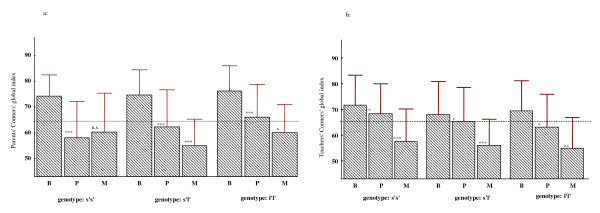
Conners' Global Index for parents (CGI-Parents) and teachers (CGI-Teachers) at baseline and at the end of each week of treatment with placebo and methylphenidate. For both outcome measurements, we used a mixed model analysis of variance to determine gene, treatment and gene x treatment interaction effects.
Mixed model analysis of variance revealed a gene x treatment interaction for CGI-Parents but not for CGI-Teachers. Children homozygous for the lower expressing alleles (s+lG = s') responded well to placebo and did not derive additional improvement with methylphenidate compared to children carrying a higher expressing allele (lA). No genotype main effects on either CGI-Parents or CGI-teachers were observed.
A double blind placebo-controlled design was used to assess the behavioral effects of methylphenidate in relation to the triallelic 5-HTTLPR polymorphism of the SLC6A4 gene in children with ADHD. This polymorphism appears to modulate the behavioral response to methylphenidate in children with ADHD as assessed in the home environment by parents. Further investigation is needed to assess the clinical implications of this finding.
ClinicalTrials.gov NCT00483106.
ADHD 的动物模型表明,哌醋甲酯对运动活动的矛盾镇静作用可能与其对 5-羟色胺传递的作用有关。在这项研究中,我们研究了 5-羟色胺转运体基因(SLC6A4)中的 5-HTTLPR 多态性与哌醋甲酯治疗 ADHA 相关行为反应之间的关系。
对 6-12 岁的患者(n = 157)进行了为期 2 周的前瞻性自身对照、安慰剂对照(交叉)试验,评估他们对哌醋甲酯(0.5mg/kg/天)的行为反应。然后,对儿童的 SLC6A4 基因中的三等位 5-HTTLPR 多态性进行了基因分型。
基线和每周安慰剂和哌醋甲酯治疗结束时,家长(CGI-Parents)和教师(CGI-Teachers)的康纳氏总体指数(Conners' Global Index)。对于这两种结果测量,我们使用混合模型方差分析来确定基因、治疗和基因 x 治疗的相互作用效应。
混合模型方差分析显示,CGI-Parents 存在基因 x 治疗的相互作用,但 CGI-Teachers 则没有。低表达等位基因(s+lG = s')纯合子对安慰剂反应良好,与携带高表达等位基因(lA)的儿童相比,他们没有从哌醋甲酯中获得额外的改善。在 CGI-Parents 或 CGI-Teachers 中均未观察到基因型的主要影响。
使用双盲安慰剂对照设计评估了 5-HTTLPR 多态性与 ADHD 儿童中 SLC6A4 基因的三等位多态性之间的关系。这种多态性似乎调节了 ADHD 儿童在家庭环境中父母评估的哌醋甲酯的行为反应。需要进一步的研究来评估这一发现的临床意义。
ClinicalTrials.gov NCT00483106。