Ioannidis John P A
Department of Hygiene and Epidemiology, University of Ioannina School of Medicine, Ioannina, Greece.
PLoS Med. 2005 Aug;2(8):e124. doi: 10.1371/journal.pmed.0020124. Epub 2005 Aug 30.
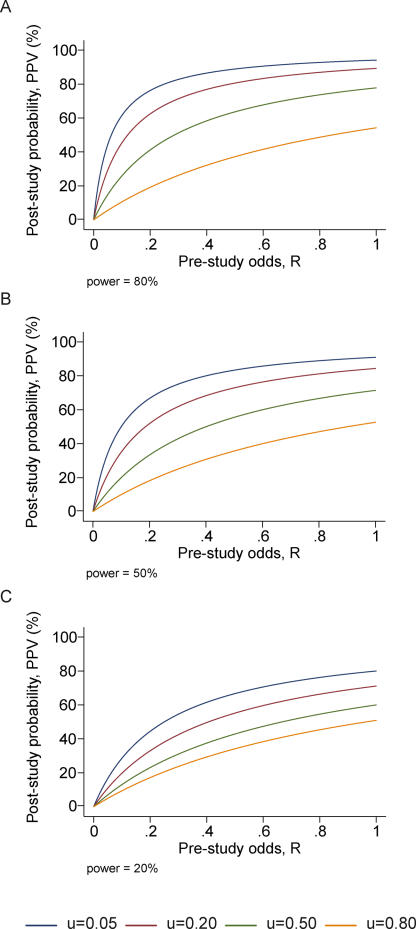
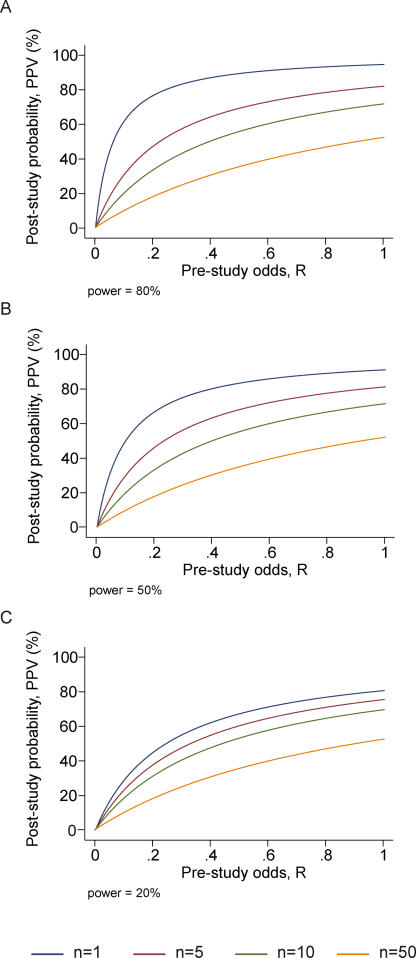
There is increasing concern that most current published research findings are false. The probability that a research claim is true may depend on study power and bias, the number of other studies on the same question, and, importantly, the ratio of true to no relationships among the relationships probed in each scientific field. In this framework, a research finding is less likely to be true when the studies conducted in a field are smaller; when effect sizes are smaller; when there is a greater number and lesser preselection of tested relationships; where there is greater flexibility in designs, definitions, outcomes, and analytical modes; when there is greater financial and other interest and prejudice; and when more teams are involved in a scientific field in chase of statistical significance. Simulations show that for most study designs and settings, it is more likely for a research claim to be false than true. Moreover, for many current scientific fields, claimed research findings may often be simply accurate measures of the prevailing bias. In this essay, I discuss the implications of these problems for the conduct and interpretation of research.
人们越来越担心,当前大多数已发表的研究结果都是错误的。一项研究主张为真的概率可能取决于研究效能和偏差、关于同一问题的其他研究数量,以及重要的是,在每个科学领域所探究的关系中真实关系与无关系的比例。在此框架下,当一个领域开展的研究规模较小;效应量较小;所测试的关系数量较多且预先筛选较少;在设计、定义、结果和分析模式方面有更大的灵活性;存在更大的经济利益和其他利益及偏见;以及当更多团队参与一个科学领域以追求统计显著性时,一项研究结果为真的可能性就较小。模拟结果表明,对于大多数研究设计和情况而言,一项研究主张为假的可能性大于为真的可能性。此外,对于许多当前的科学领域,所宣称的研究结果可能往往只是对普遍存在的偏差的准确衡量。在本文中,我将讨论这些问题对研究的开展和解释的影响。