Department of Neurobiology, Center for Glial Biology in Medicine, University of Alabama at Birmingham, Birmingham, Alabama, USA.
Cancer Res. 2010 Jul 1;70(13):5597-606. doi: 10.1158/0008-5472.CAN-09-4666. Epub 2010 Jun 22.
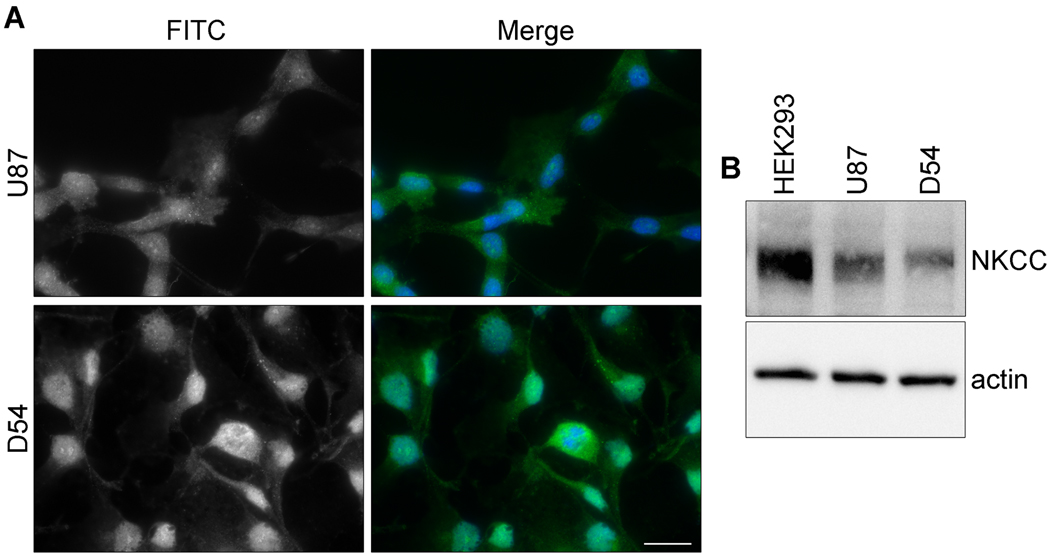
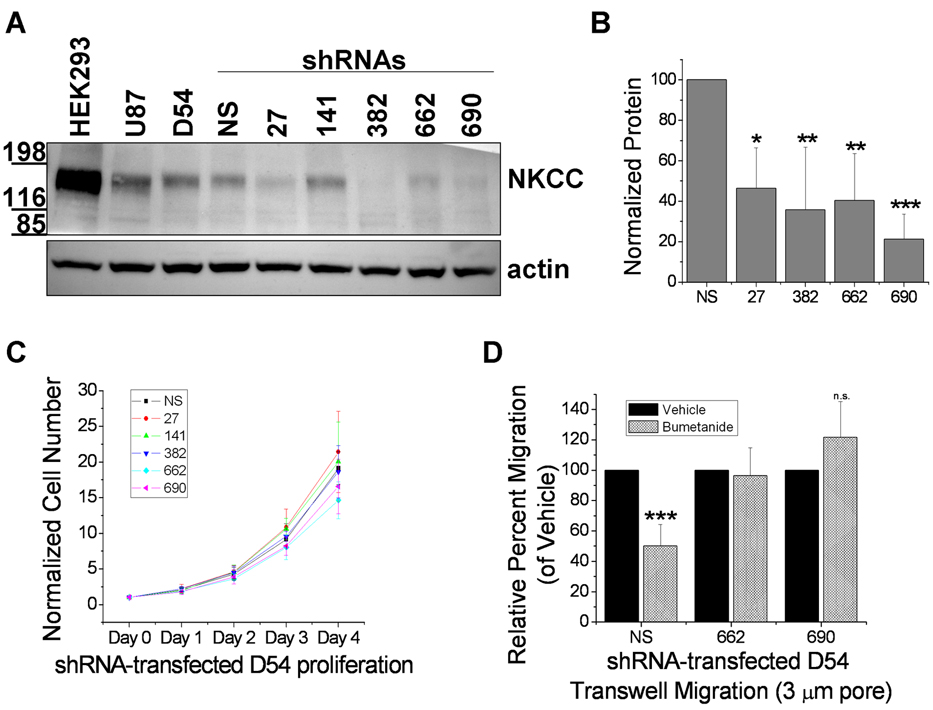
Malignant gliomas metastasize throughout the brain by infiltrative cell migration into peritumoral areas. Invading cells undergo profound changes in cell shape and volume as they navigate extracellular spaces along blood vessels and white matter tracts. Volume changes are aided by the concerted release of osmotically active ions, most notably K(+) and Cl(-). Their efflux through ion channels along with obligated water causes rapid cell shrinkage. Suitable ionic gradients must be established and maintained through the activity of ion transport systems. Here, we show that the Sodium-Potassium-Chloride Cotransporter Isoform-1 (NKCC1) provides the major pathway for Cl(-) accumulation in glioma cells. NKCC1 localizes to the leading edge of invading processes, and pharmacologic inhibition using the loop diuretic bumetanide inhibits in vitro Transwell migration by 25% to 50%. Short hairpin RNA knockdowns of NKCC1 yielded a similar inhibition and a loss of bumetanide-sensitive cell volume regulation. A loss of NKCC1 function did not affect cell motility in two-dimensional assays lacking spatial constraints but manifested only when cells had to undergo volume changes during migration. Intracranial implantation of human gliomas into severe combined immunodeficient mice showed a marked reduction in cell invasion when NKCC1 function was disrupted genetically or by twice daily injection of the Food and Drug Administration-approved NKCC1 inhibitor Bumex. These data support the consideration of Bumex as adjuvant therapy for patients with high-grade gliomas.
恶性神经胶质瘤通过浸润性细胞迁移到肿瘤周围区域在整个大脑中转移。侵入细胞在沿着血管和白质束导航细胞外空间时,其细胞形状和体积发生深刻变化。体积变化通过协同释放渗透活性离子(尤其是 K(+) 和 Cl(-))得到帮助。它们通过离子通道的外排以及必需的水导致快速细胞收缩。必须通过离子转运系统的活性来建立和维持合适的离子梯度。在这里,我们表明钠钾氯协同转运蛋白同工型-1(NKCC1)为神经胶质瘤细胞中 Cl(-) 的积累提供了主要途径。NKCC1 定位于侵入过程的前沿,使用利尿剂布美他尼进行药理学抑制可使体外 Transwell 迁移抑制 25% 至 50%。NKCC1 的短发夹 RNA 敲低产生了类似的抑制作用,并丧失了布美他尼敏感的细胞体积调节。NKCC1 功能丧失不会影响缺乏空间限制的二维测定中的细胞迁移性,但仅在细胞在迁移过程中必须经历体积变化时才表现出来。将人类神经胶质瘤植入严重联合免疫缺陷小鼠中,当 NKCC1 功能被遗传破坏或每天两次注射经食品和药物管理局批准的 NKCC1 抑制剂布美他尼时,细胞侵袭明显减少。这些数据支持将布美他尼作为高级别神经胶质瘤患者的辅助治疗的考虑。