Division of Clinical Neuroscience, Chiba University Center for Forensic Mental Health, Chiba, Japan.
Ann Gen Psychiatry. 2010 Jun 24;9:27. doi: 10.1186/1744-859X-9-27.
Cognitive deficits in schizophrenia are associated with psychosocial deficits that are primarily responsible for the poor long-term outcome of this disease. Auditory sensory gating P50 deficits are correlated with neuropsychological deficits in attention, one of the principal cognitive disturbances in schizophrenia. Our studies suggest that the alpha7 nicotinic acetylcholine receptor (alpha7 nAChR) agonist tropisetron might be a potential therapeutic drug for cognitive deficits in schizophrenia. Therefore, it is of particular interest to investigate the effects of tropisetron on the cognitive deficits in patients with schizophrenia.
A randomised, placebo-controlled trial of tropisetron in patients with schizophrenia was performed. A total of 40 patients with chronic schizophrenia who had taken risperidone (2 to 6 mg/day) were enrolled. Subjects were randomly assigned to a fixed titration of tropisetron (n = 20, 10 mg/day) or placebo (n = 20) in an 8-week double-blind trial. Auditory sensory gating P50 deficits and Quality of Life Scale (QLS), Cambridge Neuropsychological Test Automated Battery (CANTAB), and Positive and Negative Syndrome Scale (PANSS) scores were measured.
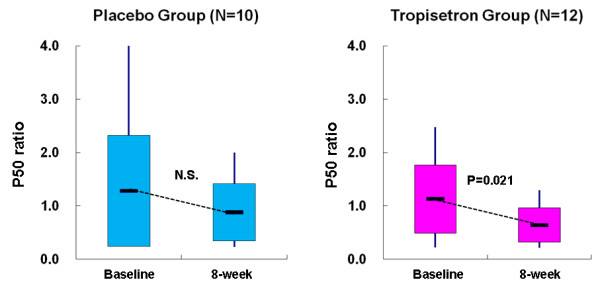
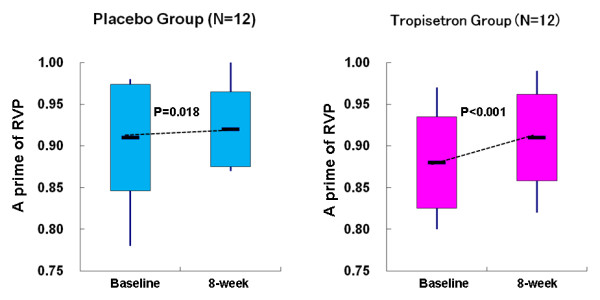
In all, 33 patients completed the trial. Tropisetron was well tolerated. Administration of tropisetron, but not placebo, significantly improved auditory sensory gating P50 deficits in non-smoking patients with schizophrenia. The score on the rapid visual information processing (sustained visual attention) task of CANTAB was significantly improved by tropisetron treatment. Total and subscale scores of PANSS were not changed by this trial. QLS scores in the all patients, but not non-smoking patients, were significantly improved by tropisetron trial.
This first randomised, double-blind, placebo-controlled trial supports the safety and efficacy of adjunctive tropisetron for treatment of cognitive deficits in schizophrenia.
精神分裂症患者的认知缺陷与主要导致该病长期预后不良的社会心理缺陷有关。听觉感觉门控 P50 缺陷与精神分裂症中主要认知障碍之一的注意力神经认知缺陷相关。我们的研究表明,α7 烟碱型乙酰胆碱受体 (α7 nAChR) 激动剂曲匹西隆可能是治疗精神分裂症认知缺陷的潜在治疗药物。因此,研究曲匹西隆对精神分裂症患者认知缺陷的影响具有特殊意义。
对曲匹西隆治疗精神分裂症患者进行了随机、安慰剂对照试验。共纳入 40 名服用利培酮(2 至 6 毫克/天)的慢性精神分裂症患者。受试者被随机分为曲匹西隆(n = 20,10 毫克/天)或安慰剂(n = 20)的 8 周双盲试验。测量听觉感觉门控 P50 缺陷和生活质量量表(QLS)、剑桥神经心理学测试自动化电池(CANTAB)和阳性和阴性综合征量表(PANSS)评分。
共有 33 名患者完成了试验。曲匹西隆耐受良好。曲匹西隆给药,但不是安慰剂,可显著改善非吸烟精神分裂症患者的听觉感觉门控 P50 缺陷。CANTAB 的快速视觉信息处理(持续视觉注意)任务的评分通过曲匹西隆治疗得到显著改善。该试验未改变 PANSS 的总分和分量表评分。QLS 评分在所有患者中,但非吸烟患者中,曲匹西隆试验显著改善。
这是第一项随机、双盲、安慰剂对照试验,支持曲匹西隆辅助治疗精神分裂症认知缺陷的安全性和有效性。