Department of Psychiatry, College of Medicine, Korea University, Ansan Hospital, Ansan, Korea.
Psychiatry Investig. 2010 Jun;7(2):141-6. doi: 10.4306/pi.2010.7.2.141. Epub 2010 Apr 6.
Serotonergic dysfunction is quite evident in panic disorder. We investigated whether the C(-1019)G polymorphism of 5-HT1A receptor gene may play a role in the pathogenesis of panic disorder in a Korean population.
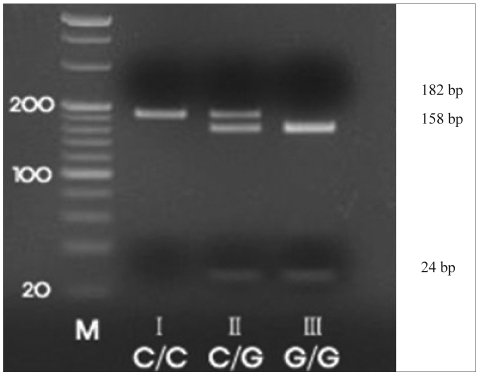
The 5-HT1A receptor genotype for the single nucleotide polymorphism (SNP) C(-1019)G was analyzed in 94 patients and 111 healthy controls. The severity of the patients' symptoms was examined using the Spielberger State-Trait Anxiety Inventory (STAI), Panic Disorder Severity Scale (PDSS), Anxiety sensitivity index (ASI), Acute Panic Inventory (API) and Hamilton's Rating Scale for Anxiety (HAM-A).
The distribution of the genotypes of the C/G polymorphism did not differ significantly from those predicted by Hardy-Weinberg equilibrium in patients as well as the controls. No association between the C(-1019)G polymorphism and panic disorder was detected in either the allele frequency or genotype distribution. There was no significant association with genotype distribution in the panic disorder with agoraphobia. However, there was a significant difference of symptom severity between C/C, C/G, and G/G genotype or between C and G allele in panic disorder patients without agoraphobia. PDSS scores were significantly higher in subjects with the G/G genotype or with G allele in patients without agoraphobia, not in total patients or patients with agoraphobia.
Although there were no significant differences in the genotype and allele distributions, we found a significant association between panic symptom severity and the serotonin 1A receptor gene. This result suggests that the serotonin 1A receptor and serotonin may play a role in the pathogenesis of panic disorder.
在惊恐障碍中,5-羟色胺能功能障碍非常明显。我们研究了 5-羟色胺 1A 受体基因的 C(-1019)G 多态性是否在韩国人群中对惊恐障碍的发病机制起作用。
对 94 例患者和 111 例健康对照者的 5-羟色胺 1A 受体基因单核苷酸多态性(SNP)C(-1019)G 进行了基因型分析。使用 Spielberger 状态特质焦虑量表(STAI)、惊恐障碍严重程度量表(PDSS)、焦虑敏感指数(ASI)、急性惊恐量表(API)和汉密尔顿焦虑量表(HAM-A)对患者的症状严重程度进行了检查。
患者和对照组的基因型分布与 Hardy-Weinberg 平衡预测值无显著差异。在等位基因频率或基因型分布中均未发现 C(-1019)G 多态性与惊恐障碍之间存在关联。在有广场恐怖症的惊恐障碍中,基因型分布也没有关联。然而,在没有广场恐怖症的惊恐障碍患者中,C/C、C/G 和 G/G 基因型或 C 和 G 等位基因之间的症状严重程度存在显著差异。在没有广场恐怖症的患者中,PDSS 评分在 G/G 基因型或 G 等位基因的患者中显著升高,而不是在所有患者或有广场恐怖症的患者中。
尽管基因型和等位基因分布无显著差异,但我们发现惊恐症状严重程度与 5-羟色胺 1A 受体基因之间存在显著关联。这一结果表明,5-羟色胺 1A 受体和 5-羟色胺可能在惊恐障碍的发病机制中起作用。