1Department of Medicine, Division of Endocrinology, University of Cincinnati, Cincinnati, Ohio, USA.
Diabetes. 2010 Sep;59(9):2145-51. doi: 10.2337/db10-0504. Epub 2010 Jun 28.
The orexigenic gut hormone ghrelin and its receptor are present in pancreatic islets. Although ghrelin reduces insulin secretion in rodents, its effect on insulin secretion in humans has not been established. The goal of this study was to test the hypothesis that circulating ghrelin suppresses glucose-stimulated insulin secretion in healthy subjects.
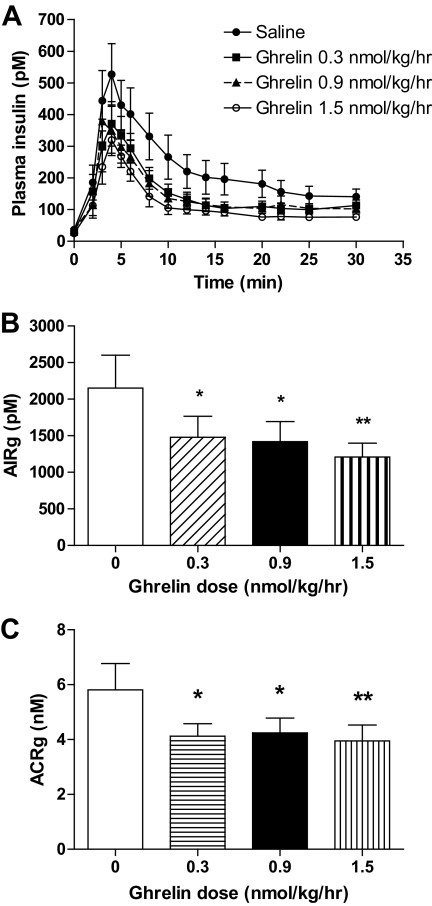
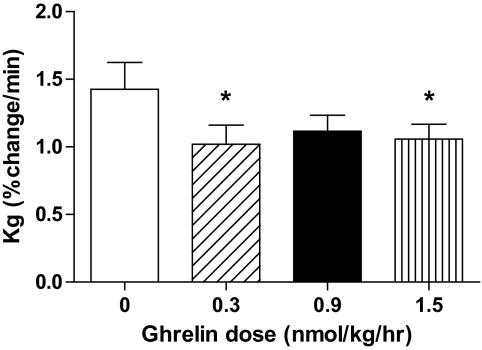
Ghrelin (0.3, 0.9 and 1.5 nmol/kg/h) or saline was infused for more than 65 min in 12 healthy patients (8 male/4 female) on 4 separate occasions in a counterbalanced fashion. An intravenous glucose tolerance test was performed during steady state plasma ghrelin levels. The acute insulin response to intravenous glucose (AIRg) was calculated from plasma insulin concentrations between 2 and 10 min after the glucose bolus. Intravenous glucose tolerance was measured as the glucose disappearance constant (Kg) from 10 to 30 min.
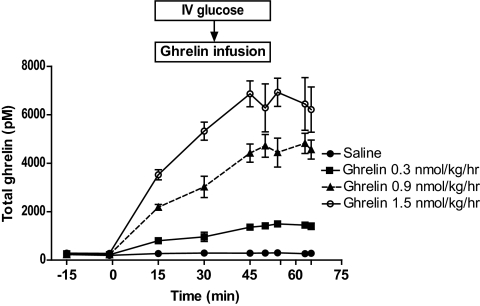
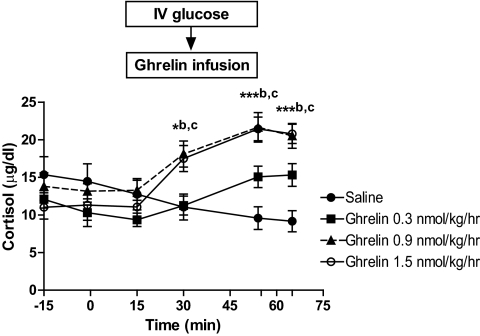
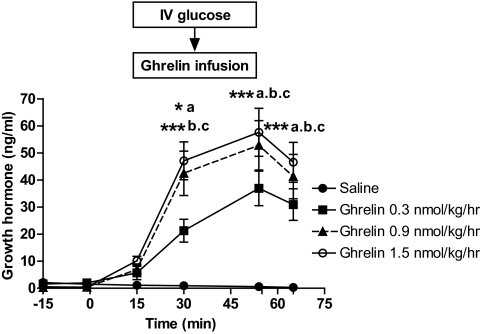
The three ghrelin infusions raised plasma total ghrelin concentrations to 4-, 15-, and 23-fold above the fasting level, respectively. Ghrelin infusion did not alter fasting plasma insulin or glucose, but compared with saline, the 0.3, 0.9, and 1.5 nmol/kg/h doses decreased AIRg (2,152 +/- 448 vs. 1,478 +/- 2,889, 1,419 +/- 275, and 1,120 +/- 174 pmol/l) and Kg (0.3 and 1.5 nmol/kg/h doses only) significantly (P < 0.05 for all). Ghrelin infusion raised plasma growth hormone and serum cortisol concentrations significantly (P < 0.001 for both), but had no effect on glucagon, epinephrine, or norepinephrine levels (P = 0.44, 0.74, and 0.48, respectively).
This is a robust proof-of-concept study showing that exogenous ghrelin reduces glucose-stimulated insulin secretion and glucose disappearance in healthy humans. Our findings raise the possibility that endogenous ghrelin has a role in physiologic insulin secretion, and that ghrelin antagonists could improve beta-cell function.
摄食激素 ghrelin 及其受体存在于胰岛中。虽然 ghrelin 可减少啮齿动物的胰岛素分泌,但它对人类胰岛素分泌的影响尚未确定。本研究的目的是检验以下假设,即循环 ghrelin 可抑制健康受试者的葡萄糖刺激的胰岛素分泌。
在 4 次平衡对照的情况下,以 0.3、0.9 和 1.5 nmol/kg/h 的速度向 12 名健康患者(8 男/4 女)输注 ghrelin 或生理盐水,持续超过 65 分钟。在稳定的血浆 ghrelin 水平下进行静脉葡萄糖耐量试验。从葡萄糖冲击后 2 至 10 分钟之间的血浆胰岛素浓度计算出静脉内葡萄糖的急性胰岛素反应(AIRg)。从 10 至 30 分钟期间的葡萄糖消失常数(Kg)测量静脉葡萄糖耐量。
三种 ghrelin 输注使血浆总 ghrelin 浓度分别升高至空腹水平的 4 倍、15 倍和 23 倍。ghrelin 输注未改变空腹血浆胰岛素或葡萄糖,但与生理盐水相比,0.3、0.9 和 1.5 nmol/kg/h 剂量降低了 AIRg(2,152 ± 448 比 1,478 ± 2,889、1,419 ± 275 和 1,120 ± 174 pmol/l)和 Kg(仅 0.3 和 1.5 nmol/kg/h 剂量)(P < 0.05 均)。ghrelin 输注使生长激素和血清皮质醇浓度显著升高(两者均为 P < 0.001),但对胰高血糖素、肾上腺素或去甲肾上腺素水平没有影响(P = 0.44、0.74 和 0.48)。
这是一项强有力的概念验证研究,表明外源性 ghrelin 可降低健康人群的葡萄糖刺激的胰岛素分泌和葡萄糖清除率。我们的发现提示内源性 ghrelin 可能在生理胰岛素分泌中起作用,并且 ghrelin 拮抗剂可能改善β细胞功能。