Department of Dermatology, Columbia University, New York, New York 10032, USA.
Nature. 2010 Jul 1;466(7302):113-7. doi: 10.1038/nature09114.
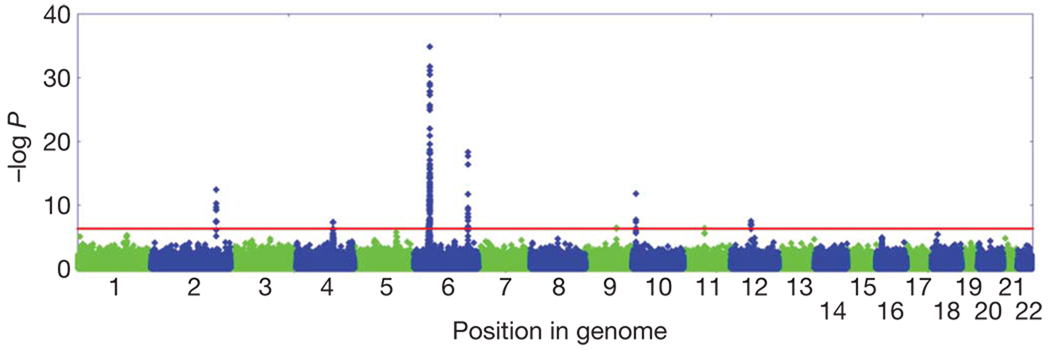
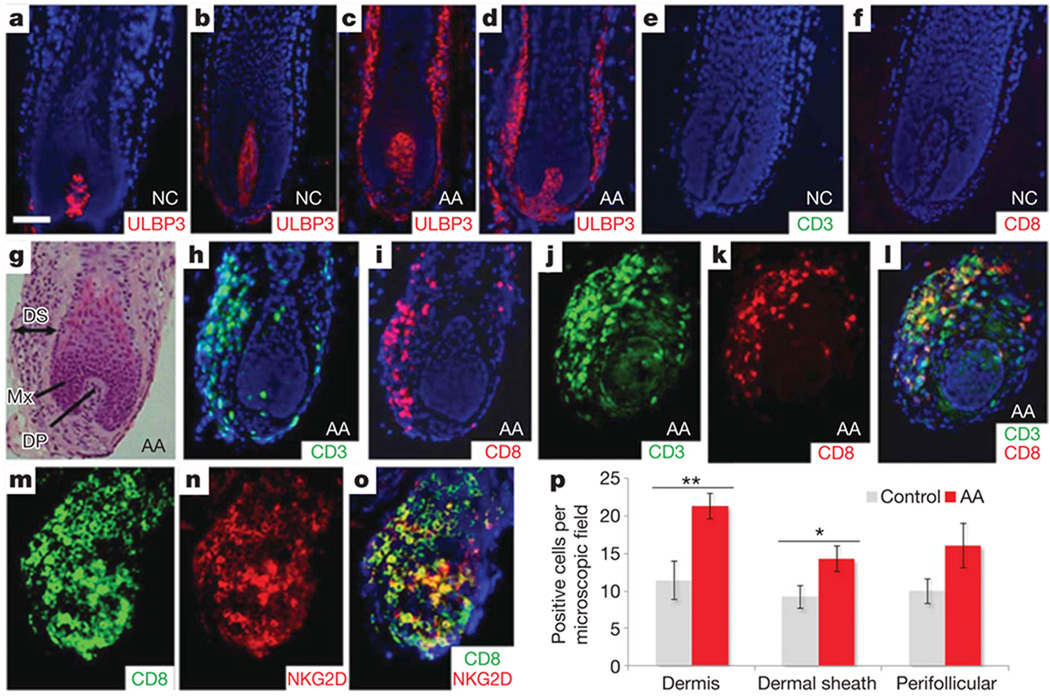
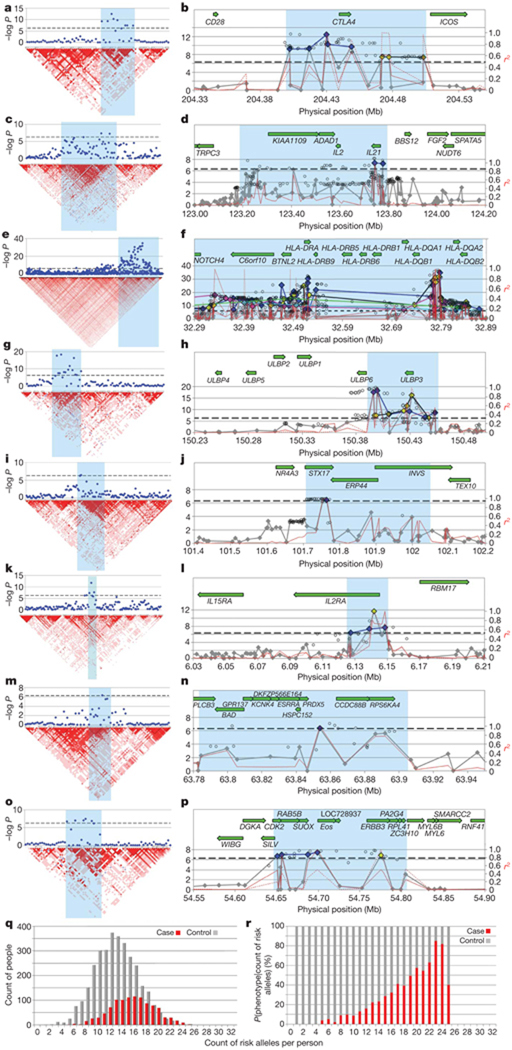
Alopecia areata (AA) is among the most highly prevalent human autoimmune diseases, leading to disfiguring hair loss due to the collapse of immune privilege of the hair follicle and subsequent autoimmune attack. The genetic basis of AA is largely unknown. We undertook a genome-wide association study (GWAS) in a sample of 1,054 cases and 3,278 controls and identified 139 single nucleotide polymorphisms that are significantly associated with AA (P <or= 5 x 10(-7)). Here we show an association with genomic regions containing several genes controlling the activation and proliferation of regulatory T cells (T(reg) cells), cytotoxic T lymphocyte-associated antigen 4 (CTLA4), interleukin (IL)-2/IL-21, IL-2 receptor A (IL-2RA; CD25) and Eos (also known as Ikaros family zinc finger 4; IKZF4), as well as the human leukocyte antigen (HLA) region. We also find association evidence for regions containing genes expressed in the hair follicle itself (PRDX5 and STX17). A region of strong association resides within the ULBP (cytomegalovirus UL16-binding protein) gene cluster on chromosome 6q25.1, encoding activating ligands of the natural killer cell receptor NKG2D that have not previously been implicated in an autoimmune disease. By probing the role of ULBP3 in disease pathogenesis, we also show that its expression in lesional scalp from patients with AA is markedly upregulated in the hair follicle dermal sheath during active disease. This study provides evidence for the involvement of both innate and acquired immunity in the pathogenesis of AA. We have defined the genetic underpinnings of AA, placing it within the context of shared pathways among autoimmune diseases, and implicating a novel disease mechanism, the upregulation of ULBP ligands, in triggering autoimmunity.
斑秃(AA)是最常见的人类自身免疫性疾病之一,由于毛囊免疫特权的崩溃和随后的自身免疫攻击,导致容貌受损的脱发。AA 的遗传基础在很大程度上是未知的。我们在一个由 1054 例病例和 3278 例对照组成的样本中进行了全基因组关联研究(GWAS),并确定了 139 个单核苷酸多态性与 AA 显著相关(P <or= 5 x 10(-7))。在这里,我们显示与包含控制调节性 T 细胞(Treg 细胞)激活和增殖的几个基因、细胞毒性 T 淋巴细胞相关抗原 4(CTLA4)、白细胞介素(IL)-2/IL-21、IL-2 受体 A(IL-2RA;CD25)和 Eos(也称为 Ikaros 家族锌指蛋白 4;IKZF4)以及人类白细胞抗原(HLA)区域的基因组区域存在关联。我们还发现与包含在毛囊中表达的基因的区域存在关联证据(PRDX5 和 STX17)。一个强关联区域位于染色体 6q25.1 上的 ULBP(巨细胞病毒 UL16 结合蛋白)基因簇内,该区域编码自然杀伤细胞受体 NKG2D 的激活配体,以前从未被牵连到自身免疫性疾病中。通过探测 ULBP3 在疾病发病机制中的作用,我们还表明,AA 患者病变头皮中的 ULBP3 在疾病活动期毛囊真皮鞘中的表达明显上调。这项研究为先天和获得性免疫在 AA 发病机制中的参与提供了证据。我们已经确定了 AA 的遗传基础,将其置于自身免疫性疾病之间的共同途径的背景下,并暗示了一种新的疾病机制,即 ULBP 配体的上调,在触发自身免疫中起作用。