Chemistry Department, Jinan University, Guangzhou, 510632, Guangdong, People's Republic of China.
Nanoscale Res Lett. 2009 Jun 5;4(8):942-7. doi: 10.1007/s11671-009-9340-8.
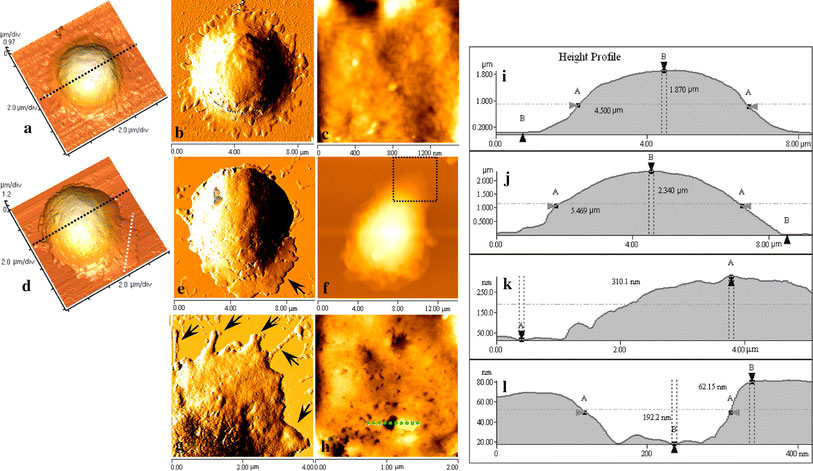
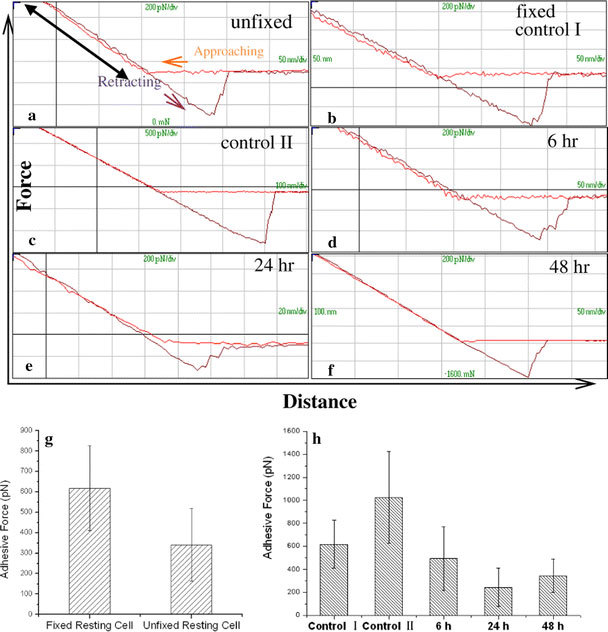
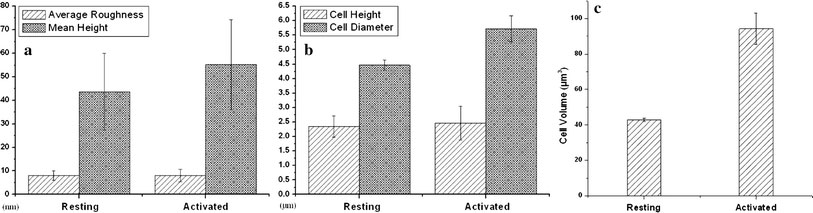
The activation of T lymphocytes plays a very important role in T-cell-mediated immune response. Though there are many related literatures, the changes of membrane surface nanostructures and adhesion property of T lymphocytes at different activation stages have not been reported yet. However, these investigations will help us further understand the biophysical and immunologic function of T lymphocytes in the context of activation. In the present study, the membrane architectures of peripheral blood T lymphocytes were obtained by AFM, and adhesion force of the cell membrane were measured by acquiring force-distance curves. The results indicated that the cell volume increased with the increases of activation time, whereas membrane surface adhesion force decreased, even though the local stiffness for resting and activated cells is similar. The results provided complementary and important data to further understand the variation of biophysical properties of T lymphocytes in the context of in vitro activation.
T 淋巴细胞的激活在 T 细胞介导的免疫反应中起着非常重要的作用。尽管有许多相关文献,但 T 淋巴细胞在不同激活阶段的膜表面纳米结构和粘附特性的变化尚未报道。然而,这些研究将帮助我们进一步了解 T 淋巴细胞在激活状态下的生物物理和免疫功能。在本研究中,通过原子力显微镜(AFM)获得外周血 T 淋巴细胞的膜结构,并通过获取力-距离曲线测量细胞膜的粘附力。结果表明,细胞体积随激活时间的增加而增加,而细胞膜表面粘附力降低,尽管静止和激活细胞的局部刚度相似。这些结果为进一步了解体外激活状态下 T 淋巴细胞生物物理特性的变化提供了补充和重要的数据。